
Heavy Cargo from Dubai to GCC

Moving heavy cargo from Dubai to another GCC country requires more planning than simply putting large items on a truck. Weight, dimensions, cargo shape, loading access, destination conditions and cross-border documentation can all affect how a shipment should be prepared and transported.
A heavy shipment might be industrial machinery, commercial equipment, construction materials, large furniture, business inventory or several bulky household items.
Each shipment can have different requirements. A compact heavy machine may need a different loading approach from a long piece of equipment, while a large furniture shipment may create access issues at both pickup and delivery.
For customers arranging heavy cargo from Dubai to GCC, the most useful first step is to collect accurate information about the shipment.
Knowing the approximate weight, dimensions, quantity, pickup location, destination and cargo type makes it easier to assess transportation requirements before the shipment is collected.
This guide explains how to prepare heavy cargo for GCC road transportation, what to consider during pickup and delivery, how FTL and LTL may differ, and what information can help when requesting a quotation.
What Counts as Heavy, Bulky or Oversized Cargo?
The term heavy cargo can describe several different situations.
Heavy Cargo
Heavy cargo is generally associated with items where weight becomes an important transportation consideration. Examples may include machinery, generators, industrial equipment, construction equipment and large commercial items.
However, weight should not be considered separately from dimensions. Two items with similar weights can create very different transportation requirements if one is compact and the other is long, wide or unusually shaped.
Bulky Cargo
Bulky cargo may not always be extremely heavy, but it can occupy substantial space. Large furniture, appliances, packaged commercial goods and irregularly shaped items can fall into this category.
For bulky shipments, volume and available loading space become important considerations.
Oversized Cargo
Oversized cargo can involve dimensions that require additional transportation planning. The exact requirements depend on the cargo, route, vehicle and applicable rules.
Customers should provide accurate measurements rather than assuming that an item will fit because its weight appears manageable.
Types of Heavy Cargo You May Need to Move
Heavy cargo from Dubai to GCC destinations can come from both households and businesses.
Machinery and Industrial Equipment
Examples can include:
- Industrial machines
- Generators
- Compressors
- Workshop equipment
- Production equipment
- Large mechanical components
- Construction equipment
For machinery, the dimensions and weight should be recorded before transportation planning begins.
If the equipment has removable components, customers should also identify which parts are separate and how they are packaged.
Heavy Commercial Cargo
Businesses may need to transport:
- Retail inventory
- Business equipment
- Industrial products
- Spare parts
- Packaged materials
- Office equipment
- Commercial machinery
- Warehouse stock
Commercial shipments should be described accurately because the shipment’s documentation and destination requirements may differ from a personal household shipment.
Furniture and Household Items
Heavy cargo is not limited to industrial equipment.
A household relocation can include:
- Sofas
- Beds
- Large tables
- Cabinets
- Mattresses
- Appliances
- Furniture sets
- Personal belongings packed into multiple cartons
For these shipments, the physical size of the furniture can be just as important as the weight.
Construction and Project Materials
Some businesses may need to move construction-related equipment or materials between Dubai and another GCC destination.
Before transportation is arranged, identify the type of material, quantity, packaging, dimensions and approximate weight.
Fragile Heavy Items
Some heavy items can also be fragile.
Glass furniture, large appliances, electronics, finished furniture surfaces and delicate equipment require careful preparation even when the shipment itself is heavy.
Heavy does not automatically mean durable.
Why Weight and Dimensions Matter
One of the most common preparation mistakes is providing only an estimated weight.
For heavy cargo, customers should ideally provide:
| Cargo Information | Why It Matters |
|---|---|
| Item Description | Helps identify the shipment |
| Quantity | Establishes the number of pieces |
| Weight | Helps assess transportation requirements |
| Length | Important for long items |
| Width | Helps evaluate loading space |
| Height | Important for vehicle and access planning |
| Photos | Useful for unusual cargo |
| Packaging | Shows how the cargo will be handled |
| Pickup Address | Helps assess collection conditions |
| Delivery Address | Helps plan final delivery |
For irregular machinery or bulky furniture, measurements should be taken at the widest and highest points rather than estimated from memory.
Photos can also be useful when an item has unusual shapes, exposed components, detachable sections or difficult loading points.

Choosing Between FTL and LTL for Heavy Cargo
FTL means Full Truckload, while LTL means Less Than Truckload.
The choice should not be based only on the word “heavy.”
When FTL May Make More Sense
A dedicated truck arrangement may be considered when the shipment:
- Occupies substantial truck space
- Contains several large items
- Requires dedicated loading space
- Needs a particular transportation arrangement
- Has equipment that should not be mixed with other cargo
- Represents a larger commercial shipment
The final suitability depends on cargo characteristics and transportation requirements.
When LTL May Be Considered
LTL or shared-load transportation can be considered when the shipment does not require the full capacity of a truck.
For example, a business might have several pallets or bulky commercial items that do not justify an entire truck.
However, heavy individual pieces still need to be assessed for weight distribution, dimensions, loading and securing.
Planning Heavy Cargo Pickup in Dubai
Pickup planning is especially important for large items.
Customers should check the pickup location before transportation is arranged.
Apartment and Villa Access
For household shipments, consider:
- Building entrance size
- Parking availability
- Service elevator dimensions
- Elevator booking requirements
- Stairs
- Corridor width
- Doorway dimensions
- Distance between the vehicle and building
- Building management requirements
A large sofa or cabinet may fit inside a room but fail to pass through a doorway or elevator.
Customers should measure large furniture before pickup and confirm any building-specific requirements with the relevant building or community management.
Warehouse and Industrial Access
Commercial and industrial locations may have loading bays, security gates, scheduled loading windows or vehicle-access restrictions.
Before collection, provide accurate information about:
- Loading area
- Vehicle access
- Forklift availability, if applicable
- Security procedures
- Loading times
- Site restrictions
- Distance from cargo to vehicle
These details can help prevent avoidable delays during collection.
For customers arranging local preparation or collection requirements, cargo services in Dubai provides a useful related service page.
How to Prepare Heavy Cargo Before Pickup
Good preparation starts before the vehicle arrives.
Build an Inventory
Create a basic inventory containing:
- Cargo description
- Quantity
- Approximate weight
- Dimensions
- Packaging condition
- Pickup location
- Destination
For commercial cargo, separate different product categories where appropriate.
Measure Large Items
Measure machinery, furniture and other large items before requesting transportation.
For each unusually large piece, record:
Length × Width × Height
If the item is irregularly shaped, take measurements at its widest points.
Photograph Unusual Cargo
Photos can help communicate the actual condition and shape of the shipment.
Take pictures of:
- Large machinery
- Unusual shapes
- Fragile sections
- Existing packaging
- Pallets
- Oversized furniture
- Removable components
Protect and Label the Shipment
Heavy cargo should be prepared according to its material and handling requirements.
Fragile surfaces may require suitable protective packaging. Loose components should be secured where appropriate, and packages should be clearly identified.
Do not assume that a heavy item does not require protection.
Loading and Securing Heavy Cargo
Loading is one of the most important stages of heavy cargo transportation.
Before loading, the cargo’s:
- Weight
- Dimensions
- Shape
- Center of gravity
- Packaging
- Lifting points
- Loading access
should be understood as applicable to the shipment.
The correct loading approach depends on the actual cargo.
Customers should also disclose whether the item requires special lifting arrangements or has unusual loading restrictions.
The objective is not simply to get the cargo onto a vehicle. It must also be positioned and secured appropriately for transportation.
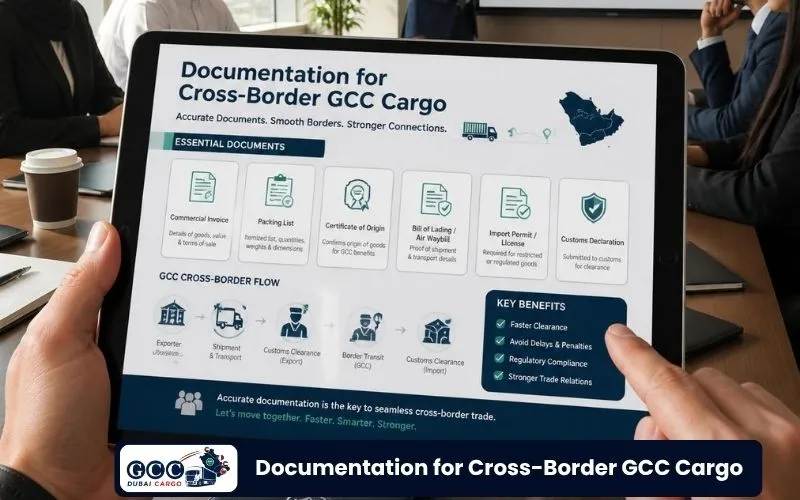
Documentation for Cross-Border GCC Cargo
Heavy cargo moving from Dubai to another GCC country may require documentation for transportation and customs processing.
Depending on the shipment, documents can include:
- Commercial invoice
- Packing list
- Transport documents
- Certificate of origin where applicable
- Importer or receiver information
- Product-specific permits where applicable
- Customs declarations
- Other documents required for the particular shipment
Requirements can vary according to the destination, cargo type, product, shipment purpose and whether the cargo is personal or commercial.
Customers should therefore avoid assuming that every shipment requires exactly the same paperwork.
Accurate cargo descriptions, quantities and shipment information are especially important when preparing cross-border documentation.
Heavy Cargo Routes from Dubai to GCC Countries
Heavy cargo transportation can involve different planning considerations depending on the destination.
Saudi Arabia
Saudi Arabia is an important GCC destination for both commercial and personal shipments.
Heavy cargo may be destined for cities such as Riyadh, Jeddah, Dammam, Khobar, Mecca, Medina, Jubail, Yanbu or Taif.
A warehouse delivery in an industrial area can have different access requirements from a residential delivery.
For detailed route information, see cargo from Dubai to Saudi Arabia.
Oman
Oman is another important road destination for cargo leaving Dubai.
Heavy shipments should be assessed according to their dimensions, destination and delivery conditions.
Customers sending large furniture, commercial equipment or industrial cargo should provide accurate delivery information before transportation planning.
More route-specific information is available through cargo from Dubai to Oman.
Qatar
Heavy cargo going to Qatar can include commercial equipment, business stock, machinery and household shipments.
The final delivery address should be provided accurately, especially when cargo is going to a warehouse, business premises or residential property.
For the dedicated route page, see cargo from Dubai to Qatar.
Bahrain
For heavy shipments heading to Bahrain, customers should provide complete information about the cargo and final delivery location.
Commercial deliveries and residential deliveries can have different unloading requirements.
You can also review cargo from Dubai to Bahrain for more destination-specific information.
Kuwait
Heavy commercial cargo, machinery, furniture and other bulky shipments may require careful planning before transportation to Kuwait.
As with other GCC destinations, accurate cargo details and destination information are useful when determining transportation requirements.
For more information about this route, visit cargo from Dubai to Kuwait.
What Can Affect Heavy Cargo Transportation Cost?
There is no single price for heavy cargo from Dubai to GCC because shipments can vary considerably.
A quotation may be affected by:
- Cargo weight
- Cargo volume
- Dimensions
- Number of pieces
- Destination
- FTL or LTL requirements
- Vehicle requirements
- Loading requirements
- Packing requirements
- Pickup access
- Delivery access
- Residential or commercial delivery
- Heavy or oversized characteristics
- Customs-related requirements
- Special handling needs
For a useful quotation, customers should provide as much accurate information as possible.
Instead of simply asking, “How much does it cost to send heavy cargo?”, provide the cargo description, quantity, measurements, weight, pickup location, destination and photos where useful.
Common Heavy Cargo Problems and Practical Solutions
Problem: Only the weight is provided
Solution: Provide dimensions as well as weight. A long or unusually shaped item may require different planning even when its weight is manageable.
Problem: Large furniture cannot pass through the building entrance
Solution: Check doors, corridors, stairs and elevator dimensions before pickup.
Problem: The delivery location has restricted access
Solution: Tell the transportation provider whether the destination is a villa, apartment, warehouse, industrial site or office and provide relevant access information.
Problem: Shipment documents do not match the cargo
Solution: Review item descriptions, quantities and shipment information before dispatch.
Problem: Heavy equipment contains loose parts
Solution: Identify removable components and prepare them separately where appropriate.
Problem: Fragile parts are exposed
Solution: Protect vulnerable surfaces and components according to the item’s material and handling needs.
Example Heavy Cargo Shipping Scenarios
Family Furniture Shipment
A family may be relocating from Dubai and need to move sofas, beds, cabinets, appliances and packed personal belongings.
The important information would include furniture dimensions, approximate weight, number of packages, building access and destination address.
Business Inventory
A retailer may need to move heavy display equipment and packaged stock to another GCC market.
In this situation, cargo quantity, pallet information, commercial documentation and warehouse access can become particularly important.
Industrial Equipment
A company may need to transport a large machine from a Dubai facility to a destination warehouse.
The customer should provide the machine’s dimensions, weight, lifting information, photos and exact pickup and delivery details.
These are examples of shipping situations, not customer testimonials or claims about completed GCC Dubai Cargo shipments.
What to Send When Requesting a Heavy Cargo Quote
For a more useful quotation request, prepare the following information:
1. Cargo type:
Explain what you are shipping.
2. Quantity:
State the number of pieces, cartons, pallets or units.
3. Weight:
Provide actual or reasonably accurate weights where available.
4. Dimensions:
Measure large or irregular items.
5. Photos:
Include photos when the cargo is unusual, bulky or difficult to describe.
6. Pickup location:
Provide the Dubai address and explain whether it is an apartment, villa, office, warehouse or industrial site.
7. Delivery location:
Provide the destination country, city and delivery address.
8. Access information:
Mention loading bays, elevators, parking restrictions or unusual access conditions.
9. Cargo purpose:
Indicate whether the shipment is personal, household or commercial.
10. Documents:
Mention any documents already available and identify any known product-specific requirements.
The more accurate the information, the easier it is to assess the shipment before transportation is arranged.
Heavy Cargo from Dubai to GCC: Practical Checklist
Before arranging transportation, confirm:
- Cargo type is clearly identified
- Quantity is known
- Heavy items are weighed where possible
- Large items are measured
- Unusual cargo has photographs
- Fragile components are identified
- Cargo is appropriately packed
- Loose components are secured
- Pickup access has been checked
- Elevator dimensions are confirmed where relevant
- Loading bay requirements are known
- Destination address is accurate
- Delivery access has been considered
- Commercial or personal shipment status is clear
- Available documents have been reviewed
- Receiver information is ready
- Any known product-specific requirements are identified
Preparing this information before pickup can make the transportation planning process much clearer.
Frequently Asked Questions
Heavy cargo can be transported by road to GCC destinations, but the suitable transportation arrangement depends on the cargo's weight, dimensions, type, destination and applicable transportation requirements. Heavy machinery, bulky furniture and commercial equipment should be assessed individually before transportation is arranged.
Useful information includes the cargo description, quantity, weight, dimensions, photographs where appropriate, Dubai pickup location, destination address, cargo purpose and access conditions. Providing accurate details helps determine the transportation requirements more effectively.
It depends on the shipment. FTL may be considered when cargo occupies substantial truck capacity or requires a dedicated transportation arrangement. LTL may be considered when the shipment can share available truck capacity. Weight, dimensions and loading requirements should be assessed before choosing an option.
Create an inventory, measure large items, record approximate weight, photograph unusual cargo, protect fragile components and confirm pickup access. For commercial shipments, review the cargo description and documentation before dispatch.
Documentation varies according to the destination, cargo type, product and shipment purpose. Depending on the shipment, documents may include a commercial invoice, packing list, transport documents, certificate of origin where applicable, receiver information, customs declarations or product-specific permits. Requirements should be confirmed for the specific shipment rather than assumed.
Made Easy
GCC Cargo Destinations
Fast, secure, and reliable cargo delivery from Dubai to GCC countries.
Let's help you!
Need reliable cargo delivery from Dubai to GCC? Get in touch with our team today.
WhatsApp Now
+971 55 735 4528
© 2026 GCC Dubai Cargo. All Rights Reserved.