
Cargo from Dubai to Kuwait

Shipping cargo from Dubai to Kuwait is easier when the shipment is planned around the actual type of goods, destination and delivery requirements.
Whether you are moving furniture, personal belongings, business stock, equipment or bulky cargo, the right transport arrangement can make the process much more straightforward.
For many shipments, road freight is a practical option because Dubai and Kuwait are connected by regional road networks and cargo can be planned around the size and nature of the shipment.
However, choosing a transport method is only one part of the process. Packaging, dimensions, documentation, loading, customs preparation and the final delivery location can all affect how smoothly a shipment moves.
GCC Dubai Cargo provides cargo solutions for customers looking to move goods from Dubai to Kuwait.
The goal is simple: understand what you are shipping, prepare it properly, arrange the appropriate transportation and coordinate delivery according to the shipment requirements.
Why Cargo from Dubai to Kuwait Requires the Right Shipping Plan
Every shipment is different.
A few cartons of commercial products are not handled in exactly the same way as a complete household move. A pallet of stock may have different loading requirements from a large piece of furniture, while machinery or oversized cargo may require additional planning before collection.
Before booking, it helps to know:
- What type of cargo are you sending?
- How many pieces are there?
- What is the approximate weight?
- What are the dimensions?
- Is the cargo fragile?
- Does it require special packing?
- Is the destination residential, commercial or a warehouse?
- Is unloading space available?
- Are there access restrictions at the destination?
Providing this information early can help a cargo provider understand the shipment more accurately and prepare a suitable transportation arrangement.
The more complete the shipment information, the easier it is to assess the practical requirements before pickup.
What People Commonly Ship from Dubai to Kuwait
Dubai is a major commercial and trading center, so shipments to Kuwait can involve many different types of goods.
Common examples include:
- Household furniture
- Personal belongings
- Clothing and household items
- Retail products
- Business stock
- Office furniture
- Electronics and appliances
- Spare parts
- Construction-related materials
- Tools and equipment
- Machinery
- Palletized cargo
- Bulky commercial goods
- Selected heavy or oversized cargo
Personal shipments often come from people relocating or sending belongings to family in Kuwait. Commercial shipments may involve retailers, distributors, contractors, suppliers or companies moving stock between markets.
The correct preparation depends on what is being shipped rather than simply the number of boxes.
Choosing the Right Transport Method from Dubai to Kuwait
There is no single shipping method that is best for every cargo shipment. The appropriate choice depends on cargo size, urgency, handling requirements and the customer’s priorities.
Road Freight for Regular Cargo
Road freight is particularly relevant when moving cargo between Dubai and Kuwait by land.
It can be suitable for furniture, household goods, business stock, pallets, equipment and many other forms of general cargo.
A road shipment can also be practical when the customer wants the cargo to move as a coordinated land journey rather than being transferred between several transport modes.
For customers comparing Dubai to Kuwait cargo options, the main advantages of road transport are its flexibility for different shipment sizes and its suitability for regional door-to-door logistics.
Sea Freight for Larger Shipments
Sea freight can make sense when the shipment involves a larger volume or when the cargo is better suited to containerized transport.
Depending on the shipment, options can include full-container or consolidated cargo arrangements.
Sea freight is often considered when the cargo is too large in volume for ordinary parcel-style transport or when the shipper is planning a larger commercial movement.
Competitor research shows that Jebel Ali and Kuwait’s port infrastructure are frequently referenced in Dubai-to-Kuwait shipping arrangements.
Air Freight for Urgent Cargo
Air freight is generally considered when speed is more important than transport cost or when the shipment is relatively suitable for air transportation.
Examples can include urgent commercial items, documents, selected electronics or other time-sensitive goods.
For furniture, large household moves or heavy commercial shipments, however, road or sea options may be more appropriate depending on the cargo.
The best method should be selected after considering the complete shipment rather than choosing based only on the word “fast.”
Dubai Pickup: Preparing Your Shipment Before Collection
A successful Dubai-to-Kuwait shipment starts before the truck arrives.
The first step is to create a basic inventory of the cargo. You should know approximately how many boxes, pallets, furniture pieces or other units are being shipped.
For each major item, record:
- Description
- Quantity
- Approximate weight
- Length
- Width
- Height
- Fragility
- Packing status
This information is especially useful when requesting a quotation.
For bulky items, dimensions can be just as important as weight. A large but lightweight item may occupy substantial vehicle space, while a compact machine may be heavy but relatively easy to load.
Packing Furniture, Personal Belongings and Fragile Cargo
Furniture and household goods require more preparation than ordinary cartons.
Tables, cabinets, sofas, beds, chairs, mirrors and appliances can be exposed to movement, vibration and handling during transportation.
Good preparation may include:
- Removing detachable parts where appropriate
- Protecting corners
- Wrapping delicate surfaces
- Using suitable cartons for smaller items
- Separating fragile goods
- Labeling boxes clearly
- Keeping hardware together
- Protecting glass and mirrors properly
- Securing doors and drawers where necessary
Fragile cargo should not simply be placed into a vehicle and expected to remain protected because it is inside a box.
Heavy furniture should also be positioned carefully during loading. Weight distribution matters, and loose items should be secured so that they do not shift during transportation.
For valuable or particularly delicate items, ask about suitable packing and protection arrangements before the shipment is collected.
Commercial Cargo from Dubai to Kuwait
Businesses shipping from Dubai to Kuwait often have different priorities from individuals.
A retailer may need to send stock to a distributor. A contractor may need equipment or materials. A supplier may need to move several pallets of products. An office may be relocating furniture and equipment.
For commercial shipments, preparation should include a clear cargo list and accurate commercial information.
Businesses should pay particular attention to:
- Product descriptions
- Quantities
- Packaging
- Weight and dimensions
- Invoice information
- Country of origin
- Consignee details
- Required customs documents
- Delivery address
- Contact information at destination
A clear shipment description can reduce confusion during documentation and delivery.
For larger commercial cargo, it is also useful to identify whether the destination is a warehouse, shop, office, industrial site or another commercial facility.

Heavy, Bulky and Oversized Cargo
Heavy cargo requires planning beyond simply finding a truck large enough to carry it.
Examples may include:
- Machinery
- Industrial equipment
- Large generators
- Construction equipment
- Heavy tools
- Large furniture
- Production equipment
- Oversized commercial items
Before booking heavy cargo transport, provide accurate dimensions and weight information whenever possible.
The loading point in Dubai should also be considered. Is there enough space for the vehicle? Is a loading bay available? Can the cargo be moved safely from the building to the vehicle?
The same questions apply in Kuwait.
If the cargo is unusually large or heavy, discuss the loading and unloading requirements before transportation is arranged. This allows the shipping plan to consider the practical side of the move rather than focusing only on the distance between Dubai and Kuwait.
Shipping to Kuwait City and Other Delivery Areas
Kuwait is compact compared with some larger GCC countries, but the final delivery address still matters.
A shipment going to a residential property has different practical requirements from cargo going to a warehouse or commercial facility.
Kuwait City can involve business and residential deliveries, while other areas may have different building, access, loading or receiving arrangements.
Depending on the shipment, customers may also need delivery coordination for locations such as:
- Hawally
- Farwaniya
- Jahra
- Mubarak Al-Kabeer
- Ahmadi
- Shuwaikh
- Shuaiba
- Other residential, commercial and industrial locations in Kuwait
These locations should not simply be treated as SEO keywords. The important question is what the receiving location requires.
For example, a commercial warehouse may have a designated receiving area and operating hours. A residential building may have limited parking, restricted access or a requirement to coordinate unloading with the building management.
Residential Delivery vs Commercial Delivery in Kuwait
The final destination can have a major practical effect on delivery.
Residential Delivery
For household cargo, consider:
- Building access
- Parking availability
- Lift or elevator access
- Stairs
- Narrow entrances
- Floor level
- Large furniture dimensions
- Availability of someone to receive the cargo
A large sofa may fit inside the building but still be difficult to move through a narrow entrance or stairway.
Customers should mention unusual access conditions before delivery rather than waiting until the truck arrives.
Commercial Delivery
Business deliveries may involve:
- Warehouses
- Shops
- Offices
- Distribution facilities
- Industrial locations
- Construction sites
Commercial locations can have designated receiving times, loading areas or vehicle access requirements.
Providing accurate opening hours and a local contact person can help reduce unnecessary waiting at the destination.
Warehouses, Industrial Areas and Business Deliveries
Commercial cargo frequently moves between warehouses and business locations rather than residential addresses.
For warehouse deliveries, the shipper should confirm:
- Exact delivery address
- Warehouse contact
- Receiving hours
- Loading bay availability
- Any vehicle restrictions
- Number of pallets or pieces
- Special unloading requirements
Industrial cargo may also require additional attention to access and unloading equipment.
A cargo provider should know about these conditions in advance whenever possible.
This is particularly important for machinery, heavy equipment and large commercial shipments.
Documents You May Need for a Kuwait Shipment
Documentation depends on the cargo, shipment type and applicable customs requirements.
Kuwait Customs states that commercial imports involve a customs declaration, submission of required documentation, payment of applicable duties and taxes according to the relevant rules, and possible inspection before release.
Its published procedure also identifies documents such as the original invoice, certificate of origin, delivery order, bill of lading, cargo manifest for land imports and packing list where applicable.
For a Dubai-to-Kuwait shipment, commonly relevant documents can include:
- Commercial invoice
- Packing list
- Certificate of origin where applicable
- Transport/shipping documentation
- Customs declaration
- Consignee information
- Product-specific permits or approvals where required
The exact requirements can vary according to the goods.
For UAE-origin commercial exports, the UAE Ministry of Economy and Tourism provides a Certificate of Origin service and identifies commercial invoice information and other supporting documents within its process.
The safest approach is to confirm the documentation requirements for the specific cargo before dispatch.
Customs Considerations Before Your Cargo Leaves Dubai
Customs preparation should happen before the shipment reaches the border.
A common mistake is describing cargo too generally.
Instead of writing only “goods” or “items,” the shipment information should describe what is actually being transported.
For commercial cargo, the invoice and packing information should be consistent with the physical shipment.
Restricted or prohibited goods also require special attention. Kuwait Customs publishes separate lists and procedures for prohibited and restricted goods, so customers should verify whether their particular products require permission or are subject to restrictions.
Dubai Customs likewise distinguishes between prohibited and restricted goods, with some restricted categories requiring approval from the relevant authority.
This is especially important for categories such as regulated products, certain food items, medicines, chemicals, equipment or other controlled goods.
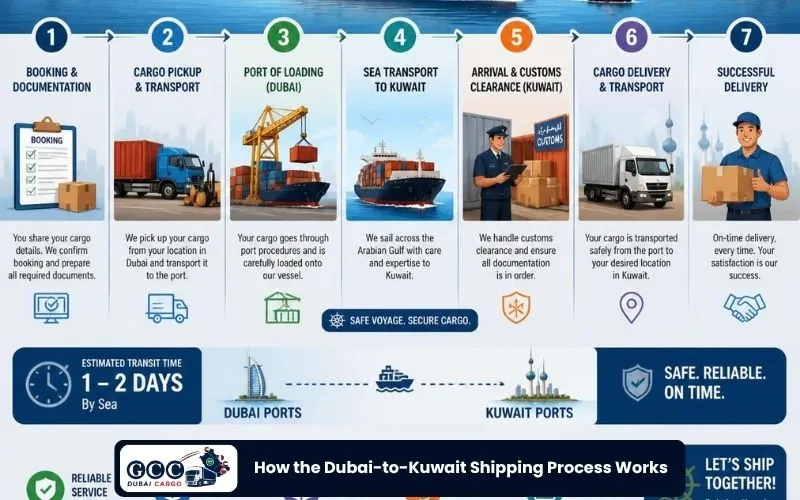
How the Dubai-to-Kuwait Shipping Process Works
A practical shipment can be organized in several stages.
1. Share Your Cargo Details
Provide the cargo type, number of pieces, dimensions, approximate weight and destination.
2. Review the Shipping Option
The appropriate transport method can then be considered based on the shipment.
3. Prepare the Cargo
Pack, label and organize the items before pickup.
4. Arrange Dubai Pickup
Confirm the collection location, contact person and loading conditions.
5. Check Documentation
Make sure the required commercial and shipping documents are prepared.
6. Loading and Dispatch
Cargo is loaded and secured for transportation.
7. Customs Processing
The shipment is handled according to the applicable export and import procedures.
8. Kuwait Delivery
After the relevant processes are completed, the cargo proceeds toward the final delivery location.
9. Final Unloading
The receiving party should be ready to accept the cargo and provide any required access.
This process can vary depending on cargo type, customs requirements and transport method.
What Can Affect Your Cargo Cost?
A cargo quotation should be based on the actual shipment rather than a generic price.
Important pricing factors can include:
| Pricing Factor | Why It Matters |
|---|---|
| Weight | Heavy cargo can affect vehicle and handling requirements |
| Volume | Large cargo occupies more vehicle space |
| Dimensions | Oversized items can change loading arrangements |
| Number of Pieces | More pieces may require additional handling |
| Cargo Type | Fragile or specialized goods may need extra protection |
| Packing | Special packing can add preparation requirements |
| Pickup Location | Loading conditions can affect collection |
| Delivery Location | Final-mile requirements can vary |
| Customs | Duties, taxes, permits or documentation may apply |
| Transport Method | Road, sea and air have different cost structures |
This is why customers should be cautious about choosing a shipping company based solely on a headline price.
A useful quotation should make clear what is included and what may be charged separately.
Common Problems That Can Delay a Shipment
Many shipping problems are caused before the cargo even leaves Dubai.
Common examples include:
Inaccurate Dimensions
If the actual cargo is much larger than the dimensions provided during quotation, the original transport plan may no longer be suitable.
Poor Packaging
Fragile goods without appropriate protection can be more vulnerable to damage during handling.
Incomplete Documentation
Missing or inconsistent documents can create customs or clearance complications.
Unclear Delivery Address
A general area name is not always enough for final delivery.
No Receiving Contact
If nobody is available to receive commercial or household cargo, unloading may become difficult.
Difficult Building Access
Large furniture may require additional planning where elevators, stairs, narrow entrances or parking limitations exist.
Unexpected Cargo
Adding extra items at pickup can change the shipment volume and loading arrangement.
Planning these details early can make the overall process much smoother.
How to Prepare Cargo for a Smoother Journey
Before pickup, use this simple checklist:
- Make a complete cargo list.
- Measure large items.
- Estimate total weight.
- Separate fragile goods.
- Pack loose items securely.
- Label cartons where useful.
- Photograph valuable or delicate items before packing.
- Keep invoices and relevant documents ready.
- Confirm the Kuwait delivery address.
- Share building or warehouse access information.
- Confirm the receiving person’s contact details.
- Mention unusual loading or unloading requirements.
- Check whether any product requires special approval.
Good preparation helps both the shipper and the transport provider.
When Door-to-Door Cargo Makes More Sense
Door-to-door shipping can be particularly convenient for customers who do not want to coordinate multiple stages independently.
Instead of arranging separate transportation from a Dubai location to a terminal and then another service in Kuwait, a door-to-door arrangement is planned around the pickup and final delivery points.
This can be useful for:
- Household relocations
- Furniture shipments
- Personal belongings
- Small business stock
- Retail cargo
- Office equipment
- Selected bulky shipments
The exact scope of door-to-door service should always be confirmed in advance, particularly when the destination has difficult access or the cargo requires special unloading.
Why Choose GCC Dubai Cargo for Dubai-to-Kuwait Cargo?
GCC Dubai Cargo focuses on cargo transportation from Dubai to GCC destinations, including Kuwait.
For a Dubai-to-Kuwait shipment, the focus should be on understanding the cargo before arranging transportation.
That means considering:
- Cargo type
- Shipment volume
- Weight
- Dimensions
- Packing requirements
- Pickup conditions
- Documentation
- Customs considerations
- Delivery location
- Residential or commercial access
Instead of treating every shipment the same way, the goal is to match the shipping arrangement to the actual requirements of the cargo.
Whether you are sending household belongings, furniture, commercial stock or heavier cargo, providing complete shipment information is the best starting point for receiving a practical quotation.
Practical Checklist Before Booking Cargo from Dubai to Kuwait
Before confirming your shipment, make sure you can answer these questions:
What am I shipping?
Describe the goods clearly.
How much cargo do I have?
Provide the number of cartons, pallets or individual pieces.
How large is it?
Measure larger or unusual items.
How heavy is it?
An approximate weight is better than no information.
Where is pickup in Dubai?
Give the complete pickup location.
Where is delivery in Kuwait?
Provide the complete destination address.
Is the cargo fragile?
Mention glass, electronics, furniture or delicate products.
Does it need special packing?
Discuss this before pickup.
Is it commercial or personal?
The shipment purpose can affect documentation.
Are the documents ready?
Prepare the relevant invoice, packing information and other paperwork.
Are there access limitations?
Mention stairs, elevators, loading restrictions, warehouses or difficult parking.
These details can help prevent avoidable misunderstandings.
FAQs About Cargo from Dubai to Kuwait
The best method depends on the type, size, urgency and handling requirements of your cargo. Road freight can be a practical option for many regional shipments, while sea freight may suit larger volumes and air freight may be considered for urgent or suitable smaller cargo. The shipment details should be reviewed before selecting the transport method.
Yes, furniture and household belongings can be prepared for cross-border transportation. Large furniture should be measured and packed appropriately, while fragile items should receive additional protection. Customers should also consider access at both the Dubai pickup location and the Kuwait delivery address.
The documents depend on the shipment and cargo type. Commercial shipments may involve documents such as a commercial invoice, packing list, certificate of origin and transport/customs documentation. Kuwait Customs publishes specific import procedures and requirements, so documentation should be confirmed for the particular goods before dispatch.
Provide the cargo type, number of pieces, approximate weight, dimensions, pickup location in Dubai and delivery location in Kuwait. It is also useful to mention whether the cargo is fragile, oversized, commercial or personal and whether packing or special loading is required.
The delivery arrangement depends on the shipment and destination requirements. Residential, commercial and warehouse deliveries can have different access and unloading conditions. Providing the complete destination details and any building, parking, loading or receiving requirements before dispatch helps the shipping plan account for the final delivery stage.
Final Thoughts on Shipping from Dubai to Kuwait
Cargo from Dubai to Kuwait should be planned around the shipment—not just the route.
Furniture, personal belongings, retail stock, office equipment, machinery and heavy cargo all have different transportation requirements.
The right approach starts with accurate cargo information, suitable packing, complete documentation and a clear delivery plan.
Road freight can be a practical solution for many Dubai-to-Kuwait shipments, while sea or air options may make more sense for specific cargo requirements.
Customs and product restrictions should also be checked before dispatch, particularly for commercial or regulated goods.
If you are preparing a shipment, start by listing what you need to send, measuring the larger pieces, confirming the pickup and delivery locations, and gathering the relevant documentation.
With those details ready, GCC Dubai Cargo can better understand your requirements and help determine a suitable cargo arrangement for the journey from Dubai to Kuwait.
Made Easy
GCC Cargo Destinations
Fast, secure, and reliable cargo delivery from Dubai to GCC countries.
Let's help you!
Need reliable cargo delivery from Dubai to GCC? Get in touch with our team today.
WhatsApp Now
+971 54 143 5685
© 2026 GCC Dubai Cargo. All Rights Reserved.