
Customs Clearance from Dubai to GCC
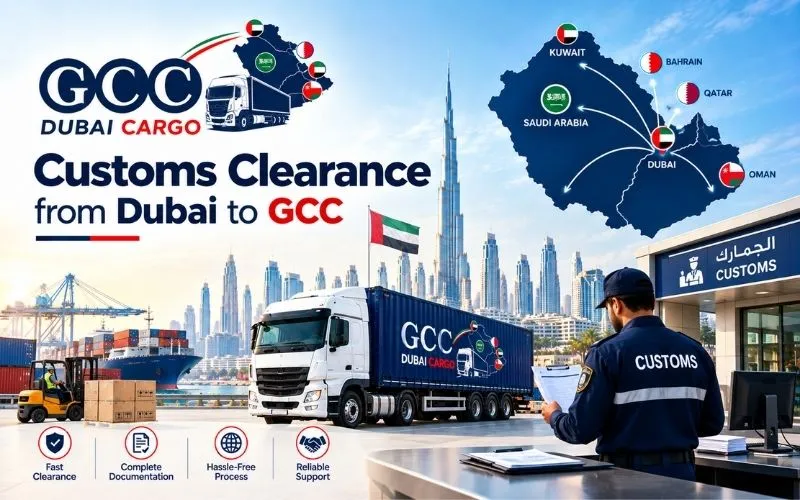
Moving cargo from Dubai to another GCC country involves more than arranging a truck and confirming a delivery address. For cross-border road shipments, customs documentation and declaration requirements form an important part of the journey.
When cargo information is incomplete, descriptions are unclear, or required documents do not match the actual shipment, questions can arise before the cargo is released.
Customs Clearance from Dubai to GCC should therefore be planned alongside the transportation itself.
Whether you are sending furniture to a family home, commercial stock to a warehouse, office equipment to another branch, or larger equipment for a business project, accurate shipment information helps create a clearer starting point.
Dubai Customs provides customs declaration services for different movements of goods, including export, import, transit, transfer and temporary admission.
For customers arranging road cargo, the practical objective is simple: know what is being shipped, prepare the available documentation, provide accurate receiver information, and understand that destination-country requirements may vary.
What Customs Clearance Means for Dubai-to-GCC Cargo
Customs clearance is the process of declaring goods to the relevant customs authority so the shipment can be assessed and processed before continuing to its next stage.
For a Dubai-to-GCC road shipment, there can be more than one customs consideration during the journey. The shipment may need to complete the appropriate procedures when leaving Dubai, while the destination country may have its own import declaration, documentation, product requirements and applicable charges.
This is why customs clearance should not be treated as something that starts only when a truck reaches a border.
Export, Transit and Destination Clearance
The exact customs procedure depends on the nature of the movement and the shipment.
Dubai Customs identifies export, import, transit, transfer and temporary-admission regimes among its customs declaration services.
The destination country can then have its own procedures for receiving the goods.
For example, Saudi Arabia’s official import guidance identifies documents such as a commercial invoice and bill of lading, with certificate-of-origin and product-specific requirements applying where relevant.
Why Road Cargo Requires More Than a Transport Booking
A road shipment requires practical coordination between cargo, transportation and documentation.
Before the vehicle is arranged, useful information can include:
- What the cargo is
- How many pieces are being shipped
- Approximate weight
- Dimensions of large items
- Cargo value
- Country of origin
- Sender information
- Receiver information
- Pickup location
- Destination address
- Commercial or personal nature of the shipment
- Any known product-specific documentation
Providing this information early helps identify questions before the cargo is loaded.
How the Dubai-to-GCC Customs Journey Works
The exact process varies according to the shipment and destination, but a typical road-cargo journey can be understood in several stages.
Cargo and Shipment Details
The first stage is understanding what is actually being shipped.
A description such as “goods,” “equipment,” or “electronics” may not provide enough information to understand the shipment properly. A more useful description identifies the actual products or items.
For commercial cargo, the description should be consistent with the commercial documentation.
For household shipments, customers should prepare an inventory of the furniture, appliances, boxes and personal belongings being moved.
Documentation and Declaration
Once the cargo is identified, the relevant documentation can be prepared.
Dubai Customs provides a customs declaration service for the movement of goods, while customs procedures may involve additional cargo information and inspection-related processes where applicable.
The key point is consistency.
The cargo being physically transported should correspond with the information presented in the documentation.
Dubai Export Procedures
Road cargo leaving Dubai may require the appropriate export or transit customs procedure depending on the nature of the movement.
Dubai Customs also provides specific services for customs declarations covering goods moving into and out of Dubai.
The applicable declaration should be determined according to the shipment circumstances rather than assumed to be identical for every cargo movement.
Border and Destination Customs
After the shipment leaves Dubai, destination-country customs procedures become important.
The requirements are not necessarily identical across all GCC countries. Product type, shipment purpose, origin, importer information and applicable regulations can influence the documentation required.
Customs Release and Final Delivery
Once the relevant customs procedures are completed and the shipment is released, the cargo can continue toward its final delivery point.
That destination might be:
- A residential property
- A commercial building
- A warehouse
- A retail location
- An office
- An industrial site
The delivery location should therefore be confirmed before the cargo starts its journey.
Documents to Prepare Before Your Cargo Leaves Dubai
Documentation depends on the shipment, product and destination, so customers should not assume that every shipment requires exactly the same paperwork.
Common documents can include the following.
| Document | Why It May Be Needed |
|---|---|
| Commercial Invoice | Identifies goods, value and trading parties |
| Packing List | Shows quantities, packages and shipment details |
| Transport Document | Supports the movement of the cargo |
| Certificate of Origin | Establishes origin where applicable |
| Importer/Receiver Information | Helps identify the destination party |
| Product-Specific Permit | May apply to regulated products |
| Customs Declaration | Provides the required customs shipment information |
Saudi Arabia’s official guidance, for example, lists commercial invoices and bills of lading and explains that additional documents can apply depending on the nature of the goods.
For Saudi land imports, official customs guidance also identifies documentation such as the original invoice, certificate of origin where applicable and packing list for shipments containing multiple items or measurements.
Commercial Invoice
For commercial shipments, the invoice should accurately identify the goods and their value.
Avoid descriptions that are unnecessarily vague.
Packing List
A packing list becomes particularly useful when a shipment contains multiple cartons, different products, furniture pieces or mixed cargo.
It can help establish what is physically included in the shipment.
Transport Documents
Road cargo requires transport documentation appropriate to the movement.
The exact document and information can depend on the shipment arrangement and destination.
Certificate of Origin and Product-Specific Documents
A certificate of origin may be relevant to certain shipments, while regulated products can require additional approvals or permits.
Do not assume that the same documentation applies to furniture, electronics, food products, machinery and other categories.
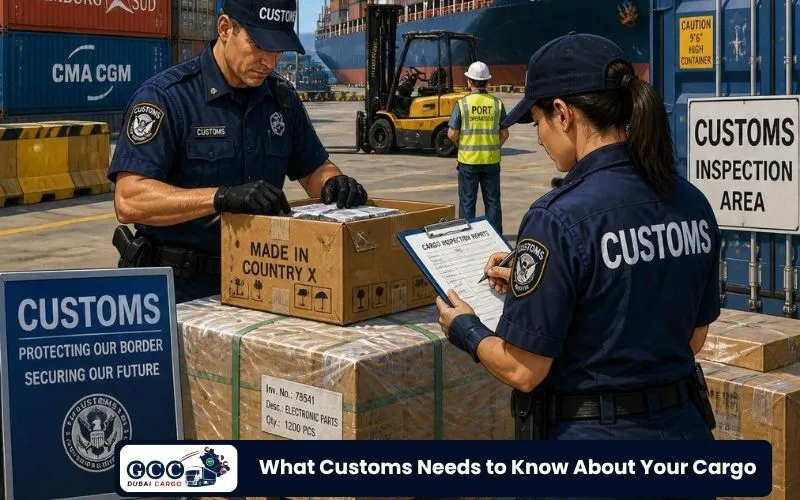
What Customs Needs to Know About Your Cargo
Accurate cargo information is one of the most important parts of preparation.
Description, Quantity and Value
Prepare a clear inventory containing:
- Item description
- Quantity
- Declared value where required
- Country of origin where relevant
- Package information
- Receiver details
A vague description can create unnecessary questions.
For example, instead of simply describing cargo as “parts,” identify the actual type of parts where the documentation requires a more specific description.
Weight, Dimensions and Packaging
Weight and dimensions are important not only for transportation planning but also for understanding the physical shipment.
Large furniture, machinery, cabinets, appliances and other bulky items should be measured before pickup.
For mixed cargo, provide the approximate number of cartons or pieces and identify unusually large or heavy items.
Customs Clearance for Different Types of Cargo
Household and Personal Belongings
Household shipments can include:
- Sofas
- Beds
- Tables
- Cabinets
- Mattresses
- Appliances
- Clothing
- Household boxes
- Personal belongings
The customer should create an inventory before packing.
Where several family members are moving belongings, separating personal effects clearly can also make the shipment easier to document.
Commercial and Retail Cargo
Business shipments may contain:
- Retail inventory
- Office supplies
- Spare parts
- Packaged products
- Equipment
- Business materials
- Commercial stock
Commercial shipments generally require particularly careful attention to invoice information, quantities, values and product descriptions.
Heavy, Bulky and Industrial Cargo
Large cargo requires additional planning before the vehicle arrives.
Examples include:
- Machinery
- Industrial equipment
- Large furniture
- Construction-related equipment
- Heavy commercial items
Provide dimensions and approximate weight rather than only saying that the cargo is “heavy.”
Fragile Cargo
Glass, electronics, appliances and furniture with delicate surfaces need careful preparation.
Photographs can be useful during pre-shipment planning, particularly for unusual or high-value items, although photographs do not replace required documentation.
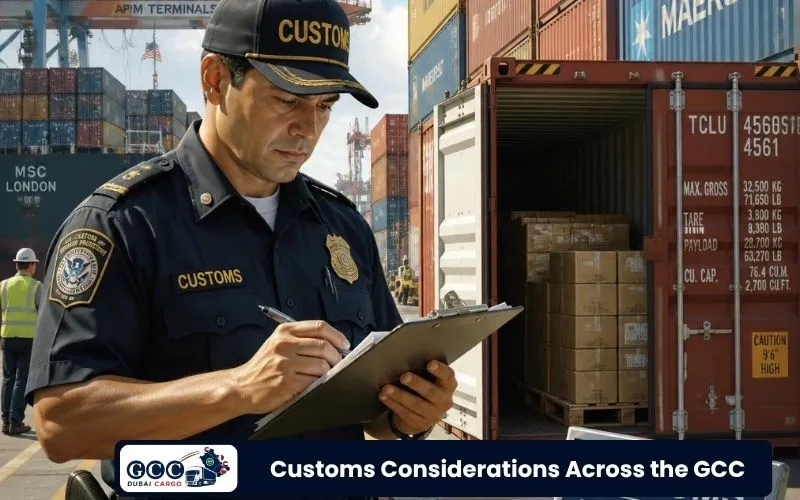
Customs Considerations Across the GCC
The GCC should be viewed as a group of connected markets rather than one identical customs destination.
Saudi Arabia
Saudi Arabia is one of the major road-cargo destinations from Dubai.
Customers moving commercial or household cargo should prepare accurate cargo details and receiver information before transportation.
For route-specific planning, see cargo from Dubai to Saudi Arabia.
Saudi Arabia’s official guidance confirms that import documentation can include commercial invoices, transport documents and other documents depending on the products involved.
Oman
Cargo moving toward Oman should be prepared with accurate shipment information and appropriate destination documentation.
Customers planning the transportation side can also review cargo from Dubai to Oman for route-specific information.
Qatar
For Qatar-bound cargo, the shipment should be documented according to its actual contents and purpose.
Commercial shipments may require more detailed product information than a simple household movement.
For route planning, see cargo from Dubai to Qatar.
Bahrain
Bahrain shipments should similarly be planned around the actual cargo, receiver, documentation and destination requirements.
For more route-specific information, customers can review cargo from Dubai to Bahrain.
Kuwait
Kuwait-bound cargo should be prepared with accurate descriptions, quantities and receiver information before dispatch.
Customers arranging the transportation leg can review cargo from Dubai to Kuwait for additional route information.
How FTL and LTL Affect Shipment Planning
Customs clearance is not the same thing as choosing FTL or LTL transportation, but the shipment model can influence how the cargo is organized and documented.
FTL, or full truckload transportation, is generally suited to cargo requiring a dedicated truck movement.
LTL, or less-than-truckload transportation, is used when a shipment does not require the entire truck capacity.
Regardless of the transportation model, the cargo itself must still be accurately described.
For LTL shipments containing multiple packages or different products, a clear packing list can be particularly useful.
For FTL shipments, the full cargo inventory should still be prepared before loading rather than relying on an approximate description.
Dubai Pickup Details That Can Prevent Problems
Customs paperwork is only one part of shipment preparation.
The physical pickup location in Dubai can also affect the loading process.
Before the vehicle arrives, check:
- Whether the building permits loading
- Whether a loading bay must be booked
- Whether security requires vehicle information
- Whether a service elevator is available
- Whether furniture can fit through the elevator
- Whether underground parking limits vehicle access
- Whether stairs are involved
- Whether there is enough space for loading
- Whether the loading point is far from the building entrance
For apartment buildings and managed communities, customers should confirm access rules with the relevant building or community management.
For broader local transportation planning, see cargo services in Dubai.
Common Customs Problems and Practical Solutions
Problem: The cargo description is too vague
Solution: Prepare a more specific inventory that identifies what the shipment actually contains.
Problem: Invoice and physical cargo do not match
Solution: Check quantities, product descriptions and values before documentation is finalized.
Problem: Receiver information is incomplete
Solution: Confirm the receiver’s name, address and available contact information before dispatch.
Problem: Large items were not measured
Solution: Measure furniture, machinery and other oversized pieces before pickup.
Problem: Required product documents were not considered
Solution: Check whether the product category has additional regulatory or import requirements before shipping.
Problem: Cargo is not properly organized
Solution: Label packages and prepare a packing list for shipments containing multiple pieces.
Problem: The delivery location has access limitations
Solution: Tell the transportation provider about elevators, loading bays, narrow access and other physical restrictions before delivery.
What Affects the Cost of Customs and Cross-Border Cargo?
There is no single customs or transportation price that applies to every Dubai-to-GCC shipment.
The overall cost can depend on factors such as:
- Cargo weight
- Cargo volume
- Dimensions
- Destination
- FTL or LTL requirement
- Vehicle requirements
- Packing requirements
- Loading complexity
- Residential or commercial delivery
- Heavy or oversized cargo
- Applicable customs charges
- Product-specific requirements
- Documentation requirements
Customers should avoid requesting a quote using only a destination name.
A more useful quote request includes the cargo description, number of pieces, dimensions of large items, approximate weight, pickup location, destination and whether the shipment is personal or commercial.
What to Send When Requesting a Cargo Quote
A good quote request can start with a simple cargo information sheet.
Include:
| Information | Example of What to Provide |
|---|---|
| Pickup | Dubai location |
| Destination | Country and city |
| Cargo Type | Household or commercial |
| Items | Furniture, cartons, machinery, stock |
| Quantity | Number of pieces/cartons |
| Weight | Approximate total |
| Dimensions | Length × width × height for large items |
| Value | Declared/commercial value where applicable |
| Access | Apartment, villa, warehouse, office |
| Receiver | Name and contact information |
| Photos | Useful for unusual or oversized cargo |
This information allows the shipment to be assessed more accurately before transportation is arranged.
A Practical Pre-Shipment Customs Checklist
Before your cargo leaves Dubai, check the following:
- Cargo inventory prepared
- Product descriptions reviewed
- Quantity confirmed
- Large items measured
- Approximate weight available
- Commercial invoice prepared where applicable
- Packing list prepared where applicable
- Transport documents arranged
- Certificate of origin checked where applicable
- Product-specific requirements checked
- Sender information confirmed
- Receiver information confirmed
- Pickup access confirmed
- Destination access considered
- Cargo packaging checked
- Documents compared against actual cargo
The purpose of this checklist is not to suggest that every shipment requires every document. Requirements vary according to the cargo, route, destination and applicable customs rules.
Frequently Asked Questions
Common documentation can include a commercial invoice, packing list, transport document and certificate of origin where applicable. Additional documents may be required depending on the product, destination and shipment type. Saudi Arabia's official guidance, for example, identifies commercial invoices and transport documentation and notes additional requirements based on the goods.
Yes. Although GCC countries share regional customs frameworks, destination procedures and product-specific requirements can differ. Customers should verify the requirements relevant to their exact cargo and destination rather than assuming one document set applies everywhere.
Provide the item description, quantity, approximate weight, dimensions of large items, cargo value where relevant, country of origin where applicable, sender details, receiver information, pickup location and destination. Commercial shipments should also have consistent commercial documentation.
Household furniture and personal belongings can be transported across borders, but the applicable customs and documentation requirements depend on the destination and circumstances of the shipment. Prepare an accurate inventory and identify unusual, regulated or high-value items before transportation.
Common problems include unclear cargo descriptions, inconsistent documentation, missing information, incorrect shipment details and failure to consider product-specific requirements. Reviewing the cargo inventory and documents before dispatch can help reduce avoidable questions.
Made Easy
GCC Cargo Destinations
Fast, secure, and reliable cargo delivery from Dubai to GCC countries.
Let's help you!
Need reliable cargo delivery from Dubai to GCC? Get in touch with our team today.
WhatsApp Now
+971 55 735 4528
© 2026 GCC Dubai Cargo. All Rights Reserved.