
Cargo from Dubai to Sakaka

Sending cargo from Dubai to Sakaka requires more than simply arranging transportation from one city to another. The shipment needs to be assessed according to its size, weight, type, pickup conditions, documentation and final delivery location.
Cargo from Dubai to Sakaka is primarily a cross-border road freight requirement. It can be relevant for individuals moving household belongings, businesses sending stock, suppliers delivering products, companies relocating equipment, or customers transporting larger furniture and other permitted goods.
Sakaka is the administrative capital of Saudi Arabia’s Al-Jouf Province in the north of the Kingdom. Its position makes accurate destination information particularly important when planning a shipment from Dubai.
GCC Dubai Cargo can assess a shipment according to the actual cargo details rather than applying one generic solution to every customer. The most useful starting point is to know what you are sending, how much space it occupies, where it will be collected in Dubai, and where it needs to be delivered in Sakaka.
Why Sakaka Requires Destination-Specific Cargo Planning
A shipment going to Sakaka may be delivered to a residence, office, warehouse, shop, supplier location or another commercial address. These destinations can have very different loading and unloading conditions.
For example, a household shipment may include sofas, beds, cabinets, appliances and cartons. A commercial shipment may consist of pallets, packaged products, spare parts or business inventory. A machinery shipment may require much more detailed information about weight, dimensions and loading arrangements.
Sakaka is also the main urban center of Al-Jouf Province, so the delivery address should be supplied as completely as possible rather than simply writing “Sakaka” on a quotation request.
Before transportation is arranged, confirm:
- Complete receiver name
- Receiver phone number
- Exact delivery location
- Cargo type
- Number of pieces
- Approximate weight
- Dimensions of large items
- Whether the destination is residential or commercial
- Whether a warehouse or loading area is available
For customers who need the broader Saudi route, the main cargo from Dubai to Saudi Arabia page provides country-level information, while this page remains focused on Sakaka.
Road Freight from Dubai to Sakaka
Road freight provides a land-based transportation option between Dubai and northern Saudi Arabia. For cargo that is suitable for road transportation, the shipment can be planned around its physical characteristics and delivery requirements.
The road-freight arrangement may involve either a dedicated truck or shared truck capacity, depending on the shipment.
The important point is not simply choosing a truck. The transportation arrangement needs to match the cargo.
A small collection of cartons may not need an entire truck. A large furniture shipment, multiple pallets or heavy equipment may require substantially more capacity.
The shipment should therefore be assessed using:
- Cargo weight
- Cargo volume
- Dimensions
- Number of packages
- Type of cargo
- Loading requirements
- Pickup location
- Sakaka delivery location
- FTL or LTL requirements
- Applicable documentation
This approach also helps prevent a common problem: quoting or arranging transportation before the actual size of the cargo is understood.
Which Cargo Can Be Sent to Sakaka?
The exact eligibility of a shipment depends on its contents and applicable UAE and Saudi requirements. Customers should provide an accurate description of the cargo rather than using a vague description such as “goods” or “items.”
Household and Personal Cargo
A Dubai-to-Sakaka household shipment may include:
- Sofas
- Beds
- Mattresses
- Tables
- Chairs
- Cabinets
- Appliances
- Household boxes
- Kitchen items
- Personal belongings
Furniture should be measured before transportation is arranged, especially when individual pieces are large.
A sofa that appears manageable inside a villa may create a completely different loading problem if it must pass through a narrow corridor, staircase, service elevator or building entrance.
For personal shipments, separate household belongings from any commercial stock and provide an inventory where practical.
Commercial and Business Cargo
Businesses may use road freight for shipments such as:
- Retail stock
- Packaged products
- Business supplies
- Office equipment
- Spare parts
- Furniture
- Product inventory
- Machinery
- Industrial equipment
Commercial cargo should be described accurately in the shipping documents. Product descriptions, quantities and declared information should match the physical shipment.
Heavy, Bulky and Industrial Cargo
Heavy or oversized cargo needs more planning than ordinary cartons.
Examples can include:
- Machinery
- Industrial equipment
- Large furniture
- Construction-related equipment
- Heavy commercial items
- Oversized components
For these shipments, provide:
| Information | Why It Matters |
|---|---|
| Weight | Helps assess transportation requirements |
| Length | Important for vehicle and loading planning |
| Width | Helps determine available space |
| Height | Important for access and vehicle planning |
| Number of Units | Shows shipment quantity |
| Photos | Help illustrate unusual cargo |
| Loading Method | Helps identify practical collection requirements |
| Delivery Location | Helps assess unloading arrangements |
Do not estimate the dimensions of unusually large cargo if measurements are available. Accurate information makes quotation and transportation planning more practical.
Fragile and Breakable Cargo
Fragile items can include glass, electronics, appliances, decorative items and furniture with delicate surfaces.
Customers should use suitable protective packaging and identify fragile pieces before loading.
The shipment should also be arranged so that heavy objects do not unnecessarily press against delicate goods.

FTL or LTL: Which Shipment Arrangement Fits?
Two common road-freight concepts are FTL and LTL.
FTL, or Full Truckload, generally means the shipment is planned around a dedicated truck capacity. It may be appropriate when the cargo is large, occupies substantial truck space, consists of multiple pallets, or has transportation requirements that make dedicated capacity practical.
LTL, or Less Than Truckload, is generally used when a shipment does not require the full available truck capacity. The cargo may share transportation capacity with other suitable shipments.
A simple comparison:
| FTL | LTL |
|---|---|
| Dedicated truck capacity | Shared truck capacity |
| Suitable for larger shipments | Suitable for smaller shipments |
| Useful for multiple pallets or large cargo | Useful for cartons, smaller commercial shipments or partial loads |
| Vehicle planning based heavily on the shipment | Space requirement is assessed against available capacity |
There is no universal rule that FTL or LTL is right for every customer. The decision should consider volume, weight, dimensions, cargo type, loading requirements and delivery requirements.
Dubai Pickup: What Should Be Checked Before Collection?
The pickup location in Dubai can affect how cargo is collected.
A shipment from a warehouse may have a loading bay and straightforward vehicle access. An apartment shipment can be different.
Before pickup, check:
- Building parking arrangements
- Loading and unloading areas
- Security access
- Service elevator requirements
- Elevator booking requirements
- Building management approval
- Stairs
- Narrow entrances
- Underground parking restrictions
- Distance between the vehicle and building entrance
- Dimensions of large furniture
- Whether large items can pass through doors and elevators
Building policies can differ, so customers should confirm specific requirements directly with their building or community management.
If you need broader local information about preparing a shipment in Dubai, see the cargo services in Dubai page.
Preparing Furniture and Large Items for Road Transport
Furniture should be prepared before the vehicle arrives.
Start by creating a simple inventory. For example:
| Item | Quantity | Approx. Dimensions | Approx. Weight | Photo |
|---|---|---|---|---|
| Sofa | 1 | Measure | Estimate | Yes/No |
| Bed Frame | 1 | Measure | Estimate | Yes/No |
| Mattress | 1 | Measure | Estimate | Yes/No |
| Cabinet | 2 | Measure | Estimate | Yes/No |
| Cartons | 10 | Record | Estimate | Yes/No |
Large furniture should be measured in its transportable condition. If an item can be dismantled, note whether it will be dismantled before collection.
Protect surfaces where appropriate, secure loose components and label boxes.
For fragile items, use suitable protective material and identify the cartons clearly.
Photographs are particularly useful for unusual furniture, machinery and oversized items because they give the cargo team a better understanding of the shipment before pickup.
What Information Is Needed for a Sakaka Cargo Quote?
A useful quotation request should contain enough information to understand the actual shipment.
Customers should ideally provide:
- Dubai pickup location
- Sakaka delivery location
- Cargo description
- Number of pieces
- Number of cartons or pallets
- Approximate weight
- Dimensions of large items
- Photos where useful
- Residential or commercial delivery status
- Any known loading restrictions
- Whether the cargo is personal or commercial
- Relevant shipment documents where available
For a business shipment, also provide product descriptions and quantities.
The more complete the information, the less likely it is that important transportation details will be discovered only after the quotation has been prepared.
How Cargo Pricing Is Calculated
There is no responsible single price for every shipment from Dubai to Sakaka.
The quotation can depend on several factors:
| Pricing Factor | Why It Matters |
|---|---|
| Weight | Affects transportation requirements |
| Volume / CBM | Indicates how much space is required |
| Dimensions | Large pieces can affect vehicle selection |
| Cargo Type | Different cargo can have different requirements |
| Number of Pieces | Influences loading and handling |
| Pickup Location | Access can affect collection planning |
| Delivery Location | Residential and commercial access can differ |
| FTL/LTL | Dedicated and shared capacity have different structures |
| Packing | Additional preparation may affect the quotation |
| Loading Requirements | Heavy or unusual cargo may require extra planning |
| Customs-Related Requirements | Product-specific procedures may affect total cost |
| Special Handling | Unusual cargo can require additional arrangements |
This is why a quotation based only on "10 boxes" may not be as useful as a request containing dimensions, weight, cargo type and pickup information.
Customers should avoid comparing two quotations until they understand what each quotation actually includes.
Documents and Saudi Customs Considerations
Cross-border cargo requires accurate documentation, but the exact documents depend on the shipment.
For applicable Saudi imports, official ZATCA guidance identifies documents including a commercial invoice and transport documentation, while a certificate of origin and product-specific documentation may apply depending on the circumstances.
ZATCA also notes that additional requirements can apply according to the nature of the imported goods.
Depending on the shipment, relevant information may include:
- Commercial invoice
- Packing list
- Transport documents
- Certificate of origin where applicable
- Sender information
- Importer/receiver information
- Customs declaration information
- Product-specific permits or certificates where applicable
Personal imports have their own requirements, and restricted or regulated goods can require additional documentation or approvals.
The safest approach is to describe the actual cargo accurately and confirm the current requirements applicable to that particular shipment before dispatch.
Do not assume that paperwork used for one product or shipment automatically applies to another.
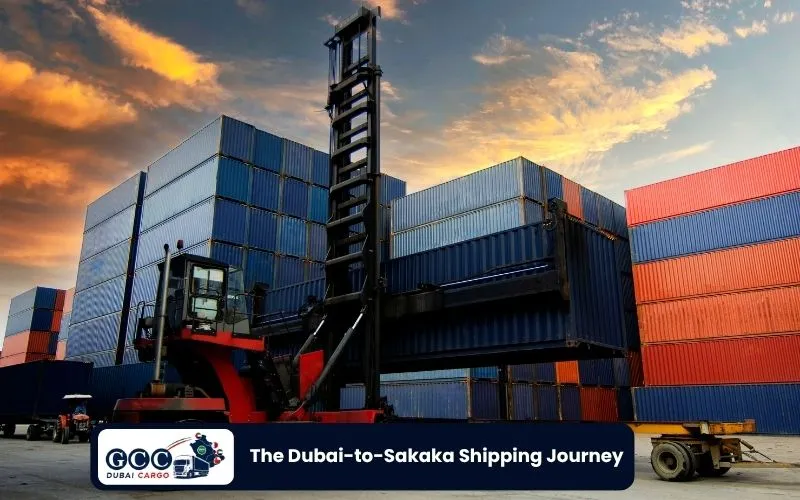
The Dubai-to-Sakaka Shipping Journey
A typical shipment can be organized around the following stages.
1. Identify the cargo
Create an inventory and determine whether the shipment is personal, household, commercial, heavy or mixed.
2. Collect shipment details
Record weight, dimensions, number of packages and photographs of unusual items.
3. Check Dubai pickup access
Confirm parking, building access, elevators, loading areas and any management requirements.
4. Review the transportation arrangement
The shipment can then be assessed for an appropriate road-freight arrangement, including FTL or LTL where suitable.
5. Prepare the cargo
Pack cartons, protect furniture and separate fragile or unusual items.
6. Prepare documentation
Review invoices, packing information and other applicable documents before transportation.
7. Arrange pickup
Cargo is collected from the agreed Dubai location according to the confirmed shipment arrangement.
8. Cross-border transportation
The shipment moves by road toward Saudi Arabia and proceeds through the applicable border and customs procedures.
9. Saudi-side delivery planning
The final Sakaka delivery address and receiver details should be available before the shipment reaches the destination stage.
10. Final delivery
Delivery is arranged according to the agreed shipment requirements and destination access.
Delivery Planning in Sakaka
The final delivery point can be a major part of shipment planning.
Residential delivery
For a home delivery, confirm:
- Building or villa access
- Parking
- Entrance dimensions
- Elevator availability
- Stairs
- Receiver availability
- Safe unloading location
Large furniture should be checked against doors and elevators before dispatch.
Commercial delivery
A shop, office or business location may have different requirements.
Provide:
- Company name
- Delivery address
- Receiver contact
- Loading/unloading instructions
- Warehouse or facility access information
- Pallet or carton information where applicable
Warehouse delivery
For warehouse deliveries, ask the receiving party about available loading areas, vehicle access and operating arrangements before the shipment is dispatched.
The purpose is simple: the cargo should arrive at a destination that is ready to receive it.
Common Dubai-to-Sakaka Cargo Problems and Solutions
Problem: Large dimensions were not provided
Solution: Measure sofas, cabinets, machinery and other large items before requesting the quotation.
Problem: The Dubai building does not allow convenient loading
Solution: Confirm parking, loading bays, security and elevator requirements with building management before pickup.
Problem: The cargo inventory is unclear
Solution: Prepare a basic list showing item descriptions and quantities.
Problem: Commercial documents do not match the cargo
Solution: Check descriptions, quantities and declared information against the actual shipment before dispatch.
Problem: The receiver’s address is incomplete
Solution: Provide the complete Sakaka delivery location and receiver contact details.
Problem: Furniture cannot fit through the destination entrance
Solution: Check doors, corridors, stairways and elevator dimensions before sending oversized furniture.
Problem: A small shipment is assumed to need a dedicated truck
Solution: Ask whether LTL or another suitable shared-load arrangement can be considered based on the actual cargo.
Problem: Heavy cargo is described only by weight
Solution: Provide length, width, height, number of units and loading information as well.
Example Shipment Scenarios
These are examples of situations a customer may encounter, not GCC Dubai Cargo customer stories.
Family furniture shipment
A family moving from Dubai to Sakaka may have sofas, beds, appliances, cartons and personal belongings. The useful first step is to create an inventory, measure large furniture and check both pickup and delivery access.
Retail stock shipment
A retailer may need to send cartons of products to a business location in Sakaka. In this case, carton count, product descriptions, quantities, weight and commercial documentation become particularly important.
Office equipment movement
An office relocation may involve desks, chairs, cabinets, computers and other equipment. The customer should identify fragile equipment separately and confirm collection and delivery access.
Machinery shipment
A contractor or business moving machinery should provide exact dimensions and weight where available, together with photographs and loading information.
Other Saudi Destinations from Dubai
Sakaka is one destination within Saudi Arabia. If your shipment ultimately needs to go somewhere else in the Kingdom, the route requirements may change according to the final city.
For example, Riyadh, Jeddah, Dammam, Al Khobar, Makkah, Madinah, Jubail and other destinations can have different delivery conditions. Avoid treating a city change as a simple address replacement because the delivery location can influence the transportation and access requirements.
If your destination changes to another GCC country, GCC Dubai Cargo also provides route-specific information for cargo from Dubai to Bahrain, cargo from Dubai to Oman, cargo from Dubai to Kuwait and cargo from Dubai to Qatar.
These pages address their respective destinations rather than treating every GCC shipment as the same route.
Preparing Your Shipment: Final Checklist
Before requesting a quotation for cargo from Dubai to Sakaka, check the following:
Cargo details
Cargo description prepared
Number of pieces recorded
Cartons/pallets counted
Approximate weight available
Large-item dimensions measured
Photos taken where useful
Pickup details
Dubai pickup address confirmed
Building or warehouse access checked
Loading area confirmed
Elevator requirements checked
Parking/security requirements checked
Delivery details
Sakaka address confirmed
Receiver name provided
Receiver phone number provided
Residential/commercial status identified
Unloading access checked
Documentation
Commercial invoice reviewed where applicable
Packing list prepared where applicable
Transport information checked
Product-specific documentation reviewed where applicable
Actual cargo contents accurately described
A little preparation before pickup can make the quotation and transportation planning much clearer.
Five Questions Customers Ask About Cargo from Dubai to Sakaka
Yes, household furniture can be considered for road transportation when the cargo meets the applicable transportation and import requirements. Provide the number of furniture pieces, dimensions, approximate weight, pickup location and Sakaka delivery details.
It depends on the shipment. FTL uses dedicated truck capacity and can suit larger shipments, while LTL may be considered when the cargo occupies only part of available capacity. Weight, volume, dimensions and loading requirements should be reviewed before choosing the arrangement.
Provide the Dubai pickup location, Sakaka delivery address, cargo type, number of pieces, approximate weight, dimensions of large items and photos where useful. Commercial shipments should also provide relevant cargo and documentation information.
No. Documentation depends on the cargo, its nature, whether it is personal or commercial, and the applicable Saudi requirements. ZATCA states that additional documentation or product-specific requirements can apply depending on the imported goods.
Measure the cargo accurately, record its weight where possible, take clear photographs and explain how it will be loaded. Also check access at the Dubai pickup location and the Sakaka delivery address, especially for machinery and large furniture.
Request a Dubai-to-Sakaka Cargo Quote
If you are preparing cargo from Dubai to Sakaka, start with accurate shipment information rather than an estimated description.
Send the cargo type, number of pieces, dimensions, approximate weight, pickup location in Dubai and delivery details in Sakaka. For commercial shipments, include the relevant product and documentation information.
GCC Dubai Cargo can then assess the shipment according to its transportation requirements and help determine the appropriate road-freight arrangement.
Made Easy
GCC Cargo Destinations
Fast, secure, and reliable cargo delivery from Dubai to GCC countries.
Let's help you!
Need reliable cargo delivery from Dubai to GCC? Get in touch with our team today.
WhatsApp Now
+971 55 735 4528
© 2026 GCC Dubai Cargo. All Rights Reserved.