
Cargo from Dubai to Arar

Shipping cargo from Dubai to Arar is not simply a matter of placing boxes on a truck and sending them north. The shipment needs to be planned around the cargo itself, the Dubai pickup location, road transportation requirements, Saudi documentation, and the final delivery address in Arar.
Arar is the capital of Saudi Arabia’s Northern Borders Region and has an important position on northern road connections. Its location makes destination planning especially important for customers sending furniture, household belongings, commercial stock, equipment, or other physical cargo from Dubai.
For a successful shipment, start with accurate information. Know what you are sending, how many pieces you have, the approximate weight and dimensions, where the cargo will be collected in Dubai, and where it needs to be delivered in Arar.
These details help determine the appropriate transportation arrangement and provide a more useful basis for a quotation.
Cargo from Dubai to Arar: What to Know Before Shipping
GCC Dubai Cargo provides cargo and road transportation solutions from Dubai toward GCC destinations, including Saudi Arabia. For an Arar shipment, the most useful starting point is to separate the cargo into four basic categories:
- Household and personal belongings
- Commercial and business cargo
- Heavy or bulky cargo
- Fragile or damage-sensitive items
The category does not determine every transportation requirement, but it helps identify the information that needs to be considered before pickup.
For example, ten cartons of personal belongings are very different from a complete household containing sofas, beds and appliances. Likewise, a pallet of retail stock is different from machinery or an oversized piece of equipment.
If you are still comparing Saudi destinations rather than shipping specifically to Arar, the broader cargo from Dubai to Saudi Arabia service page can provide wider country-level information.
Why Arar Requires Route-Specific Cargo Planning
Arar is the administrative capital of the Northern Borders Region in northern Saudi Arabia. Saudi government sources describe the city as having a strategic road position connecting routes toward several parts of the Kingdom and the wider northern region.
That geographic position matters when preparing a shipment because the final destination is not simply “Saudi Arabia.” The carrier needs the actual delivery city and address.
A useful quotation should therefore identify:
- Arar as the destination city
- The complete delivery address
- Residential, commercial or warehouse delivery
- Cargo weight
- Cargo volume or approximate CBM
- Number of pieces
- Largest item dimensions
- Cargo type
- Packing requirements
- Loading conditions
- Any known documentation requirements
The more accurately these details are provided, the easier it is to assess the shipment before collection.
What You Can Send from Dubai to Arar
Household and Personal Cargo
Household shipments can include furniture and personal effects such as:
- Sofas
- Beds
- Mattresses
- Tables
- Chairs
- Cabinets
- Appliances
- Clothing
- Books
- Kitchen items
- Packed household cartons
Furniture needs particular attention because dimensions can matter as much as weight. A large sofa may occupy substantial truck space even when its physical weight is relatively moderate.
Customers should measure unusually large pieces and provide those dimensions before requesting a quotation.
Commercial Shipments
Businesses may need to send:
- Retail inventory
- Business stock
- Office equipment
- Packaged products
- Spare parts
- Supplies
- Tools
- Commercial materials
- Warehouse-bound goods
For commercial cargo, an accurate description of the goods is particularly important because documentation and customs requirements can depend on the nature of the shipment.
Heavy, Bulky and Irregular Cargo
Heavy or bulky cargo may include machinery, equipment, large furniture, construction-related items or irregularly shaped commercial goods.
Do not describe heavy cargo only by saying “one machine.” Provide its approximate:
- Weight
- Length
- Width
- Height
- Number of pieces
- Loading requirements
- Pickup location
- Delivery location
If the item requires lifting equipment or has unusual loading characteristics, mention that before collection.
Fragile Items
Fragile cargo can include glass, electronics, appliances, furniture with delicate surfaces and breakable household goods.
The right approach is to identify fragile items separately during the quotation stage and explain how they are currently packed. This gives the transportation provider a better understanding of the shipment before loading.
Choosing Road Cargo for the Dubai–Arar Route
Road freight is particularly relevant when the shipment consists of physical goods that can travel by truck across the UAE and Saudi Arabia.
Road transportation can accommodate different shipment sizes, but the suitable arrangement depends on the cargo. A small collection of cartons does not need the same planning as a complete truckload.
The practical question is not simply “Is road cargo available?” It is:
How much cargo do I have, how much space does it occupy, and what type of delivery does it require?
For many customers, the decision comes down to LTL or FTL.
FTL or LTL: Which Shipment Model Fits?
FTL — Full Truckload
FTL means the shipment uses a dedicated truck or truck capacity arranged for the customer’s cargo.
It can make sense when:
- The shipment is large.
- The cargo occupies substantial truck space.
- A dedicated movement is preferred.
- The shipment contains large or bulky pieces.
- The customer does not want the cargo combined with unrelated shipments.
The exact vehicle arrangement should be assessed according to cargo dimensions, weight and loading requirements rather than selected simply because the shipment is going to Arar.
LTL — Less Than Truckload
LTL is designed for cargo that does not require an entire truck.
It may suit:
- Several cartons
- Small commercial consignments
- Partial household shipments
- Pallets
- Smaller quantities of business inventory
LTL can make sense when the shipment occupies only part of the available truck space. However, customers should provide accurate dimensions and piece counts because volume is important when determining how much transportation capacity the shipment needs.
Preparing Your Cargo Before Dubai Pickup
Good preparation begins before the truck arrives.
Create a simple inventory showing:
| Information | What to Record |
|---|---|
| Item Description | Sofa, carton, appliance, machine, etc. |
| Quantity | Number of pieces |
| Dimensions | Length × width × height for large items |
| Approx. Weight | Estimated weight where available |
| Condition | New, used or other relevant description |
| Packing | Carton, pallet, wrapped, crated, etc. |
| Destination | Arar delivery address |
| Special Notes | Fragile, oversized or unusual items |
Take photographs of unusually large or difficult-to-describe items. Photos can be useful when explaining the shipment before pickup.
For commercial goods, keep the physical cargo description consistent with the information supplied for transportation and customs documentation.

Dubai Pickup: Access Details That Can Affect Loading
Dubai pickup planning can be more complicated than the cargo itself.
For apartment buildings, villas, offices and warehouses, check the practical access conditions before the pickup date.
Important questions include:
- Is there a suitable parking or loading area?
- Is a loading bay available?
- Does building management require advance approval?
- Is a service elevator available?
- Will large furniture fit through the elevator?
- Are there stairs?
- Is the entrance narrow?
- Is the loading area inside underground parking?
- How far must the cargo be carried to the vehicle?
- Can the truck reach the building entrance?
Requirements vary between buildings and communities, so customers should confirm access rules with the relevant building or community management.
For broader local cargo planning, see the cargo services in Dubai page.
Packing Furniture, Cartons and Fragile Goods
Packing should reflect the physical nature of the shipment.
Furniture should be protected against scratches and contact with other pieces. Cartons should be closed securely and labeled so that the contents can be identified.
Fragile goods should have suitable cushioning and should not be placed loose inside large cartons where movement can occur.
For large furniture, consider:
- Protecting corners
- Covering exposed surfaces
- Securing drawers and movable components
- Separating glass panels
- Protecting polished surfaces
- Identifying fragile sections
For cartons, avoid overloading boxes to the point where they cannot be safely closed or handled.
The objective is simple: cargo should remain stable during loading, road movement and unloading.
Cargo Information Needed for an Accurate Quote
There is no single responsible price for every shipment from Dubai to Arar.
A quotation can depend on:
| Pricing Factor | Why It Matters |
|---|---|
| Weight | Helps determine transportation requirements |
| Volume / CBM | Shows how much truck space the shipment may occupy |
| Dimensions | Large pieces can affect vehicle and loading requirements |
| Number of Pieces | Helps estimate handling and space |
| Cargo Type | Different goods can have different requirements |
| FTL or LTL | Dedicated and shared capacity have different cost structures |
| Packing | Additional preparation can affect the quotation |
| Pickup Access | Difficult access may change loading requirements |
| Delivery Address | Residential, commercial and warehouse deliveries can differ |
| Heavy or Oversized Items | May require additional planning |
| Customs-Related Requirements | Applicable procedures can affect the overall shipment |
When requesting a quote, provide the complete cargo information instead of only saying "I have 500 kg."
Documentation and Saudi Customs Considerations
Cross-border shipments need accurate documentation.
Saudi Arabia’s Zakat, Tax and Customs Authority states that importers may need documents including a commercial invoice, bill of lading and certificate of origin where applicable. It also notes that additional documents can depend on the nature of the imported goods.
This does not mean that every personal or commercial shipment automatically requires the same paperwork.
Requirements can vary according to:
- Product type
- Country of origin
- Personal or commercial nature
- Applicable regulations
- Product-specific requirements
- Import circumstances
- Customs classification
Potential documentation can include:
- Commercial invoice
- Packing list
- Transport documents
- Certificate of origin where applicable
- Importer or receiver information
- Product-specific permits where applicable
- Customs declaration
Customers should ensure that shipment descriptions, quantities and other cargo information are accurate and consistent.
For current product-specific Saudi customs requirements, the applicable Saudi authorities or customs broker should be consulted. ZATCA’s current import guidance specifically advises importers to check requirements according to the goods being imported.
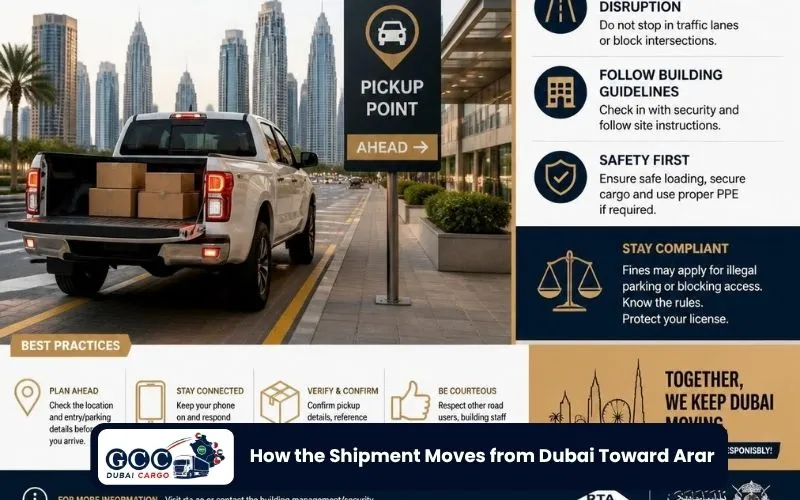
How the Shipment Moves from Dubai Toward Arar
A typical road-cargo journey can be understood in stages.
1. Cargo details are collected
The customer provides the type, quantity, dimensions, weight and destination.
2. Pickup requirements are assessed
The Dubai location is reviewed for parking, loading and building access.
3. Cargo is prepared
Furniture, cartons, pallets or other goods are packed and labeled as appropriate.
4. Loading is arranged
The cargo is loaded according to its size, weight and handling requirements.
5. Documentation is prepared
Applicable transportation and customs documents are checked.
6. Cross-border road movement begins
The shipment travels from Dubai toward Saudi Arabia through the applicable road and border procedures.
7. Customs procedures are completed as applicable
The shipment’s documentation and cargo are processed according to the relevant requirements.
8. The shipment continues toward northern Saudi Arabia
After the applicable border procedures, the cargo continues toward the Northern Borders destination.
9. Final delivery is arranged
The receiver’s address and access conditions become important for the final unloading.
The actual route, border procedures and shipment timing can vary, so customers should avoid relying on a generic delivery estimate without first providing complete shipment details.
Arar Delivery: Residential, Commercial and Warehouse Addresses
The final delivery address should be supplied as early as possible.
For a residential delivery, provide:
- Receiver’s full name
- Mobile number
- Complete address
- Building or villa information
- Access instructions where relevant
For a business or warehouse delivery, provide:
- Company name
- Delivery address
- Contact person
- Loading/unloading instructions
- Receiving hours where applicable
- Any site-access requirements
Arar is the capital of the Northern Borders Region, and the wider region has important road and logistics connections. Saudi government sources also identify transportation and logistics among the region’s strategic sectors.
That makes accurate destination information especially useful when cargo is intended for businesses, suppliers, warehouses or other commercial recipients.
Common Dubai-to-Arar Shipping Problems and Practical Solutions
Problem: The largest furniture dimensions were not provided.
Solution: Measure sofas, beds, cabinets, appliances and other unusually large items before requesting a quotation.
Problem: The Dubai building has limited loading access.
Solution: Confirm parking, loading bays, service elevators and building-management requirements before pickup.
Problem: Cargo descriptions are too vague.
Solution: Provide a practical inventory with item descriptions, quantities and photographs where useful.
Problem: The receiver cannot be reached.
Solution: Confirm the receiver’s mobile number and delivery address before dispatch.
Problem: Commercial documents do not match the cargo.
Solution: Check descriptions, quantities and shipment information before transportation.
Problem: Fragile goods are packed loosely.
Solution: Use suitable cushioning and secure the contents so they cannot move freely inside the package.
Problem: A shipment is much larger than originally estimated.
Solution: Provide CBM, dimensions and piece counts before booking rather than estimating only by weight.
What Can Affect the Cost of Cargo to Arar?
Customers often ask for a cargo price before providing shipment information.
A meaningful quotation normally requires more than the destination name.
The major cost considerations can include:
- Total weight
- Total volume
- Individual dimensions
- Number of pieces
- Type of cargo
- FTL or LTL requirements
- Packing requirements
- Loading conditions
- Pickup location
- Delivery location
- Residential or commercial access
- Heavy or oversized cargo
- Applicable customs or documentation requirements
For example, 200 kg of compact cartons and 200 kg of large furniture can require very different transportation planning because the cargo may occupy very different amounts of truck space.
For this reason, customers should request a shipment-specific quotation rather than relying on a generic per-kilogram figure.
Example Shipment Scenarios
Family sending furniture to Arar
A family may have beds, sofas, tables, appliances and several cartons of personal belongings.
The important information would include the number and dimensions of large furniture pieces, total cartons, approximate weight, Dubai pickup access and the final Arar residential address.
Retail business sending inventory
A retailer may need to send cartons of packaged goods or business stock.
Here, the inventory, number of cartons, weight, dimensions and commercial documentation become particularly important.
Company moving office equipment
Office furniture, computers, cabinets and other equipment should be listed individually where practical. Building access at the Dubai origin and the receiving conditions in Arar should be confirmed before pickup.
Contractor sending equipment
Heavy or irregular equipment should be described with accurate dimensions and weight. Loading requirements should be explained before transportation is arranged.
These are examples of shipment planning only, not GCC Dubai Cargo customer case studies.
A Simple Dubai-to-Arar Shipping Checklist
Before requesting a quotation, prepare:
Complete cargo inventory
Number of cartons or pieces
Approximate total weight
Dimensions of large items
Approximate CBM where possible
Cargo photographs where useful
Personal or commercial shipment classification
Dubai pickup address
Pickup access information
Arar delivery address
Receiver name and phone number
Packing requirements
Available commercial documentation
Any unusual cargo characteristics
This checklist can make the quotation process much more productive because the transportation requirements can be assessed using actual shipment information.
Related GCC Cargo Routes
Arar is a Saudi destination, but customers sometimes begin with one GCC destination and later change the delivery location.
For Saudi shipments, the dedicated cargo from Dubai to Saudi Arabia page covers the broader country-level route.
If the destination changes to Bahrain, see cargo from Dubai to Bahrain. For Oman, the relevant route is cargo from Dubai to Oman.
Customers sending goods toward Kuwait can review cargo from Dubai to Kuwait, while shipments intended for Qatar can be planned through cargo from Dubai to Qatar.
Keeping these routes separate helps customers find information specific to their actual destination rather than treating every GCC shipment as the same journey.
Frequently Asked Questions About Cargo from Dubai to Arar
Prepare a list of the items being shipped, number of pieces, approximate weight, dimensions of large items, cargo type, Dubai pickup address and Arar delivery address. Photos are useful for unusual, bulky or difficult-to-describe cargo.
LTL can be suitable when the shipment does not require an entire truck. Cartons, pallets, smaller commercial consignments and partial household shipments may be candidates. The appropriate arrangement depends on the cargo's weight, volume, dimensions and transportation requirements.
Documentation depends on the shipment and the goods. Saudi ZATCA identifies documents such as a commercial invoice, bill of lading and certificate of origin where applicable, while additional product-specific documents may be required depending on the imported goods.
Confirm parking and loading access, building-management requirements, service-elevator availability, elevator dimensions, stairs and the route from the apartment or office to the vehicle. Large furniture should be measured before pickup.
The quotation can be influenced by weight, volume, dimensions, number of pieces, cargo type, FTL or LTL requirements, packing, loading conditions, pickup and delivery access, heavy or oversized cargo and applicable customs-related requirements.
Request a Cargo Quote for Arar
If you are planning cargo from Dubai to Arar, start by preparing accurate shipment information rather than relying on a general cargo rate.
Send the cargo type, number of pieces, approximate weight, dimensions or CBM, Dubai pickup location and Arar delivery address. If you are shipping furniture, machinery, fragile goods or unusually large items, include photographs and measurements where possible.
GCC Dubai Cargo can then assess the shipment requirements and provide information relevant to your particular cargo movement.
The better the shipment details, the easier it is to plan the right road cargo arrangement for the journey from Dubai to Arar.
Made Easy
GCC Cargo Destinations
Fast, secure, and reliable cargo delivery from Dubai to GCC countries.
Let's help you!
Need reliable cargo delivery from Dubai to GCC? Get in touch with our team today.
WhatsApp Now
+971 55 735 4528
© 2026 GCC Dubai Cargo. All Rights Reserved.