
Cargo from Dubai to Al Khor

Shipping cargo from Dubai to Al Khor requires more than simply arranging transportation between two cities. The right arrangement depends on what you are sending, how much space it occupies, where it will be collected in Dubai, and where it needs to be delivered in Al Khor.
A household shipment may include furniture, appliances and personal belongings, while a business shipment may contain retail stock, office equipment, spare parts or packaged products.
Larger consignments may require a full truck, while smaller shipments can be considered for less-than-truckload transportation.
GCC Dubai Cargo provides cargo and road transportation solutions from Dubai for shipments destined for Qatar.
This page explains the practical points to consider before requesting a cargo from Dubai to Al Khor quotation, including cargo preparation, Dubai pickup access, LTL and FTL choices, documentation, pricing factors and final delivery planning.
Shipping Cargo from Dubai to Al Khor
Al Khor is a city in northern Qatar, located roughly 57–60 km north of Doha according to Qatari government and tourism sources. Its position in northern Qatar makes destination planning important when cargo is being delivered outside the Doha area.
For a shipment originating in Dubai, the process generally involves origin-side collection, cargo preparation, loading, road transportation, applicable border and customs procedures, and final delivery in Al Khor.
The exact arrangement depends on the shipment.
Before transportation is arranged, it is useful to know:
- What the cargo is
- How many pieces or cartons there are
- The approximate weight
- The dimensions of large items
- The total volume where available
- Whether the shipment is personal or commercial
- The Dubai pickup location
- The Al Khor delivery address
- Whether loading or unloading requires special planning
Providing these details early can make the quotation and planning process more accurate.
Why Al Khor Requires Destination-Specific Delivery Planning
Al Khor is not simply another name for Doha. It is a northern Qatar destination with its own residential, commercial and surrounding-area delivery considerations.
Official Qatari information identifies Al Khor as one of the country’s major cities, while national planning material describes Al Khor as an activity centre for northern Qatar and notes its relationship with the nearby Ras Laffan area.
This matters when planning cargo because the final delivery point can influence unloading arrangements.
Residential and Household Deliveries
A residential shipment may be going to a villa, apartment or family residence. Large furniture can create access issues even when the cargo itself is straightforward.
Before collection, check:
- Vehicle access to the property
- Available parking or loading space
- Building or community access requirements
- Elevator availability where applicable
- Service-elevator requirements
- Stair access
- Doorway dimensions
- Whether large furniture can enter the property
The same principle applies at the Al Khor destination. If a sofa, cabinet, mattress or appliance is unusually large, the receiver should check the access route before delivery.
Business and Commercial Deliveries
Commercial cargo may be delivered to an office, shop, warehouse, workshop or other business location.
The delivery plan should therefore include the exact receiving address and any relevant loading or unloading instructions.
For businesses, it is also useful to separate shipment information by product type and quantity. This can make the packing list and commercial documentation easier to review.
Northern Qatar and Industrial-Related Cargo
Al Khor’s wider location in northern Qatar also makes it relevant to cargo associated with nearby commercial and industrial activity. Official planning information notes the proximity of Al Khor to Ras Laffan and the city’s role in supporting northern communities.
If cargo is intended for a worksite, industrial area, warehouse or project-related location, provide the exact delivery point and access information before transportation is arranged.
What Can You Send from Dubai to Al Khor?
The suitability of a shipment depends on the cargo itself and applicable requirements. Common shipment categories can include household, personal and commercial goods.
Household and Personal Belongings
A household shipment may include:
- Sofas
- Beds
- Mattresses
- Tables
- Chairs
- Cabinets
- Appliances
- Household cartons
- Clothing
- Personal belongings
Furniture should be measured before requesting a quotation, especially when pieces are large or difficult to handle.
If you are arranging broader cargo services in Dubai, origin-side preparation can also be considered before the international movement.
Commercial Stock and Business Cargo
Businesses may need to move:
- Retail inventory
- Packaged products
- Office equipment
- Spare parts
- Supplies
- Business materials
- Electronics
- General commercial goods
Commercial shipments should be described accurately. Product names, quantities and shipment values should match the relevant documents.
Heavy, Bulky and Fragile Items
Large shipments may include machinery, equipment, oversized furniture or other bulky goods.
Fragile cargo can include glass items, electronics, appliances or furniture with vulnerable surfaces.
Do not assume that an item can be transported safely simply because it fits inside a truck. Its dimensions, weight, packaging and loading method should be considered before pickup.
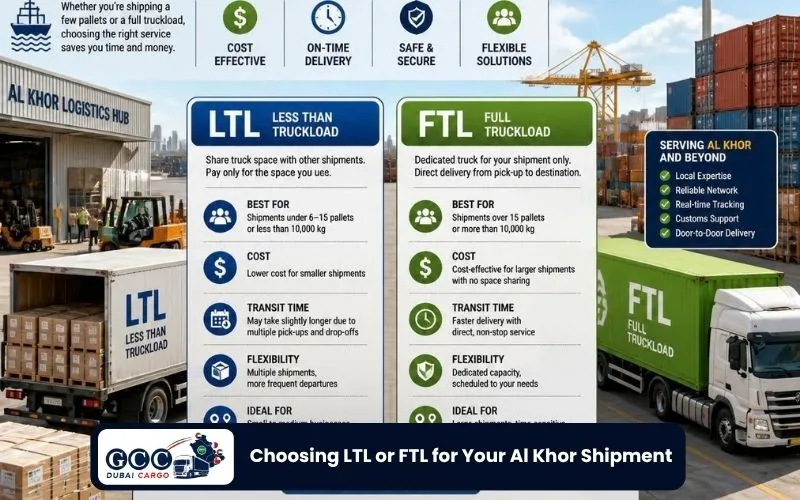
Choosing LTL or FTL for Your Al Khor Shipment
One of the most important decisions is whether the shipment needs a full truck or can move as part of a less-than-truckload arrangement.
When LTL Makes Sense
LTL, or less-than-truckload transportation, can be considered when the shipment does not require the full available truck capacity.
Examples may include:
- Several cartons of business stock
- Smaller furniture shipments
- Personal belongings
- Limited quantities of commercial goods
- Partial consignments
The suitability of LTL depends on the shipment’s dimensions, weight, cargo type and transportation requirements.
When FTL Is More Suitable
FTL, or full truckload transportation, may be appropriate when the shipment is large enough to require dedicated vehicle capacity.
This can be relevant for:
- Large household moves
- Significant commercial inventory
- Heavy equipment
- Large furniture quantities
- Machinery
- Bulky consignments
Rather than selecting FTL based only on weight, consider the overall volume, dimensions and loading requirements.
How Dubai Pickup Works
The origin point in Dubai can affect how easily cargo is collected.
A shipment from a warehouse may have a dedicated loading area, while an apartment may require more coordination.
Apartments, Villas and Offices
Before pickup, check whether:
- Building management approval is needed
- A service elevator must be booked
- Parking is available
- Security access must be arranged
- Furniture can pass through doors and elevators
- Stairs are involved
- Loading is possible close to the building entrance
If building requirements vary, confirm them directly with the relevant building or community management.
Warehouses and Loading Areas
Warehouse and commercial pickups should include information about the loading bay, operating arrangements and access restrictions where applicable.
If a large truck cannot approach the exact loading point, explain the situation before the shipment is scheduled.
Good pickup planning reduces unnecessary handling and helps avoid surprises when the cargo is ready to move.
Prepare Your Cargo Before Collection
A simple cargo inventory can make the entire process easier.
Record:
- Item description
- Quantity
- Approximate weight
- Length, width and height for large pieces
- Whether the item is fragile
- Whether it is personal or commercial
- Any unusual loading requirements
Photographs are particularly useful for unusually large furniture, machinery or awkwardly shaped items.
For multiple cartons, number the packages and maintain a basic list. This makes it easier to compare the physical shipment with the shipment information.
Packing and Loading Considerations
Good preparation begins before the cargo reaches the truck.
For household goods, protect furniture surfaces and secure removable parts where appropriate. Use suitable protection for glass and other breakable items.
For cartons:
- Use strong packaging appropriate to the contents.
- Close cartons securely.
- Avoid leaving loose items inside larger packages.
- Label packages where useful.
- Keep fragile items clearly identified.
- Separate personal and commercial goods in your inventory.
For machinery or heavy equipment, provide accurate dimensions and weight before pickup. Heavy items may require additional loading planning.
Documents and Qatar Customs Preparation
Customs requirements depend on the shipment. They can vary according to the cargo type, whether the shipment is personal or commercial, its origin and value, and applicable regulations.
Qatar’s General Authority of Customs identifies documentation requirements for land imports and commercial imports, including customs declarations, invoices, certificates of origin and, where applicable, packing lists and land transport manifests. The authority also notes that approvals or permits can apply to restricted goods.
Potential shipment information can include:
- Commercial invoice
- Packing list
- Transport documents
- Consignee information
- Certificate of origin where applicable
- Importer information
- Product-specific approvals or permits where applicable
Do not assume that every shipment requires every document.
For example, personal household goods and commercial merchandise can have different requirements. Qatar Customs also distinguishes personal importation from commercial importation and specifies different controls for each category.
The safest approach is to identify the cargo correctly and verify the applicable documentation before dispatch.
What Determines the Cargo Cost?
There is no single price for every shipment from Dubai to Al Khor.
A quotation can depend on:
| Pricing Factor | Why It Matters |
|---|---|
| Cargo Weight | Helps determine transportation requirements |
| Cargo Volume | Shows how much truck capacity is needed |
| Dimensions | Important for oversized or awkward items |
| Cargo Type | Different goods can require different planning |
| LTL or FTL | Changes the transportation arrangement |
| Pickup Location | Access can affect collection requirements |
| Delivery Location | Residential, commercial and site access can differ |
| Packing | Additional preparation may affect the quotation |
| Loading Requirements | Heavy or unusual cargo may require extra planning |
| Customs Requirements | Shipment documentation and applicable procedures can vary |
When requesting a quotation, provide as much information as possible rather than only saying, “I have cargo to Al Khor.”
A useful quotation request should include the pickup area in Dubai, destination address or area in Al Khor, cargo type, number of cartons or pieces, approximate weight, dimensions of large items and whether the cargo is personal or commercial.
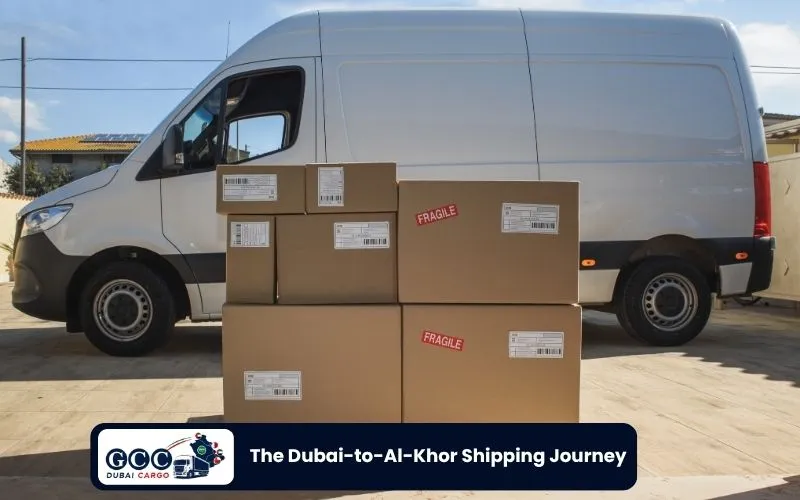
The Dubai-to-Al-Khor Shipping Journey
A typical shipment can be understood in several stages.
1. Identify the Cargo
Start with an inventory and determine whether the shipment is household, personal, commercial, heavy, bulky or fragile.
2. Collect Shipment Details
Record quantities, dimensions, approximate weight and photographs where useful.
3. Review Pickup Access
Check the Dubai property, warehouse, office or loading point.
4. Prepare and Pack
Protect the cargo according to its characteristics and secure cartons or larger items.
5. Arrange Loading
The loading plan should take account of the cargo’s size, weight and access requirements.
6. Prepare Documentation
Make sure shipment descriptions and quantities are consistent with the relevant documents.
7. Road Transportation
The cargo then moves by the planned road-freight arrangement toward Qatar.
8. Customs Procedures
Applicable customs procedures and documentation are handled according to the shipment and relevant requirements.
9. Continue Toward Al Khor
Once applicable border procedures are completed, transportation continues toward the final Qatar destination.
10. Final Delivery
The receiving location should be ready for unloading, particularly when the shipment contains large furniture, heavy cargo or multiple commercial packages.
Common Problems and Practical Solutions
Problem: Large furniture dimensions were not provided
Solution: Measure large items before requesting transportation. Include length, width and height for pieces that may create loading or access problems.
Problem: The Dubai building has restricted loading access
Solution: Confirm parking, security access, elevator arrangements and loading requirements with building management before pickup.
Problem: Cargo information does not match the physical shipment
Solution: Check quantities, descriptions and package numbers before loading.
Problem: A sofa or cabinet cannot fit through the destination entrance
Solution: Check doors, stairways, elevators and access routes at the Al Khor property before dispatch.
Problem: Commercial goods are mixed with personal belongings
Solution: Separate the inventory and identify the nature of the shipment clearly before documentation is prepared.
Problem: A heavy item cannot be moved easily from the unloading point
Solution: Tell the cargo provider about the item’s weight and dimensions in advance and provide destination access information.
Example Shipping Situations
Consider a family moving from Dubai to Al Khor with beds, sofas, appliances and several cartons. The most useful preparation would be a detailed household inventory, dimensions for large furniture and information about both properties’ access.
A retail business may instead need to send cartons of stock to a commercial location in Al Khor. In that situation, the shipment description, quantities, packaging, commercial documentation and receiving arrangements become particularly important.
Another example is a company moving office equipment. Desks, chairs, computers, cabinets and other equipment may need to be inventoried separately so the shipment can be planned accurately.
A contractor or business moving equipment should provide exact dimensions and approximate weight for heavy or oversized pieces before requesting transportation.
These are examples of planning situations, not customer testimonials or claims about previous GCC Dubai Cargo shipments.
Al Khor Delivery Planning
The final delivery point should be treated as part of the shipment plan rather than an afterthought.
Al Khor is a northern Qatar city with residential communities and connections to surrounding northern areas. Official Qatari sources also identify nearby Ras Laffan as a major industrial location.
For a residential delivery, provide the complete address and information about parking, entrances, elevators and large-item access.
For a business delivery, provide the company or receiving party’s details, warehouse or office location, loading instructions and any access information.
If the shipment is destined for a worksite or industrial-related location, confirm the exact receiving point rather than relying on a general city name.
Information to Include When Requesting a Quote
For a more useful cargo quotation, prepare the following information:
Origin: Dubai, including the pickup area.
Destination: Al Khor, Qatar, with the delivery address or area where available.
Cargo type: Household, personal, commercial, machinery, furniture, electronics or another description.
Quantity: Number of cartons, pallets, furniture pieces or other packages.
Dimensions: Length, width and height of large or unusual items.
Weight: Approximate gross weight where available.
Volume: Total CBM if already calculated.
Cargo status: Packed, partially packed or requiring packing arrangements.
Access information: Apartment, villa, office, warehouse, loading bay or other location.
Shipment nature: Personal or commercial.
The more complete the information, the easier it is to evaluate whether LTL, FTL or another transportation arrangement is appropriate.
FAQs About Cargo from Dubai to Al Khor
Yes, household furniture can be considered for transportation depending on the shipment details and applicable requirements. Sofas, beds, tables, cabinets, mattresses and appliances should be measured where necessary, especially when large items may create loading or delivery-access issues.
The choice depends on the shipment's volume, dimensions, weight and transportation requirements. LTL may suit smaller consignments that do not need a complete truckload, while FTL can be considered for larger shipments requiring dedicated capacity.
Provide the Dubai pickup location, Al Khor destination, cargo type, number of packages, approximate weight, dimensions of large items and whether the shipment is personal or commercial. Photos can also help explain unusual or oversized cargo.
Documentation depends on the cargo and applicable customs requirements. Commercial shipments can involve documents such as an invoice, packing list, certificate of origin and transport or customs documents where applicable. Qatar Customs' requirements should be checked for the specific shipment.
Confirm the complete delivery address, vehicle access, unloading area, parking or loading arrangements, building entry requirements and whether large items can pass through doors, elevators or other access points. Providing this information before transportation helps the delivery plan match the actual destination.
Planning Your Dubai-to-Al-Khor Cargo Shipment
A successful shipment starts with accurate information.
Before requesting your quotation, prepare your cargo list, measure large items, estimate the weight and volume, photograph unusual cargo, identify whether the shipment is personal or commercial, and confirm access at both ends.
For smaller shipments, LTL may be worth considering. Larger consignments may require FTL or another dedicated arrangement. Household furniture, commercial stock, fragile goods and heavy equipment can all require different preparation.
The key is to describe the shipment accurately before transportation is arranged.
For customers comparing destinations within the GCC, you can also explore cargo from Dubai to Qatar as the broader country-level service, while this page focuses specifically on Al Khor.
If your destination is elsewhere in the GCC, related route information is available for cargo from Dubai to Saudi Arabia, cargo from Dubai to Bahrain, cargo from Dubai to Oman and cargo from Dubai to Kuwait.
For the Al Khor shipment itself, start with the practical details: what you are sending, how much space it occupies, where it is being collected in Dubai, and exactly where it needs to be delivered in Al Khor.
Made Easy
GCC Cargo Destinations
Fast, secure, and reliable cargo delivery from Dubai to GCC countries.
Let's help you!
Need reliable cargo delivery from Dubai to GCC? Get in touch with our team today.
WhatsApp Now
+971 55 735 4528
© 2026 GCC Dubai Cargo. All Rights Reserved.