
Prohibited Items Kuwait Cargo: What Not to Ship from Dubai
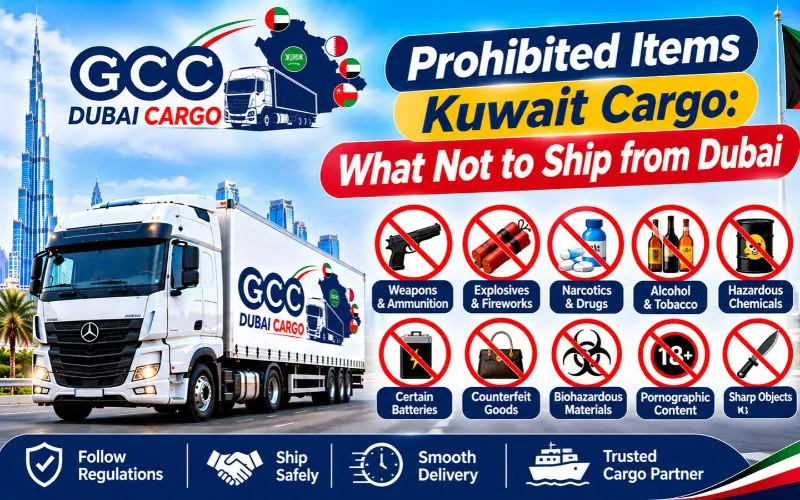
Shipping cargo from Dubai to Kuwait requires more than arranging transportation and packing your belongings. Before sending furniture, electronics, commercial stock or personal effects, you should check whether every product is acceptable for export from the UAE, transportation and import into Kuwait.
Some products are prohibited completely, while others may require official approval, supporting documents or special transportation arrangements. Certain everyday products, including perfumes, batteries, medicines and cleaning supplies, can also create problems if their contents are not identified correctly.
For customers arranging cargo from Dubai to Kuwait, checking these restrictions before collection can help prevent avoidable shipment rejection, inspection issues and additional costs.
At GCC Dubai Cargo, the practical approach is to identify the goods first, review any uncertain products, prepare an accurate cargo inventory and confirm acceptance before arranging transportation. This is particularly important for mixed shipments containing household belongings and commercial products.
This guide explains what not to ship, which goods need additional checks and how to prepare your cargo before it leaves Dubai.
Before Sending Cargo from Dubai to Kuwait, Check These Restrictions
Not every item that can be purchased or used in the UAE can automatically be exported and imported into Kuwait.
There are several separate requirements to consider:
UAE export rules determine whether goods can legally leave the country.
Kuwait import regulations determine whether products can enter the destination country.
Transportation safety rules determine whether a carrier can safely handle the goods.
Individual cargo companies may have additional acceptance restrictions.
For example, a product might be legal to import into Kuwait but unacceptable under a particular courier company’s transportation policy.
Similarly, an item accepted by a transport company does not automatically receive customs approval.
Before arranging pickup from a Dubai apartment, villa, office or warehouse, identify all products that might fall into these categories.
Prohibited, Restricted and Dangerous Goods: What Is the Difference?
Understanding these classifications is the first step in preparing a shipment.
| Category | Meaning | What Customers Should Do |
|---|---|---|
| Prohibited imports | Goods that cannot legally enter Kuwait | Exclude them from the shipment |
| Restricted imports | Products subject to additional conditions or approvals | Verify requirements before dispatch |
| Dangerous goods | Products presenting transportation safety risks | Check classification and handling requirements |
| Carrier-restricted goods | Products a transport provider does not accept | Confirm the selected service's acceptance policy |
These categories should not be treated as interchangeable.
For example, a lithium battery may require transportation safety checks without being universally prohibited from import. A medicine may require product-specific approval rather than being automatically prohibited in every circumstance.
The same principle applies to household cleaning products, cosmetics and electronic equipment.
Items Prohibited from Importing into Kuwait
Kuwait has import restrictions covering specific products and materials. Customers should pay particular attention to goods that are clearly prohibited rather than assuming that ordinary packaging or a personal-use description makes them acceptable.
The following categories are important to check before arranging cargo.
Narcotics and Controlled Substances
Narcotics and illegal controlled substances are among the most serious prohibited categories.
Do not include:
Illegal recreational drugs.
Narcotic substances prohibited under applicable laws.
Controlled substances without the legally required authorisation.
Products containing prohibited drug derivatives.
Do not assume that a product is acceptable because it is marketed as herbal, natural or a wellness supplement.
Ingredients and composition matter. Products containing controlled substances may require a different legal assessment from ordinary consumer goods.
Never conceal these products inside clothing, furniture, food packaging or other household cartons.
Alcohol and Pork Products
Alcoholic beverages and pork products are identified as prohibited imports in Kuwait.
Examples include:
Beer, wine and spirits.
Other alcoholic beverages.
Fresh or frozen pork meat.
Processed pork products.
Food products containing prohibited pork ingredients.
Customers sending grocery products, packaged foods or mixed household cartons should check product ingredients rather than relying only on the front packaging.
The official Kuwait Customs prohibited-import tariff provides further product-level information, including pork-related tariff entries. Its published page is marked as a trial version, so the applicable current classification should be confirmed with Kuwait Customs.
Gambling Equipment and Prohibited Publications
Gambling machines and certain gambling-related materials are also identified in Kuwait’s import restrictions.
Pornographic material is another prohibited category.
Customers should not assume that these items become acceptable because they are included among personal belongings rather than commercial cargo.
When preparing mixed cartons, check books, printed materials, media and unusual electronic devices before packing.
Other Goods Listed by Kuwait Customs
Kuwait Customs publishes a prohibited-import listing under the GCC unified customs tariff.
The listing contains product descriptions and corresponding customs classification information. This is important because two products with similar commercial names may have different classifications.
For unusual products, use the actual product description, material, composition and intended purpose when checking the applicable rules.
Official reference: Kuwait General Administration of Customs – Prohibited Imports.
Do not treat a short online list as a complete substitute for checking the official requirements.
Restricted Items That May Require Special Approval
Some products cannot be assessed simply by looking at their names.
Their acceptance may depend on the manufacturer, ingredients, technical specifications, quantity, intended use and applicable approvals.
Medicines and Pharmaceutical Products
Medicines require particular attention when shipping personal belongings or commercial cargo.
Different considerations may apply to:
Prescription medicines.
Non-prescription medicines.
Vitamins and supplements.
Pharmaceutical products.
Veterinary medicines.
Medical preparations.
Before including medicine in a Kuwait shipment, establish its exact name, active ingredients, quantity and intended use.
Keep the original packaging and product information available. Where applicable, have the relevant prescription, medical documentation or approval details ready for review.
Do not assume that medicine purchased legally in Dubai is automatically acceptable for import into Kuwait.
Commercial pharmaceutical shipments may also involve requirements different from personal-use quantities.
Emirates Post, for example, lists pharmaceuticals among its prohibited items and medicines among restricted items. This illustrates why the rules of an individual transport provider must be checked separately from destination-country import rules.
Food, Plants and Agricultural Products
Food and agricultural goods can involve additional import controls.
Products to check include:
Packaged food.
Fresh food.
Seeds.
Plants.
Agricultural products.
Animal-origin products.
Food supplements.
Their acceptance may depend on ingredients, origin, product condition and applicable health or agricultural requirements.
Pay particular attention to products containing animal-derived ingredients.
For commercial shipments, product labels, invoices, quantities and supporting certificates may be relevant.
Do not pack unidentified food products into general household cartons without first confirming whether they can be transported and imported.
Wireless Devices and Specialised Equipment
Some electronic and communication products may need additional technical or regulatory verification.
Examples include:
Wireless communication equipment.
Radio transmission devices.
Certain specialised electronic equipment.
Devices with unusual technical specifications.
Do not assume every electronic device is restricted. Ordinary household electronics and specialised communication equipment should be assessed according to their actual specifications and intended use.
For commercial quantities, provide the model numbers and product descriptions before requesting transportation.
Dangerous Goods That Need Transportation Checks
Dangerous goods are an important consideration when arranging cargo from Dubai to Kuwait.
A product may be legal to own but still require special handling or may not be accepted by a particular transportation service.
The applicable safety requirements also depend on the transport mode.
Perfumes, Aerosols and Flammable Liquids
Some everyday products contain alcohol, flammable ingredients or pressurised contents.
Examples include:
Perfumes.
Body sprays.
Deodorant aerosols.
Spray paints.
Certain cleaning products.
Paint thinners.
Flammable solvents.
Pressurised containers.
These products should not automatically be placed in ordinary cartons with clothing, furniture or other household goods.
Their composition, packaging and transport classification should be checked first.
For example, an aerosol container and a non-pressurised cosmetic cream may have different transportation requirements even when both are personal-care products.
Lithium Batteries and Power Banks
Lithium batteries require particular attention because damaged, incorrectly packed or unsuitable batteries can create transportation safety risks.
Common products include:
Power banks.
Rechargeable batteries.
Spare lithium battery packs.
Battery-operated equipment.
Laptops and electronic devices.
Rechargeable household appliances.
Important questions include:
Is the battery installed inside the device?
Is it being shipped separately?
Is it damaged or swollen?
What type of battery is it?
What is its capacity?
How many units are included?
A battery installed in equipment and a loose spare battery should not automatically be treated as the same shipment category.
Provide the product model and battery specifications when requesting an assessment.
Chemicals, Paints and Compressed Gases
Some industrial and household products contain hazardous ingredients or are stored under pressure.
Examples may include:
Industrial chemicals.
Paints and solvents.
Fuel-related products.
Gas cylinders.
Certain adhesives.
Corrosive cleaning substances.
Toxic chemical preparations.
Their transportation classification may require technical documentation, including a Safety Data Sheet (SDS).
For commercial shipments, the chemical name, concentration, packaging and quantity can be important.
Never hide chemical products under general descriptions such as household supplies or miscellaneous materials.
Household Items to Check Before Packing
Customers moving household belongings from Dubai to Kuwait often have mixed cartons containing furniture, electronics, kitchen goods, cleaning supplies and personal effects.
The main challenge is identifying products that should not be included with ordinary belongings.
Furniture and Personal Belongings
Common household cargo includes:
Beds and mattresses.
Sofas and chairs.
Dining tables.
Wardrobes.
Cabinets.
Household boxes.
Clothing.
Personal accessories.
These ordinary items should still be accurately listed and checked for unusual contents.
For example, a furniture shipment may contain cleaning sprays, spare batteries, tools, liquids or other products requiring separate assessment.
Check drawers, cupboards and storage compartments before wrapping or loading furniture.
Kitchen Products and Cleaning Supplies
Kitchen cartons may contain products that are not immediately obvious during a packing review.
Check:
Cooking ingredients.
Packaged food.
Cleaning liquids.
Disinfectants.
Aerosol cleaners.
Gas-related accessories.
Chemical preparations.
Do not mix leaking or unidentified liquids with clothing, furniture or electrical equipment.
Separate uncertain products until their acceptance has been confirmed.
Electronics and Electrical Appliances
Household electronics and appliances may generally be different from restricted electronic components or dangerous-goods shipments.
Examples include:
Televisions.
Refrigerators.
Washing machines.
Computers.
Laptops.
Kitchen appliances.
Audio equipment.
Check whether appliances contain installed batteries, rechargeable components, liquids or other materials that could affect transport acceptance.
Protect screens and delicate surfaces with suitable packing materials.
Record large-item dimensions and identify any unusual components before requesting a cargo quotation.
Commercial Products That Need Careful Verification
Businesses shipping inventory from Dubai to Kuwait should review product eligibility before preparing pallets or cartons.
Commercial cargo can contain many different products, so a general description such as retail goods or business supplies may not be sufficient.
Pay attention to:
Cosmetics and personal-care products.
Medicines and health products.
Food and packaged consumables.
Chemical products.
Electronic equipment.
Wireless devices.
Batteries and electrical components.
Industrial materials.
A commercial invoice should accurately describe the products, quantities and applicable values.
A packing list should identify the packages and their contents in a way that can be reconciled with the actual shipment.
For mixed commercial cargo, separate products that require additional verification rather than allowing one uncertain product to complicate the entire consignment.
Can You Ship Used Items to Kuwait?
Used household belongings are common in international relocation shipments.
Examples include used furniture, clothing, kitchen equipment, appliances and personal possessions.
However, used status does not automatically establish that an item is permitted for import.
Before arranging transportation, prepare an inventory showing:
Description of each item.
Whether it is new or used.
Quantity.
Approximate weight.
Dimensions of large items.
Photographs where useful.
Ownership or intended use where relevant.
Check electrical appliances for damaged batteries or unusual components.
Also inspect furniture drawers, storage boxes and containers for restricted products.
If the shipment includes both used personal belongings and new commercial purchases, identify them separately in the inventory and supporting documentation.
Air Cargo and Road Cargo Have Different Safety Requirements
Customers sometimes assume that an item refused by an airline can automatically be moved by road.
That is not necessarily correct.
Air, road and sea transportation have different dangerous-goods requirements and handling procedures.
For example:
| Product | What needs checking |
|---|---|
| Perfume | Alcohol content, packaging and carrier acceptance |
| Aerosol | Pressurised contents and flammability |
| Power bank | Battery type, capacity and packaging |
| Paint | Chemical composition and hazard classification |
| Gas cylinder | Contents, pressure and transportation restrictions |
| Industrial chemicals | SDS, classification and applicable approvals |
For road transportation, dangerous-goods classification and applicable road transport requirements must be assessed.
International frameworks include IATA requirements for air transport, ADR for applicable road transport and IMDG requirements for sea transport. The relevant framework depends on the actual transport arrangement.
A useful reference is the TTL guide to dangerous goods shipping from Dubai to Kuwait, which discusses dangerous-goods classification and documentation.
Do not use air-freight restrictions as a complete list of Kuwait import prohibitions, or assume road transport removes the need for product approval.
Documents to Prepare for Restricted Cargo
Documentation depends on the product, shipment type and applicable Kuwait import requirements.
Not every shipment requires every document. However, customers should be prepared to provide relevant information when a product needs additional verification.
| Document or information | Purpose |
|---|---|
| Commercial invoice | Identifies goods, quantities and declared values |
| Packing list | Describes packages and their contents |
| Product specifications | Helps identify the actual product |
| Safety Data Sheet (SDS) | Provides information about chemical products |
| Certificate of origin | Establishes origin where applicable |
| Product permits | Supports products requiring official approval |
| Importer information | Identifies the receiving party |
| Transport documents | Records the transportation arrangement |
For commercial products, descriptions should be consistent across the invoice, packing list and actual cargo.
For example, if an invoice describes 20 electronic devices, the packing list and physical shipment should reflect the same products and quantities.
For chemicals, medicines and specialised equipment, additional technical information may be necessary.
How to Check an Item Before Dubai Pickup
Checking products before collection is much easier than discovering an issue after the shipment has been loaded.
Use the following process.
Step 1: Identify the exact product
Write down the commercial name, manufacturer, model and ingredients or composition where relevant.
Step 2: Establish its intended use
Explain whether the item is for personal use, household use, resale, commercial operations or industrial purposes.
Step 3: Check Kuwait import eligibility
Review the applicable Kuwait Customs requirements and confirm whether the product is prohibited, restricted or subject to additional conditions.
Step 4: Check UAE export requirements
Confirm whether the product can legally leave the UAE and whether any export approval applies.
Step 5: Confirm transportation acceptance
Ask whether the selected road cargo service accepts the product and whether special handling or documentation is required.
Step 6: Prepare supporting information
Keep photographs, product labels, technical specifications, quantities and relevant documents available.
Step 7: Finalise the cargo inventory
Remove prohibited or unapproved products and update the packing list before loading.
This process is particularly useful when shipping mixed household and commercial cargo.
Common Mistakes That Can Delay Kuwait Cargo
Many shipment problems begin with incorrect information or poor preparation.
The following mistakes are worth avoiding.
| Common mistake | Practical solution |
|---|---|
| Hiding restricted products inside cartons | Identify and declare the actual contents |
| Using vague descriptions such as miscellaneous goods | Provide accurate product names |
| Packing perfumes with ordinary household items | Check their transportation classification first |
| Including unidentified medicines | Verify the product and applicable requirements |
| Sending batteries without specifications | Provide battery type and capacity |
| Mixing food and prohibited ingredients | Check labels and product composition |
| Incorrect quantities on documents | Reconcile the inventory and packing list |
| Assuming used products are automatically permitted | Verify import eligibility |
| Ignoring product permits | Confirm approvals before dispatch |
| Changing cargo after documentation | Update the shipment records |
One common problem occurs when customers prepare cartons themselves and forget what has been placed inside them.
A carton labelled household items may contain batteries, cleaning products, aerosols or medicines.
Keep an itemised inventory and check the contents before sealing the packages.
What Happens When a Shipment Contains a Prohibited Item?
The consequences depend on the product, applicable law, transportation company and circumstances of the shipment.
Possible outcomes include:
Refusal to accept the goods for transportation.
Removal of the affected product from the shipment.
Additional documentation requests.
Customs inspection.
Shipment detention.
Return or other handling arrangements.
Applicable penalties or legal action in serious cases.
A restricted product without the required approval may also prevent the relevant shipment from progressing.
For example, a mixed shipment of furniture and personal belongings might contain one product that requires additional verification.
The customer should not assume that the remaining goods will automatically be cleared or that the uncertain product can simply be ignored.
If an issue is identified before dispatch, separate the affected item and review its status.
If the shipment has already been dispatched, provide accurate information to the transport provider and follow the applicable customs procedure.
Never attempt to solve a documentation problem by changing the product description or concealing its contents.
Preparing Household and Commercial Cargo for Kuwait
Once you have checked the products, prepare the remaining goods carefully.
For household shipments:
Create an inventory of furniture and cartons.
Check wardrobes, drawers and cabinets.
Separate cleaning products and liquids.
Inspect appliances and battery-operated equipment.
Protect fragile items.
Measure large furniture.
Label cartons according to their contents.
For commercial shipments:
Prepare an accurate product list.
Separate different product categories.
Record quantities and package dimensions.
Check ingredients and technical specifications.
Keep invoices and supporting documents ready.
Identify products requiring additional approvals.
Customers arranging cargo services in Dubai should also consider pickup access.
For example, an apartment building may require advance approval for a service elevator, while a warehouse may have designated loading bays and vehicle access arrangements.
Confirm these details with the relevant building or property management before collection.
At the Kuwait destination, provide the correct delivery address, receiver contact details and any residential or warehouse access instructions.
What Information Should You Provide for a Cargo Quotation?
Before requesting a quotation from GCC Dubai Cargo, prepare the following details:
| Information | Details to provide |
|---|---|
| Pickup location | Dubai apartment, villa, office or warehouse |
| Destination | Kuwait city and delivery address |
| Cargo type | Household, personal or commercial |
| Item description | Actual products being shipped |
| Quantity | Number of pieces and cartons |
| Weight | Approximate total shipment weight |
| Dimensions | Measurements of large or bulky items |
| Special products | Batteries, liquids, chemicals or other uncertain goods |
| Documentation | Available invoices, permits and product information |
| Delivery access | Receiver details and unloading requirements |
Providing accurate information helps determine whether the shipment is suitable for the requested transportation arrangement.
How GCC Dubai Cargo Can Help with Your Kuwait Shipping Enquiry
Preparing international cargo requires coordination between the sender, transportation provider and receiving party.
GCC Dubai Cargo provides a Dubai-based cargo service for customers arranging shipments to GCC destinations.
For Kuwait enquiries, customers should share their cargo details before arranging collection, especially when the shipment contains products that may require additional verification.
The assessment should consider:
Household and personal belongings.
Commercial stock and business supplies.
Furniture and appliances.
Heavy or bulky cargo.
Fragile products.
Package quantities and dimensions.
Product descriptions and available documentation.
Pickup and destination access.
Depending on the shipment, road transportation may involve full truckload (FTL) or less than truckload (LTL) arrangements.
The suitability of either option depends on cargo volume, weight, dimensions, product acceptance and transportation requirements.
A dedicated truck does not make a prohibited product acceptable, and shared-load transportation does not remove customs obligations.
Customers should confirm product acceptance before finalising the transportation arrangement.
For additional information about the Kuwait route, visit our cargo from Dubai to Kuwait service page.
Planning cargo from Dubai to Kuwait?
Contact GCC Dubai Cargo through WhatsApp at +971 54 143 5685 or email info@gccdubaicargo.com.
Share your cargo inventory, photographs, approximate weight, dimensions and destination details. If any product has uncertain import or transportation status, identify it before pickup so it can be reviewed separately.
Frequently Asked Questions | Prohibited Items Kuwait Cargo
Kuwait prohibits certain imports, including narcotics, alcoholic beverages, pork products, gambling machines and pornographic material. Other products may be restricted or subject to additional conditions. Always check the current Kuwait Customs requirements for the specific product before dispatch.
These products should be assessed separately. Medicines may require product-specific documentation or approval. Perfumes can involve flammable liquid transportation requirements, while cosmetics may have applicable product and import conditions. Confirm both customs eligibility and carrier acceptance before packing.
Acceptance depends on the product, battery type, condition, capacity and transportation requirements. Power banks and loose lithium batteries need particular attention. Provide battery specifications and equipment details before arranging collection.
Ordinary furniture, clothing, appliances and personal belongings may be considered for transportation, subject to applicable import requirements and carrier acceptance. Used status does not automatically exempt goods from customs rules. Prepare an accurate inventory and check unusual items separately.
The shipment or affected goods may be rejected, detained, inspected or subject to other customs action. Additional documentation or approval may be required for restricted products. The outcome depends on the item and applicable regulations. Always check uncertain products before loading.
Made Easy
GCC Cargo Destinations
Fast, secure, and reliable cargo delivery from Dubai to GCC countries.
Let's help you!
Need reliable cargo delivery from Dubai to GCC? Get in touch with our team today.
WhatsApp Now
+971 54 143 5685
Quick Links
© 2026 GCC Dubai Cargo. All Rights Reserved.
