
Cargo Documents for Kuwait: Required Papers from Dubai
Sending cargo from Dubai to Kuwait involves more than arranging a truck and preparing your goods for collection. The shipment must also have appropriate documentation for UAE export procedures, transportation and customs clearance in Kuwait.
Preparing the correct paperwork before dispatch can help reduce avoidable questions, document discrepancies and border delays.
The documents you need depend on what you are shipping, whether the goods are personal or commercial, their country of origin and any regulations applying to the products.
A business exporting retail stock may need a commercial invoice, detailed packing list, certificate of origin and relevant transport documents. Someone moving household furniture or personal belongings may follow a different documentation process.
For customers arranging road cargo from Dubai to Kuwait, GCC Dubai Cargo recommends collecting shipment information early and checking that the paperwork accurately describes the physical cargo. This guide explains the main documents, their purposes and the practical steps to prepare before your shipment leaves Dubai.
What Paperwork Should You Prepare Before Sending Cargo to Kuwait?
Start by identifying the type of shipment and the person or business receiving it in Kuwait.
There is no single document package that applies identically to every shipment. Commercial goods, used household belongings, machinery and regulated products can have different requirements.
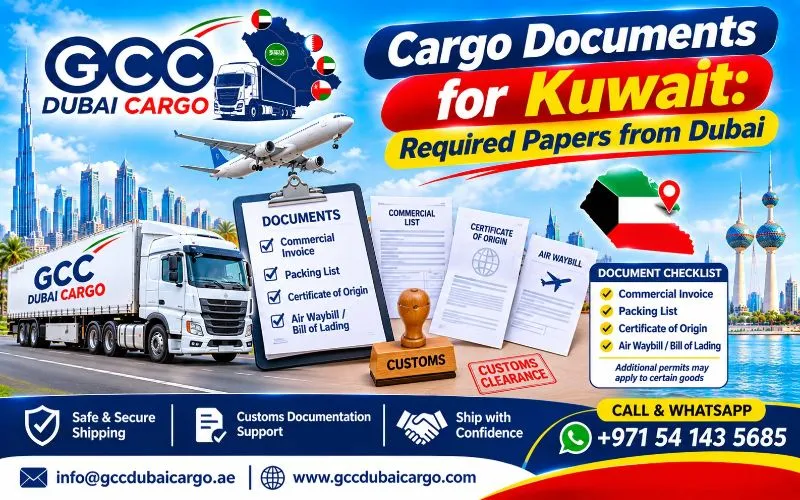
For a typical commercial shipment, the documentation checklist may include:
Commercial invoice.
Detailed packing list.
Certificate of origin, where applicable.
Road consignment note or other appropriate transport document.
UAE export customs declaration.
Kuwait import customs declaration and supporting paperwork.
Applicable transit documents for the road journey.
Product-specific licences, permits or conformity certificates, where required.
Importer or consignee information.
The Kuwait import requirements published by the International Trade Administration identify the commercial invoice, certificate of origin, packing list and transport document among the principal documents used for commercial imports.
Import Requirements and Documentation
However, customers should not assume that every item on this list is mandatory for every personal or commercial shipment.
The correct checklist should be established according to the cargo description, transport method, product classification and current customs requirements.
Essential Documents for Commercial Cargo from Dubai to Kuwait
Businesses exporting products, supplies, machinery, spare parts or retail inventory should pay particular attention to the consistency of their commercial documents.
Each document serves a different purpose. Together, they help customs authorities and the parties involved understand what is being transported, its value, its origin and the number of packages.
1. Commercial Invoice: Describing the Goods and Their Value
A commercial invoice provides the financial and product information associated with a commercial shipment.
It is an important reference for customs valuation and import procedures in Kuwait.
A properly prepared invoice should generally identify:
Exporter’s business name and address.
Importer’s or buyer’s name and address.
Invoice number and date.
Detailed description of each product.
Quantity and unit of measurement.
Unit price and total value.
Currency.
Country of origin.
Applicable HS codes.
Relevant shipment and delivery information.
For example, an invoice describing a shipment as simply “spare parts” may not provide enough information to identify the actual products.
A clearer description could distinguish between automotive filters, mechanical components and electrical replacement parts.
The product description should reflect the goods physically included in the shipment.
For Dubai exporters, it is also important to check that the seller, buyer, values and quantities are consistent with the supporting paperwork.
If an invoice is amended after cargo has been packed, review the associated packing list and customs information as well.
2. Packing List: Recording Every Package
A packing list explains how the cargo is arranged and what each package contains.
It is especially important for road freight involving multiple cartons, pallets, furniture pieces, machinery or mixed commercial goods.
A detailed packing list may include:
| Information | What to record |
|---|---|
| Package number | Unique carton, pallet or crate identification |
| Cargo description | Contents of each package |
| Quantity | Number of items inside |
| Packaging type | Carton, pallet, crate or other packaging |
| Gross weight | Total package weight including packaging |
| Net weight | Weight of goods excluding packaging |
| Dimensions | Length, width and height |
| Shipping marks | Labels identifying packages |
| Total packages | Overall shipment count |
Imagine a retailer sending 35 cartons of products from Dubai to a warehouse in Kuwait.
If the actual shipment contains 35 cartons but the packing list records only 34, the discrepancy should be corrected before dispatch.
Similarly, a packing list that records general product categories without identifying the contents of individual packages may be insufficient for the relevant clearance procedure.
The packing list should be checked against the actual loaded cargo, not simply copied from an older shipment.
3. Certificate of Origin: Confirming Where Goods Were Manufactured
A certificate of origin identifies the country in which the goods originate according to the applicable origin rules.
This document is different from an invoice showing that the goods were purchased in Dubai.
For example, a Dubai trading company might export electronic accessories manufactured in another country. The fact that the goods were stored or sold in the UAE does not automatically make them UAE-origin products.
A certificate of origin may be required for Kuwait import clearance, depending on the goods and applicable requirements.
It can also be relevant when an importer seeks preferential tariff treatment under an applicable trade arrangement.
Before requesting the document, confirm:
The actual country of manufacture or origin.
Whether the shipment qualifies for the claimed origin status.
Whether certification by the appropriate authority is necessary.
Whether authentication or legalization is required.
Whether the information matches the commercial invoice.
Do not assume that every shipment qualifies for preferential GCC customs treatment simply because it is dispatched from a GCC country.
The applicable rules of origin must be satisfied.
4. Road Consignment Note and Transport Documents
A transport document records the movement of cargo and identifies the parties involved in transportation.
For road freight from Dubai to Kuwait, the relevant document may be a road consignment note or road waybill.
It generally identifies:
Shipper.
Consignee.
Transport company or carrier.
Cargo description.
Number of packages.
Shipment weight.
Collection and delivery locations.
Relevant transport references.
A road consignment note should not be confused with documents used for other transportation methods.
| Transport method | Relevant transport document |
|---|---|
| Road freight | Road consignment note or road waybill |
| Sea freight | Bill of lading |
| Air freight | Airway bill |
The document should reflect the actual transportation arrangement.
For a shipment travelling from Dubai to Kuwait by truck, a sea bill of lading is not a substitute for the applicable road transport paperwork.
5. Customs Declaration and UAE Export Documentation
Before cargo leaves Dubai, the applicable UAE export customs procedures must be addressed.
A customs declaration records shipment information for the relevant customs process.
Depending on the shipment, the declaration may be supported by:
Commercial invoice.
Packing list.
Certificate of origin, if applicable.
Transport information.
Exporter and consignee details.
Product-specific approvals.
Other supporting documents requested by customs.
Dubai Customs provides customs declaration services through its applicable customs systems.
The exporter or authorized customs representative should confirm which declaration type and supporting documents apply to the particular shipment.
It is important to distinguish UAE export clearance from Kuwait import clearance. Completing the export procedure in Dubai does not automatically mean that the shipment has completed its import formalities in Kuwait.
Documents for Household Goods and Personal Belongings
Shippingpersonal belongings from Dubai to Kuwait is different from exporting products for commercial sale.
A family relocating to Kuwait may send sofas, beds, wardrobes, appliances, kitchen items, clothing and household cartons.
In this situation, the customer should prepare an accurate inventory of the belongings.
A useful household cargo inventory can contain:
Owner’s full name.
Contact information.
Collection address in Dubai.
Delivery address in Kuwait.
Description of household items.
Number of cartons.
Furniture quantities.
Appliance descriptions.
Approximate weights and dimensions.
Identification of new and used items.
Depending on the shipment and applicable procedures, additional information may be requested, such as:
Passport or identification copy.
Kuwait residence or visa information.
Proof of ownership or supporting purchase documents.
Authorization for customs representation.
Additional declarations for specific goods.
These are possible supporting requirements, not a universal checklist for every household shipment.
Preparing a household inventory
Avoid vague descriptions such as "home items" or "miscellaneous belongings."
Instead, use descriptions such as:
| General description | More useful description |
|---|---|
| Furniture | One wooden dining table |
| Bedroom items | One bed frame and mattress |
| Electronics | One television |
| Kitchen goods | Two cartons of kitchen utensils |
| Household boxes | Three cartons of clothing |
This makes it easier to compare the inventory with the actual cargo.
Customers shipping personal effects should also confirm whether new or unused items are subject to different import requirements from previously used household belongings.
Additional Approvals for Regulated Goods
Some products require more than standard commercial paperwork.
Kuwait maintains import licensing and product-specific regulatory requirements for certain categories. The relevant authority and supporting documentation depend on the goods being imported.
Import Requirements and Documentation
Examples may include:
Food products.
Pharmaceuticals and medical supplies.
Chemicals.
Telecommunications equipment.
Certain electronic products.
Industrial machinery.
Products subject to conformity assessment.
Other controlled or restricted goods.
Before booking transportation, the exporter should provide an accurate product description and, where available, its HS code.
The Kuwait importer should confirm whether the goods require:
Import licence.
Regulatory approval.
Product registration.
Certificate of conformity.
Health or safety documentation.
Other product-specific authorization.
Do not wait until the cargo reaches the border to investigate whether a product needs an additional permit.
If the shipment contains several product categories, each category should be reviewed separately rather than treating the entire load as one general cargo item.
Why Saudi Transit Documentation Matters for Kuwait Road Freight
One important consideration when arranging road transportation from Dubai to Kuwait is the route through Saudi Arabia.
Unlike shipments travelling directly to some neighbouring destinations, road cargo heading to Kuwait normally passes through Saudi territory.
This introduces an additional transportation and customs consideration.
The documentation process may involve:
UAE export documentation.
Road transport paperwork.
Applicable Saudi transit arrangements.
Kuwait import documentation.
Final customs release and delivery arrangements.
The exact transit procedure depends on the shipment, its customs status, the route and the applicable arrangements made by the carrier or customs representative.
A transit declaration is not the same as a Saudi import declaration. Goods moving through Saudi Arabia under an authorized transit arrangement are not necessarily being imported for consumption in Saudi Arabia.
The exporter and transport representative should confirm the correct transit procedure before dispatch.
This is particularly important for shipments containing mixed commercial products, regulated goods or cargo requiring special approvals.
For additional information about the intermediate transportation stage, customers can explore cargo from Dubai to Saudi Arabia.
Businesses sending goods to other destinations with Saudi transit considerations may also find information about cargo from Dubai to Bahrain and cargo from Dubai to Qatar useful.
What the Kuwait Importer or Receiver Should Prepare
Documentation is not solely the responsibility of the Dubai exporter.
The receiving party in Kuwait may need to arrange import-related information and supporting documents before the cargo arrives.
For commercial shipments, the importer should confirm:
Correct registered business name.
Valid commercial or trade licence.
Applicable importer registration.
Import eligibility for the product category.
Relevant import permissions.
Correct delivery address.
Customs broker or authorized representative details.
Contact information for receiving the shipment.
Kuwait’s import requirements identify import licensing for certain product categories and explain that local representation can be necessary for customs clearance.
Import Requirements and Documentation
The importer should also confirm whether the invoice, certificate of origin or other commercial documents require specific authentication.
The authentication requirements should be checked for the actual country of origin and shipment category. A procedure applicable to one exporting country should not automatically be applied to UAE-origin paperwork.
For household shipments, the receiver should provide accurate contact and destination information and check whether any personal identification or residence-related documentation is needed.
How to Prepare Accurate Cargo Documents in Dubai
Good documentation starts with accurate information about the physical goods.
Before arranging pickup, GCC Dubai Cargo customers should collect the following information.
Create a complete cargo inventory
Record each item, carton, pallet or crate.
For commercial cargo, list products separately with their quantities and descriptions.
For household shipments, record furniture, appliances and personal belongings individually where practical.
Measure large and bulky items
Furniture dimensions can affect both transportation arrangements and loading requirements.
Measure:
Sofas.
Beds.
Wardrobes.
Cabinets.
Tables.
Machinery.
Industrial equipment.
Record the measurements in consistent units.
Also estimate the weight of each large item where possible.
Photograph unusual cargo
Photographs can help identify items that have unusual shapes, visible damage, large dimensions or special packaging requirements.
They are particularly useful for machinery, oversized furniture and fragile appliances.
Photographs support shipment identification but do not replace required customs paperwork.
Check all document information
Before dispatch, compare:
Invoice quantities against packing list quantities.
Product descriptions against actual cargo.
Weights against physical shipment information.
Country of origin against supporting evidence.
Consignee details across relevant documents.
Package markings against the packing list.
This simple review can identify discrepancies before the truck is loaded.
Dubai Pickup and Loading Details That Affect Documentation
Documentation preparation should also consider the physical pickup location.
Cargo collected from an apartment, villa, office or warehouse in Dubai may require different loading arrangements.
For example, a family sending furniture to Kuwait should check whether large pieces can be removed through the building’s service elevator or staircase.
Before arranging collection, confirm:
Building management approval, where applicable.
Service elevator booking.
Loading bay availability.
Vehicle parking arrangements.
Security access.
Distance between the cargo and loading area.
Furniture dimensions.
Access restrictions for large vehicles.
Where requirements vary by building or community, confirm them with the relevant management.
Customers arranging cargo services in Dubai should provide these details early so that pickup and loading can be considered alongside the shipment inventory.
For commercial shipments, warehouse loading times, pallet arrangements and forklift availability may also affect collection planning.
Common Kuwait Cargo Documentation Mistakes and Their Solutions
Even when the principal documents are available, incorrect information can create problems.
| Common problem | Practical solution |
|---|---|
| Invoice describes products too generally | Use clear product descriptions and applicable classifications |
| Packing list has incorrect carton quantities | Count the actual packages before dispatch |
| Shipment weight differs between documents | Recheck weights and correct the relevant paperwork |
| Origin is shown incorrectly | Verify the manufacturing country and supporting origin evidence |
| Receiver details are incomplete | Obtain accurate importer and consignee information |
| Required product approval is missing | Check the relevant Kuwait regulatory requirements before dispatch |
| Road transport paperwork is incomplete | Confirm the required waybill and carrier details |
| Transit arrangements are unclear | Confirm Saudi transit procedures before the truck departs |
| Household inventory is too vague | Record furniture, appliances and cartons separately |
| Large furniture dimensions are missing | Measure items and confirm loading access |
Why document consistency matters
Consider a commercial shipment containing 60 cartons of retail products.
The commercial invoice lists 60 cartons, but the packing list records 58.
Even if the goods are physically correct, the difference may require clarification.
The same issue can occur when the consignee’s business name differs between documents or when the country of origin is incorrectly recorded.
Checking these details before loading is generally more practical than trying to resolve inconsistencies after the cargo has entered the transportation process.
How Documentation Fits into the Dubai-to-Kuwait Road Journey
A well-prepared shipment follows a coordinated process.
Shipment identification
The customer explains whether the cargo consists of household belongings, commercial stock, furniture, machinery or mixed goods.
Cargo information collection
Package quantities, weights, dimensions, descriptions and destination details are recorded.
Documentation review
The applicable invoices, packing lists, origin documents and supporting paperwork are checked.
Dubai pickup and loading
Collection arrangements are confirmed, cargo is prepared and the shipment is loaded.
UAE export procedures
Applicable export declarations and customs requirements are addressed.
Cross-border road transportation
The shipment moves through the relevant route, including applicable Saudi transit arrangements.
Kuwait import clearance
The destination import procedures and any additional document requirements are handled as applicable.
Final delivery arrangements
The receiving party confirms the delivery address, access arrangements and unloading requirements.
For customers who have already prepared their documents and want to arrange transportation, the dedicated cargo from Dubai to Kuwait service page provides the relevant route information.
What Determines the Cost of Documentation and Cargo Transportation?
There is no single documentation or transportation price that applies to every Dubai-to-Kuwait shipment.
The total cost depends on the cargo and the work required to prepare and move it.
Important factors include:
Cargo weight and total volume.
Number of cartons, pallets or packages.
Overall dimensions.
Commercial or personal nature of the shipment.
Full truckload or less-than-truckload arrangements.
Pickup and delivery locations.
Loading and unloading requirements.
Packing requirements.
Oversized or heavy cargo.
Applicable customs declarations.
Product-specific permits or approvals.
Additional documentation or authentication requirements.
For a more accurate quotation, provide the cargo description, approximate weight, dimensions, package quantity, collection address and delivery address.
Commercial customers should also provide the invoice details and identify whether the goods are regulated or require additional approvals.
This allows the transportation and documentation requirements to be considered together rather than treating the shipment as an unspecified load.
Frequently Asked Questions About Cargo Documents for Kuwait from Dubai
Commercial shipments commonly involve a commercial invoice, detailed packing list, applicable certificate of origin, road transport document and customs declarations. Additional permits, approvals and transit paperwork may be necessary depending on the goods and route. The Kuwait importer should confirm the current destination requirements before dispatch.
Not necessarily. The requirement depends on the product, shipment category and applicable import procedures. Commercial shipments commonly require origin documentation, but requirements can differ for personal belongings and other shipment types. The certificate must accurately identify the goods' actual country of origin.
Customers should prepare an itemized inventory containing furniture descriptions, appliances, cartons, quantities and relevant shipment details. Depending on the customs procedure, identification, residence information, ownership evidence or additional declarations may also be requested. Used and new goods should be identified accurately.
Road cargo travelling from Dubai to Kuwait normally passes through Saudi Arabia. Applicable transit customs arrangements and supporting transport documentation therefore need to be confirmed before dispatch. The exact requirements depend on the shipment and its customs status.
Differences in quantities, product descriptions, weights or package counts may result in customs queries and additional verification. Review both documents against the actual cargo before loading. If an error is identified, arrange the necessary corrections before the shipment proceeds.
Prepare Your Kuwait Cargo Documents Before Pickup
The right documentation helps connect the Dubai pickup, UAE export procedures, Saudi transit arrangements and Kuwait import clearance into one coordinated shipping process.
Whether you are sending household furniture, personal belongings, business inventory, industrial equipment or retail products, start by preparing an accurate cargo inventory and identifying the documents relevant to your shipment.
GCC Dubai Cargo can discuss your cargo transportation requirements and the shipment information needed to assess your Dubai-to-Kuwait movement.
Before requesting a quotation, share:
Cargo type and description.
Number of packages.
Approximate weight and dimensions.
Commercial or personal shipment status.
Pickup location in Dubai.
Delivery location in Kuwait.
Available invoices and supporting documents.
Any known product-specific approval requirements.
For comparison, road transportation to Oman follows different border and customs arrangements. Customers researching that destination can also review cargo from Dubai to Oman.
Made Easy
GCC Cargo Destinations
Fast, secure, and reliable cargo delivery from Dubai to GCC countries.
Let's help you!
Need reliable cargo delivery from Dubai to GCC? Get in touch with our team today.
WhatsApp Now
+971 54 143 5685
Quick Links
© 2026 GCC Dubai Cargo. All Rights Reserved.
