
Food Cargo Dubai to Kuwait: Rules and Shipping Tips
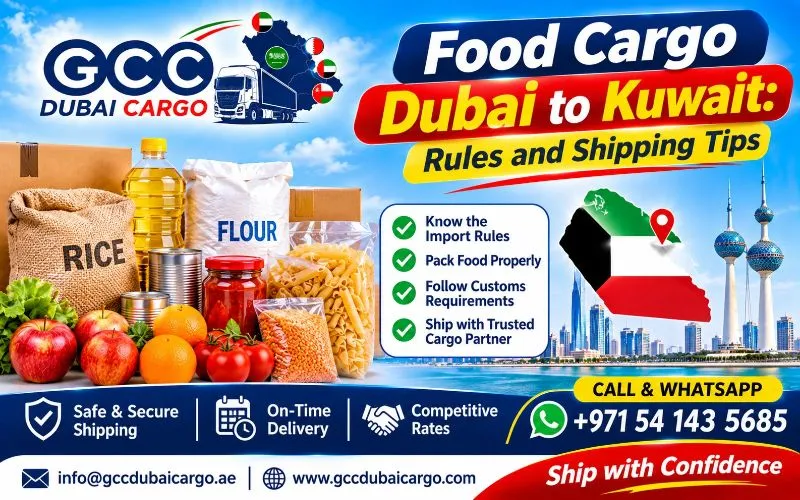
Shipping food cargo from Dubai to Kuwait requires more preparation than ordinary commercial cargo. Before arranging transportation, you need to understand whether the products are acceptable for import, what food-related documents may be required, how the goods should be packed and whether they need temperature-controlled transportation.
A shipment of sealed biscuits, rice, spices or canned products has different requirements from frozen meat, dairy products or fresh produce. The condition of the food, its packaging, expiry information and destination import requirements can all affect the shipping arrangement.
For individuals, retailers, food distributors and commercial suppliers, the first step is to identify the exact products being transported. This helps establish whether the shipment can move through standard road freight arrangements or needs additional checks.
At GCC Dubai Cargo, customers planning food transportation from Dubai can begin by sharing their product details, quantities, shipment dimensions and Kuwait delivery address. These details help establish the appropriate transportation and documentation requirements before pickup is arranged.
This guide explains the important considerations for preparing food cargo from Dubai to Kuwait, avoiding common shipping problems and requesting a suitable cargo quotation.
What to Check Before Sending Food Cargo to Kuwait
Before booking transportation, identify the food products and confirm their import eligibility.
Kuwait has food safety and import controls administered by its Public Authority for Food and Nutrition (PAFN). A product being legally available in Dubai does not automatically mean it can enter Kuwait.
Start by collecting the following information:
Exact product names and descriptions.
Manufacturer and country of origin.
Ingredient information where relevant.
Quantity and package sizes.
Manufacturing and expiry dates.
Batch or lot numbers.
Storage requirements.
Whether the shipment is personal or commercial.
Whether the products contain meat, dairy or other animal-derived ingredients.
For example, a retailer sending 100 cartons of packaged snacks should prepare a product list identifying the different varieties, quantities and expiry dates.
A family sending a small quantity of commercially packaged groceries has a different shipping situation. Personal shipments should not automatically be treated as exempt from food import requirements.
Important: Confirm product acceptance before collection. Do not purchase or pack a large quantity of food specifically for transportation until the applicable Kuwait import conditions have been checked.
Which Food Products Can Be Considered for Dubai–Kuwait Shipping?
Food cargo includes several product categories. Their packaging, shelf life, transportation conditions and import documentation can differ considerably.
Dry and Packaged Food Products
Dry and commercially packaged products may include:
Rice and lentils.
Flour and grains.
Packaged biscuits and snacks.
Tea and coffee.
Spices and seasoning products.
Canned food.
Sealed sauces and condiments.
Packaged sweets.
Other shelf-stable grocery products.
These products generally do not need refrigeration when their storage instructions permit normal ambient conditions.
However, their commercial packaging, labeling, product composition and import eligibility still need to be considered.
For commercial consignments, avoid sending mixed cartons with vague descriptions such as general groceries. Provide a proper inventory that identifies the products and quantities.
Frozen and Chilled Food
Frozen and chilled products require considerably more transportation planning.
Examples include:
Frozen vegetables.
Frozen bakery products.
Frozen seafood.
Chilled dairy products.
Certain prepared food products.
Other temperature-sensitive packaged foods.
The correct transportation arrangement depends on the manufacturer’s storage instructions and the required temperature range.
A standard cargo truck does not provide active refrigeration simply because the goods are packed inside insulated cartons.
Where refrigeration is necessary, confirm that suitable temperature-controlled transportation is available before booking. The loading process, transfer arrangements and unloading schedule should also be considered.
A cold-chain shipment may require transportation temperature records or other supporting evidence depending on the product and applicable import requirements.
Fresh Produce and Other Perishable Products
Fresh fruits, vegetables and other perishable products need careful assessment.
Their suitability depends on:
Product variety.
Harvest or production condition.
Packaging ventilation.
Expected storage conditions.
Temperature requirements.
Remaining shelf life.
Applicable plant health and food import requirements.
Do not assume that every fresh product can be transported using the same arrangement.
A shipment of fresh vegetables may require different conditions from one containing chilled beverages or frozen food.
Meat, Dairy and Animal-Origin Food
Meat, poultry, seafood and dairy products deserve particular attention because additional health, veterinary, halal or product-specific documentation may apply.
For example, Kuwait’s imported food regulations address halal slaughter certificates for red meat, poultry and birds, as well as halal certification for certain foods containing animal-origin ingredients.
The exact requirements should be checked against the product category and the current applicable regulations.
For customers considering these products, it is better to provide the ingredient details, product origin and intended use before requesting transportation.
Kuwait Food Import Rules That Shippers Should Understand
Food import requirements are different from ordinary cargo customs procedures.
Kuwait’s Public Authority for Food and Nutrition regulates imported food under its applicable food safety framework. Ministerial Resolution No. 6 of 2023 sets out requirements relating to food eligibility, labeling, documents, inspection and transportation conditions.
Customers should pay particular attention to the following areas.
Product Eligibility and Food Safety
Imported food must satisfy applicable safety and technical requirements.
The regulations address matters such as:
Suitability for human consumption.
Product condition and quality.
Food safety and hygiene.
Applicable halal requirements.
Compliance with technical standards.
Restrictions imposed by the relevant authorities.
Certain products may require additional checks or may be subject to restrictions.
Food that is spoiled, contaminated, incorrectly described or otherwise non-compliant can face problems during inspection.
Therefore, identify the food before arranging transportation rather than relying only on a general cargo description.
Food Labels, Expiry Dates and Batch Information
Food labels are important because inspectors may compare the actual products with their accompanying documents.
Pay attention to:
Product name.
Manufacturer information.
Ingredient declaration.
Country of origin.
Production information.
Expiry or validity date.
Batch identification.
Storage instructions.
Other information required by the applicable labeling standards.
Kuwait’s food import regulations require compliant food labeling and provide for verification of product identity and validity information. They also address the information that must appear on food shipment packing lists, including package numbers, sizes, net weight, validity dates and batch numbers.
Never remove or cover the manufacturer’s original label to make a package easier to handle.
If product information is incorrect, incomplete or inconsistent, ask the supplier to resolve it before dispatch.
Food Inspection and Import Approval
Imported food may undergo document checks, physical examination or laboratory testing depending on the product and the applicable risk assessment.
The Kuwait PAFN Raqeb portal provides separate customs clearance request guidance for individuals and companies importing food. Its documentation lists category-specific supporting documents, including health certificates, halal slaughter certificates and certain fish import licenses.
This distinction is important for customers because a commercial importer and an individual importing food may follow different administrative processes.
A transportation booking does not itself provide food import approval.
Check the current requirements with the Kuwait importer and relevant authorities before the goods leave Dubai.
Documents to Prepare for Food Cargo from Dubai to Kuwait
Documentation should match the actual products being transported.
The following table provides a practical overview.
| Document | Why it may be needed |
|---|---|
| Commercial invoice | Identifies the products, quantities, values and parties involved in a commercial transaction. |
| Packing list | Describes packages, quantities, weights and product details. |
| Certificate of origin | Identifies where the products originate. |
| Health certificate | Provides relevant official health attestations for the food consignment. |
| Halal certificate | May apply to meat and foods containing animal-origin ingredients. |
| Customs declaration | Records the shipment for customs processing. |
| Import permit or trade license | May be required for commercial food imports. |
| Product-specific approvals | May apply to particular food categories. |
| Temperature records | May be necessary for relevant temperature-sensitive shipments. |
Kuwait’s Resolution No. 6 of 2023 identifies several of these documents in its imported food regulations, including health certificates, certificates of origin, packing lists, customs declarations and applicable halal certificates.
These documents should not be interpreted as a universal checklist that every private or commercial food shipment must satisfy in exactly the same way.
Requirements depend on the product, country of origin, nature of the shipment and the applicable import procedure.
Keep the Product Details Consistent
One of the most avoidable documentation problems is a mismatch between the actual cargo and its paperwork.
For example:
The invoice identifies 50 cartons, but the shipment contains 55.
The packing list uses a different product description.
The batch information is missing.
The declared weight does not match the actual shipment.
The product origin is incorrectly stated.
Before dispatch, compare the invoice, packing list and physical cargo.
For commercial suppliers, obtain accurate product information from the manufacturer or exporting food facility.
Choosing Suitable Transportation for Different Food Products
Selecting transportation depends on the condition of the food rather than simply the number of cartons.
Road freight is a practical option to investigate for many Dubai-to-Kuwait consignments, but the transportation arrangement must match the product’s requirements.
Standard Road Freight for Suitable Shelf-Stable Goods
Products that can safely remain at ambient temperatures may be considered for standard road transportation, subject to acceptance and applicable import requirements.
Examples can include properly sealed dry groceries, canned goods and certain packaged food products.
Before selecting this option, confirm:
Whether the products have temperature restrictions.
Whether the packaging can withstand handling.
Whether cartons are sufficiently strong.
Whether the shipment is suitable for shared loading.
Whether the goods need additional protection from moisture or heat.
The route from Dubai to Kuwait involves transit through Saudi Arabia before reaching Kuwait. This means the shipment must be prepared for cross-border transportation and the relevant customs procedures along the journey.
Temperature-Controlled Transportation
Frozen and chilled food may require refrigerated vehicles or other suitable temperature-controlled equipment.
The required setting should come from the product’s storage instructions and applicable food safety requirements.
Before arranging transportation, confirm:
Required temperature range.
Whether the cargo must remain frozen or chilled throughout the journey.
Whether loading can take place without unnecessary exposure.
Whether suitable equipment is available.
Whether the receiver can unload and store the food immediately.
Do not assume that an insulated box alone can maintain a required temperature over a long journey.
If a suitable refrigerated arrangement cannot be confirmed, do not dispatch the goods under ordinary road cargo conditions.
FTL and LTL Considerations
Commercial food shipments may be assessed according to their quantity, volume and transportation requirements.
| Transportation option | Potential suitability | Main consideration |
|---|---|---|
| FTL – Full Truckload | Larger commercial consignments | Dedicated vehicle capacity and compatible cargo conditions. |
| LTL – Less Than Truckload | Smaller suitable consignments | Compatibility with other goods, handling and consolidation arrangements. |
| Temperature-controlled transport | Chilled or frozen products | Required temperature range and cold-chain continuity. |
For LTL shipments, food products should not be consolidated with incompatible cargo.
For example, food should not be placed alongside chemicals, strong-smelling substances or other goods that could compromise product safety.
Also, not every food category is suitable for shared-load transportation. Confirm the arrangement before booking.
How to Pack Food Cargo Before Dubai Pickup
Good packaging protects products from damage, contamination and unnecessary handling problems.
The correct method depends on the product and the manufacturer’s packaging instructions.
Use Suitable Cartons and Containers
Choose packaging that can support the actual weight of the products.
For dry groceries:
Use clean, strong cartons.
Close all openings securely.
Avoid overfilling boxes.
Protect products against moisture.
Keep heavy items separate from lightweight products.
For bottled sauces, beverages or other liquid food products, ensure that containers are properly closed and protected against leakage.
Use suitable internal separators when necessary.
Separate Different Food Categories
Do not combine all products without considering their storage and handling requirements.
Keep separate groups for:
Dry packaged food.
Frozen food.
Chilled food.
Fragile glass containers.
Liquid products.
Products with specific storage instructions.
This makes it easier to identify cargo and prepare an appropriate loading arrangement.
Preserve Original Product Labels
Original labels should remain visible and readable.
Avoid placing shipping stickers over important information such as expiry dates, ingredients, batch numbers or manufacturer details.
Where several products are packed together, maintain an inventory that identifies the contents of each carton.
Prepare an Accurate Shipment Inventory
A useful food cargo inventory should contain:
| Information | Example |
|---|---|
| Product name | Packaged biscuits |
| Quantity | 20 cartons |
| Carton dimensions | 50 × 40 × 35 cm |
| Gross weight | Actual measured weight |
| Net weight | Product weight excluding packaging |
| Expiry information | As printed on the product |
| Batch number | Manufacturer's batch reference |
| Storage conditions | Ambient, chilled or frozen |
| Origin | Declared country of origin |
These details help the transportation provider understand the shipment and allow the importer to prepare the relevant documentation.
Dubai Pickup and Kuwait Delivery Planning
Food cargo preparation should include both collection and final delivery arrangements.
In Dubai, pickup may take place at a residential building, villa, retail shop, commercial premises or warehouse.
Before arranging collection, check the following:
Is there a suitable loading area?
Does building management require prior approval?
Is a service elevator available?
Are there restrictions on vehicle height or parking?
Can the cargo be moved directly from storage to the loading point?
Are the cartons ready when the vehicle arrives?
For large commercial consignments, confirm the loading bay and equipment requirements in advance.
Customers arranging broader cargo services in Dubai should also provide accurate collection information so the appropriate arrangements can be considered.
Planning Delivery in Kuwait
The receiving location matters just as much as the Dubai pickup point.
A shipment destined for a Kuwait City retailer may have different unloading requirements from a consignment going to a distribution warehouse or food supplier.
Before dispatch, confirm:
Complete delivery address.
Receiver’s name and contact number.
Business or residential delivery type.
Warehouse operating hours, if applicable.
Unloading arrangements.
Available storage facilities.
Whether the receiver is ready to accept the products.
For chilled and frozen food, confirm that suitable storage is ready before the shipment arrives.
Avoid allowing temperature-sensitive goods to wait unnecessarily at the delivery location.
How Much Does Food Cargo from Dubai to Kuwait Cost?
There is no single transportation price for every food shipment.
The quotation depends on the cargo type, shipment size, transportation requirements and delivery arrangements.
The following factors are particularly relevant.
1. Shipment weight: Total gross weight affects vehicle capacity and transportation planning.
2. Cargo volume: The number and dimensions of cartons determine how much vehicle space is required.
3. Product category: Dry packaged goods and temperature-sensitive food can require different arrangements.
4. Transportation method: FTL, LTL and temperature-controlled arrangements have different cost structures.
5. Pickup location: Residential and commercial collection points may involve different loading requirements.
6. Kuwait delivery location: The destination address and unloading arrangements affect the quotation.
7. Packing requirements: Additional protective packaging or special preparation can influence the total cost.
8. Documentation and customs: Applicable permits, inspections, customs processing and other related charges should be considered separately where relevant.
Information to Provide When Requesting a Quote
To obtain a useful quotation, prepare:
Exact food product descriptions.
Number of cartons or pallets.
Total gross weight.
Carton dimensions.
Product origin.
Personal or commercial shipment status.
Storage temperature requirements.
Dubai pickup address.
Kuwait delivery address.
Available documents.
Preferred collection date.
If you are comparing different transportation options, provide the same shipment information for each quotation.
This makes it easier to understand whether the quoted service includes collection, transportation, customs-related arrangements and final delivery.
Common Food Shipping Problems and How to Avoid Them
Food cargo can encounter problems when customers overlook product-specific requirements.
Here are practical examples.
| Potential problem | Recommended solution |
|---|---|
| Food is not approved for import | Confirm product eligibility before collection. |
| Expiry information is unclear | Check original labels and product validity before dispatch. |
| Invoice descriptions are inaccurate | Match product names and quantities across documents. |
| Frozen products are placed in ordinary cargo | Confirm suitable temperature-controlled transport before booking. |
| Food cartons become wet or damaged | Use appropriate protective packaging and secure closures. |
| Mixed products are difficult to identify | Separate categories and prepare a detailed inventory. |
| The importer is not ready | Confirm receiving arrangements before dispatch. |
| Product-specific documents are missing | Check the applicable requirements with the importer and authorities before shipment. |
Example: A Retailer Sending Packaged Groceries
Imagine a Dubai-based grocery supplier preparing 80 cartons of packaged snacks and canned products for a Kuwait distributor.
The supplier should prepare a product-level packing list rather than describing the entire shipment as grocery items.
Carton quantities, product descriptions, expiry dates and weights should be checked against the commercial invoice.
The Kuwait receiver should also confirm the applicable import requirements and be prepared to complete the relevant clearance procedures.
This preparation makes the transportation enquiry more accurate and reduces avoidable documentation discrepancies.
Example: A Supplier Sending Frozen Products
Consider a supplier planning to send frozen food to a commercial buyer in Kuwait.
The supplier must first establish the required storage temperature, confirm product eligibility, arrange the relevant health documentation and verify that suitable refrigerated transportation is available.
The receiving business must also have appropriate frozen storage ready.
A standard cargo booking should not be used as a substitute for a verified cold-chain arrangement.
How to Request a Food Cargo Quotation from GCC Dubai Cargo
If you are planning food cargo from Dubai to Kuwait, begin with a clear description of the products.
GCC Dubai Cargo can assess the transportation enquiry using the information you provide. The appropriate arrangement must be confirmed according to the shipment’s characteristics, acceptance requirements and available transportation options.
For a more useful quotation, send:
Product names and descriptions.
Quantity and carton count.
Total shipment weight.
Carton or pallet dimensions.
Product origin.
Personal or commercial shipment details.
Required storage temperature, if applicable.
Dubai collection address.
Kuwait delivery address.
Available documentation.
If you are comparing the broader cargo from Dubai to Kuwait service, provide the food-specific details separately so your enquiry can be assessed correctly.
GCC Dubai Cargo also provides information about other regional destinations, including cargo from Dubai to Saudi Arabia, cargo from Dubai to Bahrain, cargo from Dubai to Oman and cargo from Dubai to Qatar.
For Kuwait-bound food consignments, however, product eligibility and documentation should always be checked specifically for Kuwait rather than assuming that requirements are identical across the GCC.
Planning a food shipment? Contact GCC Dubai Cargo with your product list, shipment measurements, storage requirements and destination details to discuss a suitable transportation arrangement.
Frequently Asked Questions | Food Cargo Dubai to Kuwait
Some commercially packaged food products may be considered for transportation, provided they meet Kuwait's applicable import, food safety and labeling requirements. Acceptance depends on the product, ingredients, origin, shelf life and shipment type. Confirm the requirements before arranging pickup.
Depending on the products and applicable import procedures, documentation may include a commercial invoice, packing list, certificate of origin, health certificate, customs declaration, importer permit and relevant halal certification. Additional product-specific documents may apply. The Kuwait importer should verify the current requirements with the relevant authorities.
Frozen food generally requires transportation that maintains the product's specified frozen storage conditions throughout the journey. A normal cargo truck cannot automatically provide this protection. Confirm the required temperature, equipment availability and handling arrangements before dispatch.
Meat and dairy products require additional checks because their import conditions may involve food safety, health certification, halal requirements and product-specific controls. Not every product is automatically acceptable. Confirm the relevant import conditions and supporting documents before making transportation arrangements.
Provide the product descriptions, quantities, carton dimensions, total weight, country of origin, storage requirements, pickup address in Dubai and delivery address in Kuwait. Also mention whether the goods are personal or commercial and identify any available health certificates or import approvals. Accurate information helps establish a more appropriate transportation quotation.
Made Easy
GCC Cargo Destinations
Fast, secure, and reliable cargo delivery from Dubai to GCC countries.
Let's help you!
Need reliable cargo delivery from Dubai to GCC? Get in touch with our team today.
WhatsApp Now
+971 54 143 5685
Quick Links
© 2026 GCC Dubai Cargo. All Rights Reserved.
