
Cargo Documents for Qatar: Required Papers from Dubai
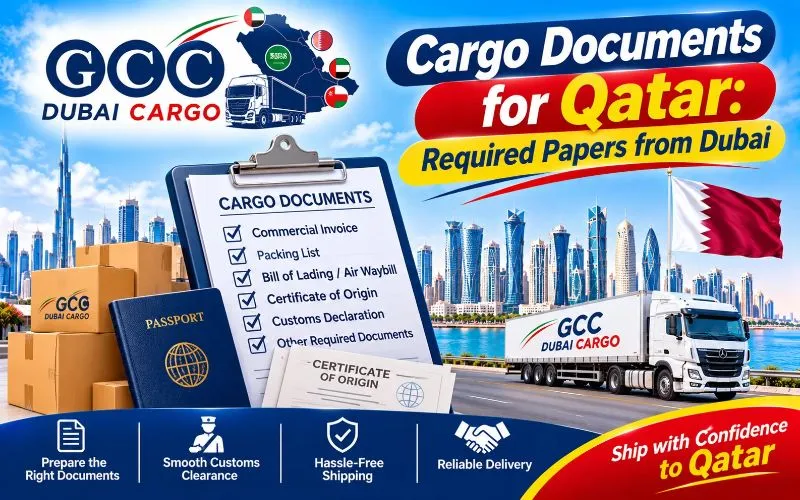
Shipping cargo from Dubai to Qatar requires more than arranging a truck and preparing your belongings. The shipment must also have appropriate documentation so that the goods can be identified, declared and processed through the applicable customs procedures. Preparing the paperwork before collection can help prevent avoidable problems during transportation.
Whether you are sending household furniture, personal belongings, appliances, office equipment or commercial products, the documents needed depend on what you are shipping and whether the shipment is personal or business-related.
For road cargo, transport documentation is particularly important because goods entering Qatar by land are handled under different documentation procedures from air and sea shipments.
At GCC Dubai Cargo, customers planning transportation to Qatar should consider their cargo description, quantities, declared value, country of origin, packaging details and receiver information before arranging pickup. This guide explains the documents to understand, how to prepare them and what to check before your shipment leaves Dubai.
Why Cargo Documentation Matters When Shipping from Dubai to Qatar
Cargo documentation helps customs authorities identify the contents, origin, quantity and declared value of imported goods. It also provides information about the sender, receiver and transportation arrangements.
For a Dubai-to-Qatar shipment, documentation serves several purposes:
Identifies the actual products or personal belongings being transported.
Establishes the declared value and country of origin.
Provides a record of package quantities and shipment contents.
Supports applicable UAE export and Qatar import procedures.
Helps identify goods that may need additional permits or approvals.
Provides information for transport and customs declarations.
An important distinction is that the paperwork for a personal shipment may differ from that for a commercial consignment.
For example, a family sending used furniture to a residence in Doha has different documentation considerations from a company exporting retail inventory to a Qatar warehouse.
Qatar’s General Authority of Customs publishes separate guidance for commercial and personal imports. Its procedures also provide for customs inspection and examination according to applicable risk assessment criteria.
The Main Documents to Prepare for Qatar Cargo
Before arranging transportation, understand the purpose of each document and determine which ones apply to your shipment.
The following documents are important reference points for customers shipping goods from Dubai to Qatar.
1. Commercial Invoice and Shipment Value
A commercial invoice provides details about the goods being shipped and their declared value.
For commercial cargo, the invoice generally identifies:
Seller or exporter information.
Buyer or importer information.
Product descriptions.
Quantities and units.
Unit prices and total shipment value.
Currency.
Country of origin.
Relevant product classification details.
The descriptions should be specific enough to identify the actual products.
For example, describing a shipment as “general goods” does not provide the same level of information as identifying it as “stainless steel kitchen equipment” or “electrical spare parts.”
The declared value should accurately represent the goods according to the applicable customs valuation requirements.
For commercial imports, Qatar customs guidance identifies a detailed original invoice among the supporting documents for the customs declaration.
What about personal cargo?
For household belongings, customers should prepare an accurate item inventory and any supporting invoices or value information available. Do not automatically assume that every personal shipment needs the same commercial invoice as a business export.
The appropriate paperwork should be confirmed according to the shipment’s nature and applicable customs procedures.
2. Packing List and Cargo Inventory
A packing list describes how the shipment is physically arranged.
It is particularly useful when cargo contains multiple cartons, furniture pieces, pallets or different product categories.
A practical packing list can include:
| Information | Example |
|---|---|
| Package number | Carton 01 |
| Contents | Kitchen utensils |
| Quantity | 12 pieces |
| Packaging | Cardboard carton |
| Gross weight | Actual measured weight |
| Dimensions | Length × width × height |
| Reference | Invoice number, where applicable |
For household shipments, the inventory might identify:
One three-seat sofa.
Two beds.
Four dining chairs.
One refrigerator.
Six household cartons.
Two television sets.
For business cargo, list products separately with their quantities, package numbers and relevant identification details.
Qatar customs guidance identifies a packing list for multiple goods and indicates that applicable product classification details should be included.
The most important preparation rule is consistency.
If the invoice describes 30 cartons but the packing list identifies 32, the difference should be investigated and corrected before dispatch.
3. Certificate of Origin
A Certificate of Origin identifies the country where the goods were manufactured or produced according to applicable origin rules.
It is not necessarily the same as the country from which the shipment is dispatched.
For example, a business may store imported electrical products in Dubai before sending them to Qatar. Their presence in Dubai does not automatically make them UAE-origin products.
The Certificate of Origin is particularly relevant to commercial imports, origin verification and applicable preferential tariff treatment.
Qatar’s official commercial import procedures list an original Certificate of Origin among the documents supporting the customs declaration.
Customers should confirm:
Whether the certificate is applicable to their goods.
Which authority should issue or certify it.
Whether the declared origin matches the actual goods.
Whether the certificate details correspond with the invoice.
Whether original or electronically verifiable documentation is required.
Do not assume that every household shipment needs the same origin certificate as a commercial consignment.
4. Road Cargo Manifest and Transport Documents
Road transportation has its own documentation requirements.
A cargo manifest identifies the goods being carried in a particular transport movement. It provides shipment information for the applicable land transportation and customs procedures.
Qatar’s General Authority of Customs specifically identifies a cargo manifest for land imports. Its guidance distinguishes this from a bill of lading for sea or air imports.
Depending on the transport arrangement, other supporting transport records may include:
Road consignment note.
Road waybill or CMR, where applicable.
Carrier and vehicle information.
Sender and consignee details.
Cargo descriptions and package quantities.
Relevant transit documentation.
A road waybill and a cargo manifest serve related but different purposes. One records the carriage arrangement, while the manifest identifies the cargo associated with the transport movement.
Customers should confirm the applicable documents with the transportation and customs parties handling the shipment.
5. Customs Declaration and Supporting Approvals
A customs declaration records information about goods entering or leaving a customs territory.
It may include product descriptions, quantities, values, origin and applicable classification information.
For Dubai exports, the relevant customs declaration procedure depends on the goods, export regime and applicable customs requirements.
Dubai Customs identifies invoice and packing-list information among the documents used for customs declarations, with permits required for applicable restricted goods.
For Qatar imports, the importer, authorized representative or customs broker submits the applicable customs declaration and supporting information.
Additional approvals may be required for products controlled by relevant authorities.
It is important to identify these requirements before collection rather than waiting until the cargo reaches the destination.
Personal Belongings and Household Cargo: What Should You Prepare?
Sending personal belongings from Dubai to Qatar involves different considerations from shipping business inventory.
A family relocating to Doha, for example, may be transporting used furniture, kitchen equipment, clothes, mattresses, appliances and household cartons.
A detailed inventory makes this shipment easier to identify and assess.
Documents for Furniture and Household Items
Prepare an inventory that separates large items and cartons.
For example:
| Category | Items to record |
|---|---|
| Bedroom | Beds, mattresses, wardrobes |
| Living room | Sofas, tables, television |
| Kitchen | Appliances, utensils, kitchen boxes |
| Personal items | Clothing, books and belongings |
| Electronics | Computers, monitors and televisions |
Record the number of pieces and provide reasonable descriptions.
For unusual, expensive or difficult-to-identify items, photographs can provide useful supporting information.
Also distinguish used personal belongings from newly purchased goods. Their nature, value and applicable import treatment may require different consideration.
Personal Identification and Receiver Details
Qatar’s customs guidance for personal imports identifies identification requirements, including an ID card, passport or residence visa depending on the person’s status. It also specifies that personal imports should be genuinely personal in nature and in non-commercial quantities.
Customers should therefore prepare relevant receiver information, such as:
Full name as shown on identification.
Applicable Qatar identification or passport details.
Contact number.
Residential or delivery address.
Information about the nature of the shipment.
Supporting purchase or value information, where relevant.
Do not assume that an individual shipment automatically qualifies for duty-free treatment. Customs authorities determine the applicable treatment.
Commercial Shipments to Qatar: Additional Documentation
Businesses sending products from Dubai to Qatar should pay particular attention to product descriptions, origin, quantities and importer information.
A shipment containing retail stock, packaged products, machinery or spare parts needs clear documentation that corresponds with its actual contents.
Business and Importer Information
Commercial cargo documentation should identify the exporting and importing parties correctly.
Check:
Exporter or seller’s registered business details.
Qatar importer or buyer information.
Consignee name and delivery details.
Applicable commercial registration or customs information.
Invoice reference numbers.
Contact information for the receiving party.
The registered business activity and importer eligibility may also be relevant to customs processing.
Qatar’s commercial import guidance identifies evidence of importer activity for obtaining a customs code and requires applicable approvals for restricted goods.
Product Classification and HS Codes
HS codes are used to classify products for customs purposes.
Correct classification helps determine the applicable customs treatment, duties and regulatory requirements.
A business sending electrical components, industrial equipment or packaged consumer products should not rely on broad descriptions such as “spare parts” or “equipment” when more specific identification is available.
Before preparing the invoice and packing list:
Identify each product category.
Confirm the appropriate classification.
Record quantities and product descriptions.
Check that the supporting documents use consistent information.
Confirm whether the product needs additional approvals.
Incorrect classification can create difficulties during customs processing.
Product-Specific Permits and Certificates
Some goods are subject to additional controls.
Depending on the product, applicable requirements may involve health, safety, conformity, technical or other regulatory approvals.
Examples include certain food products, medicines, chemicals, medical equipment and controlled electrical products.
The required approval depends on the product and the relevant authority. Not every product in these categories automatically follows the same process.
Businesses should confirm the applicable requirements with the Qatar importer and relevant authorities before shipping.
How Road Cargo Documents Move from Dubai to Qatar
Understanding the transportation journey helps customers recognize why accurate paperwork must be prepared before the truck departs.
A typical road cargo arrangement involves several stages.
1. Cargo information is collected
The shipper provides descriptions, quantities, weights, dimensions, values and receiver details.
2. Supporting documents are reviewed
Applicable invoices, packing lists, origin certificates and permits are identified.
3. Dubai export procedures are considered
The relevant customs declaration and supporting paperwork are prepared according to the shipment and export arrangement.
4. Road transportation documents are arranged
The applicable cargo manifest, road waybill and related transport information are prepared by the responsible parties.
5. Transit requirements are checked
Depending on the route and operational arrangements, the shipment may need transit documentation for an intermediate country.
6. Qatar import procedures are completed
The importer or authorized representative submits the applicable declaration and documents to Qatar customs.
7. Delivery arrangements are confirmed
After applicable customs procedures and release requirements are completed, the cargo can proceed according to the agreed transportation arrangement.
The precise route, transit procedures and document responsibilities should be confirmed before dispatch.
Customers researching other regional transportation arrangements can also explore cargo from Dubai to Saudi Arabia, cargo from Dubai to Kuwait and cargo from Dubai to Bahrain.
Dubai Pickup: Preparing Cargo Information Before Loading
Documentation preparation should begin before the pickup vehicle arrives.
Customers arranging cargo services in Dubai should provide accurate information about the collection location and the cargo itself.
This is especially important for apartment buildings, villas, offices and warehouses.
Apartment, Villa and Office Access
Confirm practical pickup arrangements, including:
Building security and visitor access.
Loading bay availability.
Service elevator booking.
Building management approval, where applicable.
Parking restrictions.
Distance between the property and loading area.
Staircase access for large furniture.
Warehouse loading arrangements.
Building requirements can vary, so confirm them with the relevant management before collection.
Measuring and Recording Large Items
Large items should be measured before requesting a quotation.
For example, a sofa may fit inside a residential room but may not pass through a narrow doorway or service elevator.
Record:
Length, width and height.
Approximate weight.
Number of separate pieces.
Whether dismantling is necessary.
Packaging requirements.
Any unusual loading conditions.
Protect fragile items such as glass furniture, mirrors, electronic equipment and appliance surfaces.
Label cartons according to their contents and maintain an inventory that reflects the actual packed shipment.
Qatar Customs: What Happens When the Shipment Arrives?
When cargo reaches Qatar, the applicable customs process involves reviewing the declaration and supporting documentation.
Depending on the shipment, customs may examine:
Commercial invoice details.
Country of origin.
Packing list.
Cargo manifest.
Product classification.
Importer information.
Required permits or approvals.
Declared values and quantities.
Qatar customs procedures allow inspection and examination according to risk assessment criteria. Customs may also request translations of foreign invoices or supporting documents into Arabic.
Customs duties are determined according to the applicable tariff classification, origin and relevant exemptions or agreements.
Customers should avoid assuming that all shipments are charged identically or that a Certificate of Origin automatically guarantees preferential duty treatment.
It is also important to distinguish customs release from final delivery. The receiver may still need to coordinate access to a residential property, commercial building or warehouse.
For example, a business receiving pallets in Doha should confirm that the delivery location can accommodate the planned unloading arrangement.
Common Paperwork Mistakes That Can Delay Qatar Cargo
Small inconsistencies can create unnecessary complications.
The following examples show what customers should check before shipment dispatch.
| Potential problem | Practical solution |
|---|---|
| Invoice shows 20 cartons but packing list shows 22 | Recount packages and correct the documents |
| Product description is too general | Provide a clear description of each product |
| Country of origin is incorrect | Verify actual manufacturing origin |
| Receiver's name differs between documents | Standardize the consignee information |
| Large furniture is missing from the inventory | Record every major item before packing |
| Required permit was not arranged | Check product-specific approvals before dispatch |
| Shipment value is inaccurate | Review the declared value and supporting records |
| Cargo dimensions are missing | Measure large or unusual items before collection |
| Receiver is unaware of customs requirements | Confirm importer responsibilities in advance |
Another common issue occurs when goods are added after the paperwork has been prepared.
For example, a customer may add three cartons of kitchen items after creating the original inventory. The packing list should be updated so that it reflects the actual cargo being transported.
Do not treat the paperwork as a formality. It should accurately represent the shipment at the time of dispatch.
How to Request a Cargo Quotation with the Correct Details
Providing complete shipment information helps GCC Dubai Cargo understand the transportation requirements and assess the appropriate service arrangement.
Before requesting a quotation, prepare the following information.
Cargo details
Type of goods.
Personal or commercial shipment.
Number of cartons or individual items.
Approximate total weight.
Total cargo volume.
Dimensions of large items.
Photographs, where useful.
Pickup details in Dubai
Collection address.
Apartment, villa, office or warehouse.
Floor number, where relevant.
Elevator and loading access.
Preferred collection arrangements.
Destination details in Qatar
City and delivery address.
Residential or commercial delivery.
Receiver’s full name.
Receiver’s contact information.
Unloading access and site restrictions.
Documentation details
Commercial invoice, if applicable.
Packing list or personal inventory.
Certificate of Origin, where applicable.
Product permits, if required.
Importer or receiver information.
Any known customs or transit requirements.
Providing these details early helps identify missing information before the cargo is prepared for transportation.
For customers comparing regional destinations, GCC Dubai Cargo also provides information about cargo from Dubai to Oman and cargo from Dubai to Kuwait.
Frequently Asked Questions About Cargo Documents for Qatar from Dubai
The documents depend on the shipment and the applicable customs procedures. Customers should prepare an accurate household inventory, relevant value or purchase information, receiver identification details and applicable transport documentation. Qatar's personal import procedures identify passport, ID or residence visa information as relevant identification. Additional documents or approvals may be necessary depending on the goods.
Qatar's General Authority of Customs identifies a cargo manifest as a supporting document for land imports. This is different from the bill of lading used for air or sea imports. The responsible transportation and customs parties should confirm the applicable manifest and supporting transport documents for the shipment.
No blanket assumption should be made that every shipment follows an identical document checklist. Qatar's commercial import guidance lists an original Certificate of Origin among the supporting documents for commercial customs declarations. Requirements for personal shipments and different cargo categories should be confirmed according to the applicable customs procedure.
A discrepancy can lead to additional verification, questions or inspection during customs processing. For example, an invoice showing 15 cartons while the packing list identifies 17 creates uncertainty about the actual shipment. Review both documents, correct the quantities and ensure that the final paperwork reflects the goods being transported.
The receiver should provide their full name, contact number, delivery address and applicable identification or business/importer information. For commercial shipments, the importer may also need relevant customs registration details and product-specific approvals. Confirming these details before collection helps avoid problems when the shipment reaches Qatar.
Prepare Your Qatar Cargo Documents Before Collection
Correct documentation is an important part of arranging road cargo from Dubai to Qatar. Commercial invoices, packing lists, Certificates of Origin, road manifests and customs declarations each serve a different purpose, and their applicability depends on the shipment.
Whether you are sending household furniture, personal belongings, office equipment or commercial inventory, start with an accurate cargo inventory and confirm the requirements for your particular goods.
GCC Dubai Cargo helps customers plan their cargo transportation requirements from Dubai to Qatar. Share your cargo type, approximate weight, dimensions, pickup address and destination details to discuss the appropriate transportation arrangement.
Made Easy
GCC Cargo Destinations
Fast, secure, and reliable cargo delivery from Dubai to GCC countries.
Let's help you!
Need reliable cargo delivery from Dubai to GCC? Get in touch with our team today.
WhatsApp Now
+971 54 143 5685
Quick Links
© 2026 GCC Dubai Cargo. All Rights Reserved.
