
Food Cargo Dubai to Qatar: Rules and Shipping Tips
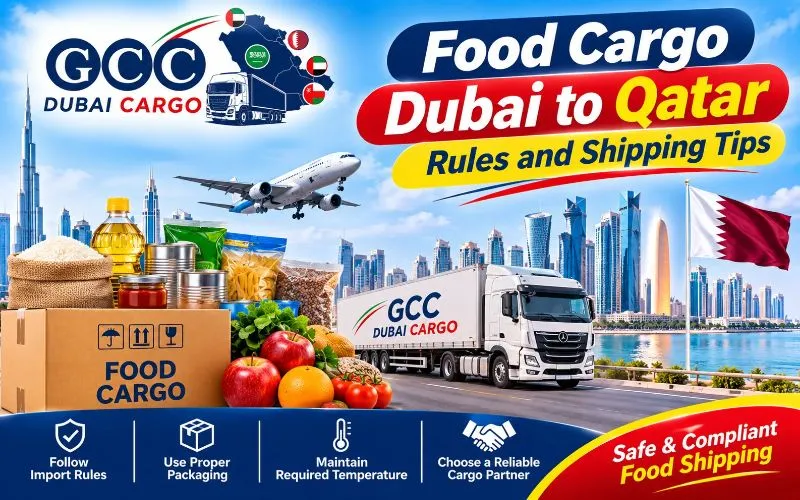
Shipping food cargo from Dubai to Qatar requires more preparation than transporting ordinary household or commercial goods. Food products must meet applicable Qatar import requirements, and their packaging, labeling, shelf life and transportation conditions need to be considered before dispatch.
A shipment of dry groceries has different requirements from frozen meat, chilled dairy or other perishable products.
For individuals, retailers, wholesalers and food suppliers, understanding these differences can help prevent unnecessary border delays and product damage.
GCC Dubai Cargo provides a Dubai-based point of contact for customers exploring cargo transportation to Qatar. Before arranging a shipment, it is important to identify the exact food products, confirm whether the Qatar importer can receive them, prepare the applicable documents and select a transportation arrangement suitable for the cargo.
This guide explains the important rules, road freight considerations and practical shipping tips to review before sending food products from Dubai to Qatar.
Before Shipping Food from Dubai, Check These Three Things
Before arranging a pickup, establish three important details.
First, confirm product eligibility. Not every food product is automatically acceptable for import into Qatar. Restrictions can depend on ingredients, product origin, processing methods and applicable food safety regulations.
Second, confirm the receiver’s import readiness. Commercial food shipments generally require an appropriately registered importer and compliance with Qatar’s food import procedures. The receiver should verify product registration and applicable approvals before dispatch.
Third, establish the correct transportation conditions. Dry groceries may be suitable for ordinary cargo arrangements, while frozen and chilled products need appropriate temperature management throughout the journey.
These checks should happen before cartons are collected or loaded.
Which Food Products Can Be Considered for Qatar Cargo?
The type of food determines the documentation, packing and transportation arrangements that may be necessary.
Dry groceries and packaged food
Dry food products are generally easier to prepare for road transportation because many do not require refrigeration.
Examples include:
Rice, flour and lentils
Pasta and noodles
Packaged biscuits and snacks
Breakfast cereals
Dried fruits and nuts
Spices and seasoning products
Canned vegetables and packaged sauces
Commercially sealed grocery products
However, being shelf-stable does not automatically mean a product is approved for Qatar import. Its ingredients, labeling, country of origin and remaining shelf life must still comply with applicable requirements.
Frozen, chilled and perishable products
Frozen and chilled food requires additional planning.
Examples include frozen seafood, meat, poultry, dairy products and selected prepared foods.
These products may require temperature-controlled transportation, appropriate packaging, temperature records and product-specific health documentation.
Do not book ordinary dry cargo transportation for temperature-sensitive food without confirming that the required conditions can be maintained.
Meat, poultry, dairy and animal-derived ingredients
Animal-origin products require particular attention.
Meat and poultry may need health and Halal slaughtering certificates issued by appropriately recognized authorities. Certain other foods containing animal-derived ingredients may also require Halal certification under applicable rules.
Before dispatch, confirm the product’s origin, processing establishment, ingredients and certificate requirements with the Qatar importer.
Qatar Food Import Rules That Shippers Should Understand
Qatar regulates imported food to protect consumers and ensure that products meet applicable safety and technical standards.
The country’s General Authority of Customs publishes a GCC guide covering imported food controls, including certification, inspection and food suitability.
Importer and food product registration
Commercial food imports should be coordinated with the receiving business in Qatar.
The Ministry of Public Health uses its Wathiq system for food establishment and product registration. Government service information identifies registration of food establishments and registration of imported food products as separate procedures.
Before arranging transportation, the receiver should confirm:
Whether the importing establishment is registered.
Whether the relevant food product is registered.
Whether any additional product approvals are necessary.
Whether the business holds the appropriate commercial activity.
Whether any product-specific import restrictions apply.
A cargo company should not assume that a shipment can enter Qatar simply because the same product is sold in Dubai.
Food labeling, ingredients and expiry dates
Food labeling is another important part of shipment preparation.
Imported products should have labels that comply with the applicable Qatar and GCC food standards.
Depending on the product and applicable standard, important label information can include:
Product name and brand.
Ingredients.
Country of origin.
Manufacturer details.
Net weight in metric units.
Production date.
Expiry date.
Relevant nutritional information.
Arabic labeling requirements should also be checked. Some products may use bilingual Arabic and English labels, subject to the applicable rules.
Qatar’s labeling guidance highlights the importance of original production and expiry date information and applicable shelf-life standards.
Avoid dispatching products with damaged labels, unclear ingredients or missing expiry information.
Food inspection and laboratory testing
Food shipments entering Qatar may be inspected at the relevant entry point.
The Ministry of Public Health’s imported food inspection service explains that inspections can include laboratory analysis where required. The process is linked to the import customs declaration and the applicable food registration requirements.
Sharek
This means customers should not assume that a complete set of documents guarantees immediate release.
If a shipment requires sampling or additional checks, the receiver should be prepared for additional processing time.
Documents to Prepare Before Food Cargo Leaves Dubai
The documents depend on the product, origin, shipment purpose and Qatar import requirements.
| Document | Why it may be needed |
|---|---|
| Commercial invoice | Identifies the products, quantities and declared values |
| Packing list | Describes cartons, packages and shipment contents |
| Health certificate | Confirms applicable food safety attestations |
| Halal certificate | Relevant to qualifying animal-origin products |
| Halal slaughter certificate | Relevant to meat and poultry |
| Customs declaration | Supports formal import processing |
| Certificate of origin | Establishes the origin of the goods where applicable |
| Product approvals | Required for certain regulated products |
| Temperature records | Relevant to temperature-sensitive food where required |
| Transport documents | Identify the cargo movement and shipment parties |
The Qatar Customs GCC food control guide outlines health certificates, contents lists, customs documentation and Halal certification among the relevant requirements.
Health and conformity certificates
A health certificate may be required to demonstrate that food complies with applicable import standards.
The certificate must be appropriate to the shipment and issued by the competent authority or an accepted organization.
A general company declaration should not be assumed to replace an official shipment-specific certificate.
Halal certification where applicable
Meat and poultry shipments may require a Halal slaughtering certificate.
Certain products containing animal-derived ingredients may also require Halal certification.
Customers should verify that the issuing Islamic organization is recognized by the relevant Qatari authorities. Certificate details should match the shipment rather than refer only to the manufacturer’s general production arrangements.
Commercial invoice, packing list and customs declaration
Commercial food shipments should have accurate product descriptions and quantities.
For example, an invoice describing 100 cartons of packaged biscuits should match the actual shipment and packing list.
Avoid broad descriptions such as “food items” when more precise product information is available.
Incorrect descriptions or mismatched quantities can create additional questions during customs review.
Choosing Road Transportation for Dubai-to-Qatar Food Shipments
Road freight can be considered for suitable food products moving from Dubai to Qatar, particularly packaged groceries and commercial stock.
The route requires transportation through Saudi Arabia because the UAE and Qatar do not share a direct land border.
Understanding the Saudi transit route
A typical road movement from Dubai to Qatar follows the UAE–Saudi land crossing and continues through Saudi Arabia towards the Qatar border at Abu Samra.
This means the shipment involves more than one border-related procedure.
The cargo documentation must support the applicable UAE export, Saudi transit and Qatar import arrangements.
For customers arranging food transportation, the important consideration is ensuring that the documents, product descriptions and transit arrangements are correct before dispatch.
Customers exploring the wider Saudi corridor can also review cargo from Dubai to Saudi Arabia for additional destination-related transportation information.
When FTL transportation makes sense
Full Truckload (FTL) transportation may be worth considering when a business has a large quantity of food stock.
For example, a wholesale supplier sending several pallets of packaged groceries to a distributor in Doha may prefer a dedicated truck arrangement.
Potential benefits include:
Greater control over cargo allocation.
More space for a large shipment.
Easier planning for palletized stock.
Reduced dependence on shared cargo arrangements.
The appropriate truck depends on shipment dimensions, total weight, loading requirements and any special transportation conditions.
When LTL may be suitable
Less-than-Truckload (LTL) transportation may be considered for smaller shipments that do not require an entire truck.
A retailer sending a limited quantity of packaged snacks or dry grocery cartons may explore shared-load transportation.
However, food products should only be consolidated when the arrangement is suitable.
Consider:
Whether the products require refrigeration.
Whether different goods can safely travel together.
Whether cartons can withstand additional handling.
Whether packaging protects against contamination and leakage.
Whether the shipment can remain traceable.
Frozen and chilled food should not be placed into ordinary shared cargo arrangements without confirmed temperature-controlled handling.
Dry Food and Temperature-Sensitive Cargo Need Different Planning
Food transportation should begin with the correct product category.
Dry food
Dry groceries generally need clean, dry and secure packaging.
Cartons should protect products against moisture, dust, crushing and movement during transportation.
Chilled food
Chilled products need a suitable temperature range maintained throughout transportation.
The required range depends on the specific food and applicable standards.
Frozen food
Frozen products require a transportation arrangement capable of maintaining the specified frozen condition.
The shipper should also consider loading time, border inspection, possible waiting periods and the receiving facility’s ability to accept the goods.
Temperature-sensitive shipments may require temperature records. The importer should confirm the relevant requirements before booking.
GCC Dubai Cargo customers should disclose these requirements before requesting a quotation. A standard road freight vehicle should never be assumed to provide refrigeration.
How to Pack Food Products for Cross-Border Road Freight
Packaging protects food products during loading, transportation, border inspection and unloading.
For dry packaged food, consider these steps:
Use strong cartons appropriate for the weight of the products.
Keep food in its original sealed retail or manufacturer packaging.
Protect cartons against moisture and accidental leakage.
Use suitable inner cushioning for fragile glass containers.
Avoid overfilling cartons.
Keep carton weight manageable for handling.
Use clear labels showing product identification and quantities.
Keep different food categories separated where appropriate.
For palletized commercial shipments, distribute weight evenly and use suitable wrapping to prevent cartons shifting during transportation.
Do not place heavy cartons on top of products that may be crushed.
Protecting beverages and glass containers
Bottled drinks, sauces and glass jars need additional attention.
Use dividers and cushioning where necessary. Check lids and seals before packing, and keep liquid products protected against leakage.
A leaking carton can affect neighboring packages and create unnecessary inspection or handling problems.
Dubai Pickup Preparation for Food Shipments
Pickup arrangements should be assessed before the collection vehicle arrives.
Food cargo may be collected from a commercial warehouse, retail premises, distribution centre or another agreed location in Dubai.
Customers should confirm:
The number of cartons or pallets.
Total cargo weight.
Largest carton or pallet dimensions.
Whether forklift assistance is available.
Whether the loading area can accommodate the vehicle.
Whether warehouse security approval is required.
Whether loading bay reservations are necessary.
Whether cargo must be collected at a particular time.
For commercial premises, confirm that the warehouse team has the shipment ready and that the inventory matches the paperwork.
For residential pickups involving packaged food, check parking, building access and any applicable management requirements.
Customers looking for broader cargo services in Dubai can explore the available service information before arranging their shipment.
Preparing Food Cargo for Delivery in Doha and Other Qatar Cities
The final delivery arrangement is just as important as the Dubai pickup.
Doha is a major destination for commercial food distribution, retail supplies and wholesale grocery shipments.
Other destinations may include Al Rayyan, Al Wakrah, Lusail, Al Khor and Mesaieed.
Delivery requirements depend on the actual address and receiving facility.
For example, a shipment going to a supermarket distribution warehouse may require a loading appointment and a designated unloading area.
A smaller delivery to a retail shop may involve limited vehicle access and restricted unloading space.
Before dispatch, provide:
Full receiver name and contact number.
Accurate delivery address.
Warehouse or business identification.
Receiving hours.
Unloading arrangements.
Any appointment requirements.
Details of the party responsible for customs processing.
For perishable products, confirm that the receiving facility can accept the cargo under the required storage conditions.
A shipment should not arrive at a location where suitable refrigeration or storage is unavailable.
Common Food Shipping Problems and How to Prevent Them
Food cargo can encounter problems when product information, documentation or handling requirements are incomplete.
| Potential problem | Practical solution |
|---|---|
| Product is restricted or not eligible for import | Check product-specific requirements before pickup |
| Importer is not registered | Confirm the receiver's registration and readiness |
| Food labels are incomplete | Review original labels before dispatch |
| Health certificate does not match the shipment | Verify product descriptions and certificate details |
| Halal certificate is not accepted | Confirm the issuing organization's recognition |
| Food expires before delivery | Review remaining shelf life and plan transportation carefully |
| Dry cartons become wet | Use moisture-resistant outer packaging |
| Frozen food loses temperature control | Confirm suitable refrigerated transportation before booking |
| Mixed food cartons create inspection questions | Prepare a clear product-wise packing list |
| Delivery warehouse is unavailable | Arrange receiving hours and appointments in advance |
One common mistake is preparing the transport documents without checking whether the product itself satisfies Qatar's food requirements.
A transport booking should follow product eligibility and importer confirmation, not replace them.
What Determines the Cost of Food Cargo from Dubai to Qatar?
There is no single transportation rate suitable for every food shipment.
The final quotation depends on the cargo and the service arrangement.
Important pricing factors include:
Total cargo weight.
Number of cartons or pallets.
Shipment volume and dimensions.
Type of food product.
FTL or LTL transportation.
Special temperature requirements.
Loading and unloading arrangements.
Pickup location in Dubai.
Delivery address in Qatar.
Applicable customs and documentation requirements.
Additional packaging or handling requirements.
A small shipment of dry groceries may need a different arrangement from a large commercial order of palletized packaged food.
Likewise, frozen products may involve different equipment and operating costs from ordinary dry cargo.
When requesting a quotation, provide accurate shipment details instead of estimating quantities.
A Practical Checklist Before Requesting a Food Cargo Quote
Use this checklist to prepare the shipment.
Product information
Cargo information
Import preparation
Transportation and delivery
Providing this information helps the cargo company assess the shipment more accurately and identify questions that need to be resolved before dispatch.
Frequently Asked Questions About Food Cargo Dubai to Qatar
Packaged food and dry groceries may be eligible for transportation, provided the products meet Qatar's applicable import, labeling and food safety requirements. The importer should verify product eligibility and registration before dispatch.
Depending on the products, documents may include a commercial invoice, packing list, health certificate, customs declaration and applicable Halal certificates. Additional permits or supporting documents may be required for certain food categories. The Qatar importer should confirm the current requirements.
Potentially, provided suitable temperature-controlled transportation is available and the product satisfies the relevant import requirements. The required temperature, packaging and temperature records should be confirmed before booking. Ordinary dry cargo transportation is not an appropriate substitute.
Imported food is subject to Qatar's applicable food control procedures. Inspection and laboratory sampling may be conducted depending on the shipment and regulatory assessment. Customers should prepare the required documentation and allow for possible inspection-related delays.
Prepare a product-wise inventory showing descriptions, quantities, carton dimensions, total weight and packaging type. Include manufacturing and expiry information where relevant, and disclose whether the products require temperature control. Also provide the Qatar importer's details and confirm that the receiving party is ready to complete the import procedures.
Arrange Your Food Cargo from Dubai to Qatar with Proper Preparation
Shipping food products across borders requires attention to more than transportation costs. Product eligibility, importer registration, labeling, certification, packaging and delivery arrangements all influence whether a shipment is ready to move.
Whether you are preparing packaged groceries for a retailer, commercial stock for a distributor or a suitable food shipment for another receiving business, start by identifying the exact products and their transportation requirements.
GCC Dubai Cargo can be contacted to discuss your proposed cargo movement from Dubai to Qatar and the transportation information needed for a quotation.
Share your product list, shipment quantity, weight, dimensions, pickup address and Qatar delivery details so the appropriate road freight arrangement can be assessed.
Made Easy
GCC Cargo Destinations
Fast, secure, and reliable cargo delivery from Dubai to GCC countries.
Let's help you!
Need reliable cargo delivery from Dubai to GCC? Get in touch with our team today.
WhatsApp Now
+971 54 143 5685
Quick Links
© 2026 GCC Dubai Cargo. All Rights Reserved.
