
Prohibited Items Qatar Cargo: Banned Goods from Dubai
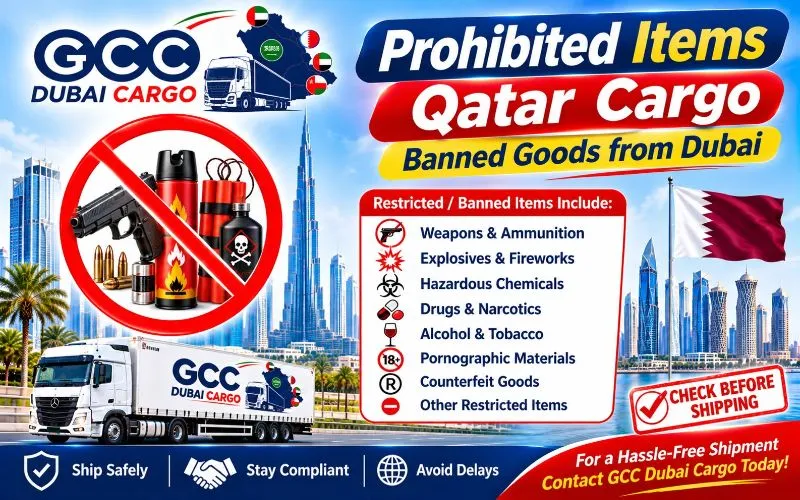
Sending cargo from Dubai to Qatar involves more than packing goods and arranging a truck. Before your shipment is collected, you should know whether every item can legally enter Qatar, whether it needs prior approval, and whether the selected transport channel accepts it.
This is especially important for mixed shipments containing household goods, personal belongings, commercial stock, electronics, medicines, food, liquids or other sensitive products. An item may be legal to own in Dubai but still be prohibited, restricted, or subject to additional controls when imported into Qatar.
Qatar’s General Authority of Customs distinguishes between prohibited goods and restricted goods. Restricted goods may require approval from the competent authority before importation, while prohibited goods are not normally permitted under the applicable customs and other laws.
For this reason, the safest approach is to review the cargo before pickup rather than discovering a problem after the shipment has already started moving.
What This Qatar Prohibited Items Guide Covers
This guide focuses on cargo moving from Dubai to Qatar, particularly road and land transportation.
It explains:
Goods that are generally prohibited
Categories that may require approval
Why courier and airline lists can differ from road cargo
Medicines, food, batteries and other sensitive products
Household and commercial cargo considerations
Documents and cargo descriptions
Dubai pickup preparation
Customs considerations in Qatar
Common mistakes that can cause a shipment to be held
The lists in this guide should be treated as a practical screening guide rather than a substitute for checking the current requirements applicable to a specific product.
Prohibited vs Restricted Goods in Qatar
One of the most important distinctions is between a prohibited item and a restricted item.
A prohibited item is generally not permitted to enter Qatar under the applicable rules. Qatar’s customs information identifies categories such as drugs, weapons, ammunition, explosives, radioactive materials and alcoholic drinks among prohibited goods.
A restricted item is different. It may be importable, but the importer may need approval, a permit, registration, certification or other documentation from the relevant authority.
Qatar’s official restricted-goods tariff shows that many food, animal, agricultural and other product categories can be subject to control by authorities such as the Ministry of Public Health or agricultural authorities.
Therefore, do not assume:
“It is not prohibited, so I can automatically put it in the truck.”
The correct question is whether the specific product is allowed for the intended import, transport method and quantity, and whether any approval is required.
Items That Are Generally Prohibited
Some categories require particularly careful screening because Qatar customs rules prohibit their import under applicable laws.
Drugs and Controlled Substances
Narcotics and illegal drugs are prohibited categories. Qatar’s customs guidance specifically identifies drugs of all kinds and types among prohibited goods.
Do not describe a controlled substance using a vague cargo description such as “personal item,” “sample” or “medicine.”
Medicines require separate consideration because some medicines may be subject to controls rather than being treated in exactly the same way as illegal narcotics.
Weapons, Ammunition and Explosives
Firearms, ammunition and explosives are among the categories identified by Qatar customs as prohibited.
This means customers should not assume that an item is acceptable simply because it is commercially available in Dubai.
Potentially sensitive products should be identified before pickup rather than packed with ordinary household or commercial cargo.
Alcoholic Drinks
Alcoholic drinks are identified by Qatar customs as prohibited goods.
This is particularly important for mixed household or commercial shipments because bottles can sometimes be packed together with otherwise ordinary personal belongings.
Check the contents of cartons before they are sealed. Do not rely on a general description such as “kitchen items” or “personal effects.”
Radioactive Materials
Radioactive sources and materials are also identified in Qatar’s customs guidance as prohibited goods.
Any shipment involving potentially hazardous, industrial or scientific material should be reviewed before transportation.
Counterfeit and Illicit Goods
Counterfeit products and goods that infringe intellectual property rights can create customs problems. Qatar’s importation guidance states that goods violating approved intellectual property rights may not be imported.
This matters particularly for commercial shipments containing branded clothing, accessories, electronics, spare parts or other branded products.
A genuine commercial invoice and accurate product description are important when shipping branded goods.
Other Prohibited Categories
Qatar’s official tariff also identifies specific prohibited commodities, including certain narcotic substances, some agricultural products, asbestos-containing materials and specified electronic smoking devices.
This demonstrates why a simple internet list of “banned items” should not be treated as complete. Product classification and the exact HS code can matter.
Goods That May Require Approval Before Shipping
Not every sensitive item is automatically prohibited.
Some goods can be imported only after meeting requirements imposed by the relevant authority.
Medicines
Medicines require particular care.
Qatar’s Ministry of Public Health provides specific controls for controlled drugs carried for personal use and requires supporting medical documentation in applicable cases.
Do not assume that a medicine legally sold in Dubai can automatically be shipped as ordinary cargo to Qatar.
Before including medicines, identify:
Exact product name
Active ingredients
Quantity
Intended use
Whether it is prescription-only
Whether it contains a controlled substance
Any available prescription or medical documentation
Whether Qatar approval is required
If there is uncertainty, verify the product with the relevant Qatar authority before dispatch.
Food and Animal Products
Food products can be subject to health and import controls.
Qatar’s restricted-goods database contains numerous food and animal-product categories associated with the Ministry of Public Health’s Ports Health and Food Control Section.
Do not treat all food as either “allowed” or “banned.”
The exact product, ingredients, origin, quantity, packaging and intended use can affect the requirements.
Commercial food shipments may require more documentation than ordinary personal belongings.
Plants and Agricultural Products
Plants, seeds and agricultural products can also require official controls.
The Qatar restricted-goods tariff identifies numerous seed and agricultural categories that fall under agricultural authority controls.
If your cargo contains plants, seeds, soil, agricultural materials or related products, identify them before pickup.
Telecommunications Equipment
Some communications equipment may be subject to regulatory approval.
This is particularly relevant to commercial shipments containing radio, communication or transmission equipment.
Do not assume that every electronic device has the same import requirements. Ordinary consumer electronics, wireless equipment and specialized communications equipment can fall into different regulatory categories.
Chemicals and Dangerous Goods
Chemicals, paints, solvents, fuels, aerosols, pressurized products and other dangerous goods require additional attention.
Even when an item is not prohibited by Qatar customs, the transport provider may have separate dangerous-goods rules.
Before booking, provide the exact product name and, where applicable, safety information such as an SDS.
Why Airline, Courier and Road Cargo Rules Can Differ
A common mistake is copying a prohibited-items list from an airline or courier website and assuming it is the complete Qatar customs list.
That can be misleading.
For example, Qatar Airways publishes restrictions for baggage and air transportation, while courier operators can have their own acceptance rules.
A product can therefore face three separate questions:
Is it legal to import into Qatar?
Does it require approval or documentation?
Will the selected transport provider accept it?
These questions are related but not identical.
This is especially important for batteries, aerosols, liquids, perfumes, chemicals and other goods that may have transport restrictions.
Household Cargo From Dubai: What to Check
Household shipments can contain many different item types in one load.
Typical cargo may include:
Sofas
Beds
Tables
Cabinets
Mattresses
Appliances
Electronics
Clothes
Kitchen items
Household cartons
Personal belongings
Before loading, separate ordinary household goods from anything that may need additional review.
Pay particular attention to:
Medicines
Liquids
Aerosols
Batteries
Chemicals
Food
Alcohol
Items containing restricted materials
A household shipment should have a clear inventory so that the contents are known before the truck is loaded.
For customers arranging cargo from Dubai to Qatar, providing the cargo list before pickup can make the initial assessment more useful.
Commercial Cargo and Business Stock
Commercial shipments require more detailed product identification.
A business sending stock to Qatar should prepare information such as:
Product name
Quantity
Product description
Country of origin
Approximate value
HS code where known
Packaging type
Dimensions and weight
Intended use
Available permits or certificates
Avoid descriptions such as “goods,” “parts,” “accessories” or “general items” when a more specific description is available.
A detailed description helps the shipment documentation correspond more closely with the physical cargo.
This is particularly important when a commercial shipment contains regulated products.
Batteries, Liquids, Aerosols and Other Sensitive Cargo
Some of the most commonly misunderstood cargo categories are not necessarily prohibited by Qatar customs but can be subject to transport or handling restrictions.
Batteries
Battery-powered electronics should be identified before pickup.
Provide information about:
Battery type
Whether the battery is installed
Quantity
Device type
Battery capacity where relevant
Do not hide batteries inside cartons under a generic description.
Liquids
Liquids can include cosmetics, cleaning products, oils, food products, chemicals and other materials.
The exact contents matter.
A liquid that is harmless for ordinary household use can still require special transport arrangements depending on its composition.
Aerosols and Pressurized Products
Spray cans, gas cylinders and other pressurized products need careful screening.
Never assume that an aerosol is acceptable simply because it is a common retail product.
Perfumes and Fragrances
Perfumes and fragrance products can require special transport consideration because of their ingredients and flammability characteristics.
Provide the exact product details before packing them with general cargo.
Documents to Prepare Before a Dubai-to-Qatar Shipment
The documents required depend on the cargo.
Potential documents can include:
Commercial invoice
Packing list
Certificate of origin
Transport documentation
Importer or receiver information
Customs declaration
Product-specific permits
Certificates or approvals where applicable
Qatar’s importation guidance lists an original detailed invoice and original certificate of origin among customs documentation for applicable imports.
However, customers should not assume that every shipment requires every document.
Requirements can depend on:
Cargo type
Product
Personal or commercial nature
Country of origin
Importer status
Applicable regulations
HS classification
How to Describe Cargo Correctly
Accurate cargo descriptions are one of the simplest ways to improve shipment preparation.
Instead of:
“Personal goods”
Use a more useful description such as:
“Used household furniture, including sofa, dining table and cabinets.”
Instead of:
“Electronics”
Identify the actual products where possible.
For commercial cargo, describe the product and its intended use rather than using a generic category.
The physical cargo, invoice and packing list should tell a consistent story.
Qatar customs guidance allows authorities to require additional documentation, permits and conformity information depending on the goods.
Dubai Pickup Checks Before Loading
The prohibited-item check should happen before the truck arrives.
At the Dubai pickup point, confirm:
What is being shipped
How many pieces there are
Which cartons contain sensitive products
Whether any liquids are present
Whether batteries are included
Whether medicines are included
Whether food is included
Whether any chemicals or aerosols are present
Whether large items have been measured
Whether the pickup location has suitable access
For apartment buildings, villas, offices and warehouses, also confirm parking, loading areas, security access, service elevators and the distance between the cargo and the vehicle.
Customers arranging broader cargo services in Dubai should prepare the cargo information before the pickup is finalized.
What Happens When Cargo Reaches Qatar Customs
Cargo entering Qatar is subject to customs procedures applicable to the shipment.
Customs may review:
Cargo description
Documentation
Product classification
Quantity
Value
Applicable permits
Restrictions
Physical contents
Qatar’s importation guidance states that goods subject to local or international prohibitions, applicable agreements, local regulations or intellectual-property restrictions may not be imported.
For restricted goods, the necessary approval must come from the relevant competent authority.
The important point for the shipper is that customs compliance begins before the truck leaves Dubai. Waiting until arrival to investigate a questionable product can create avoidable complications.
Common Problems That Cause Cargo to Be Held
Problem: A prohibited item is mixed with ordinary household goods
Solution: Create an inventory and screen the contents before packing.
Problem: A restricted product is shipped without approval
Solution: Identify regulated products early and confirm the required approval before dispatch.
Problem: The invoice description does not match the cargo
Solution: Check product descriptions, quantities and values before documents are finalized.
Problem: A business sends commercial stock with vague descriptions
Solution: Provide specific product descriptions and HS information where available.
Problem: Large furniture cannot be removed from the building
Solution: Measure furniture, doors, corridors and elevators before pickup.
Problem: The delivery location has limited vehicle access
Solution: Provide the receiver’s complete address and access information before delivery planning.
How to Check Your Shipment Before Pickup
Use this simple pre-shipment checklist:
Cargo identification
List every major item.
Count cartons and pieces.
Measure oversized items.
Estimate weight.
Identify liquids, powders, aerosols and chemicals.
Identify batteries and battery-powered products.
Separate medicines and food.
Identify branded or regulated products.
Documentation
Prepare the invoice where applicable.
Prepare the packing list.
Confirm receiver information.
Check certificate-of-origin requirements where applicable.
Identify required permits.
Check product classification.
Pickup
Confirm building access.
Confirm parking/loading arrangements.
Check elevator access.
Confirm large-item dimensions.
Separate questionable goods before loading.
Destination
Confirm the Qatar delivery address.
Confirm receiver details.
Check whether the destination is residential, commercial or warehouse-based.
Confirm any access limitations.
Prohibited Items and Qatar Road Cargo Planning
Road cargo from Dubai to Qatar can be suitable for many types of household and commercial shipments, but transportation does not remove customs requirements.
The cargo still needs to be legally importable into Qatar.
For smaller consignments, an LTL arrangement may be considered where appropriate. Larger shipments may be evaluated for FTL transportation. The correct option depends on cargo size, weight, dimensions, number of pieces, destination and loading requirements.
Prohibited-item screening should happen before deciding how the shipment will be transported.
For example, changing from LTL to FTL does not make a prohibited product legal. Similarly, putting a restricted product into a larger truck does not remove the need for an applicable permit.
Qatar Destinations and Delivery Considerations
Cargo from Dubai may be destined for residential, commercial, warehouse or industrial locations in Qatar.
The receiver should provide the complete delivery information before transportation is arranged.
For locations in and around Doha, Lusail, Al Rayyan, Al Wakrah and other Qatar destinations, the shipment plan can depend on the actual delivery address and access conditions.
The most important information is not simply the city name.
Provide:
Complete address
Receiver name
Contact information
Delivery type
Building or site access
Loading or unloading restrictions
Special delivery instructions
This information helps prevent problems after customs clearance when the cargo needs to move to its final destination.
Requesting a Cargo Quote With Complete Information
A cargo quote is more useful when the shipment information is complete.
Before requesting transportation from Dubai to Qatar, provide:
Cargo type
Number of pieces
Weight
Dimensions
Cargo value where applicable
Pickup location
Delivery location
Personal or commercial status
FTL or LTL preference if known
Any sensitive or regulated items
Loading requirements
Delivery access information
Do not request a quote using only “Qatar cargo” if the shipment contains unusual, regulated or oversized goods.
The more accurately the cargo is described, the easier it is to determine what needs to be checked before transportation.
Frequently Asked Questions | Prohibited Items Qatar Cargo
Qatar customs identifies categories including drugs, weapons, ammunition, explosives, radioactive materials and alcoholic drinks among prohibited goods. Specific tariff-based prohibitions also exist for certain products and materials.
No. Restricted goods may be imported when the required approval or permit has been obtained from the relevant authority. Prohibited goods are generally not permitted under the applicable rules.
It depends on the medicine, ingredients, quantity and applicable controls. Some medicines may require supporting documentation or approval, while controlled substances can be subject to stricter rules. Qatar's Ministry of Public Health publishes specific controls for controlled drugs.
They should be identified before shipment. Whether they can be transported depends on the product, battery type, composition, quantity, packaging, applicable customs requirements and transport-provider rules. Airline and courier restrictions can also differ from road cargo requirements.
Provide a clear cargo description, number of pieces, dimensions, weight, pickup and delivery details, personal or commercial status, and information about medicines, food, batteries, liquids, chemicals or other sensitive products. Where applicable, prepare invoices, packing lists, certificates, permits and other required documents.
Final Reminder Before Shipping
A prohibited-item list is useful, but it should not be treated as a complete legal checklist for every shipment.
Qatar customs requirements can depend on the product, classification, intended use and applicable authority. The official Qatar customs tariff also contains detailed prohibited and restricted classifications that go beyond a simple list of common household items.
The safest approach is to identify questionable cargo before pickup, describe it accurately, prepare applicable documentation and verify any required approval before the shipment moves from Dubai.
For a Dubai-to-Qatar shipment, cargo preparation is part of the transportation process—not something to leave until the truck is already on the road.
Made Easy
GCC Cargo Destinations
Fast, secure, and reliable cargo delivery from Dubai to GCC countries.
Let's help you!
Need reliable cargo delivery from Dubai to GCC? Get in touch with our team today.
WhatsApp Now
+971 54 143 5685
Quick Links
© 2026 GCC Dubai Cargo. All Rights Reserved.
