
Food Cargo Dubai to Bahrain: Rules and Shipping Tips
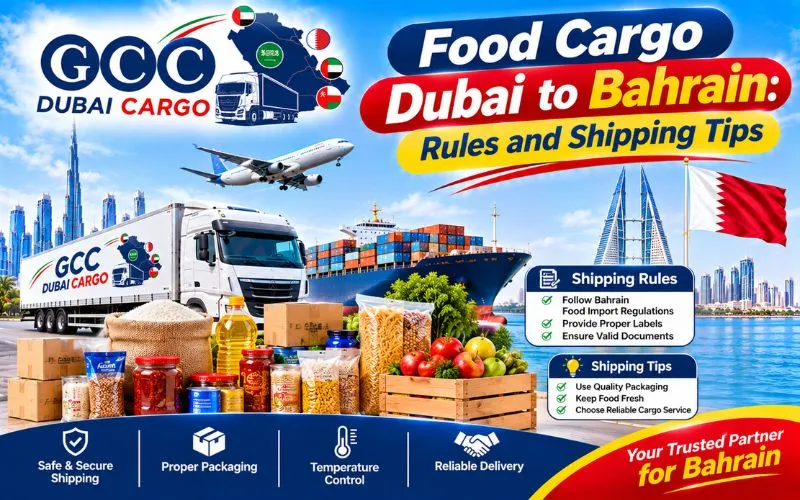
Sending food from Dubai to Bahrain requires more preparation than arranging an ordinary cargo shipment. Before booking transportation, you need to understand the type of food being shipped, whether the product is eligible for import, what documentation may be required and how the goods should be protected during the journey.
For a grocery supplier, restaurant, food distributor or trading company, even a small documentation mistake can create problems when a shipment reaches Bahrain. Temperature-sensitive products need additional attention because transportation conditions, storage requirements and product shelf life must be considered together.
GCC Dubai Cargo helps customers understand the practical requirements of arranging cargo transportation from Dubai to Bahrain. This guide explains food categories, Bahrain’s import procedures, road freight arrangements, packaging considerations and the information you should prepare before requesting a quotation.
Whether you are sending dry packaged groceries, commercial food inventory, chilled products or frozen goods, the first step is to identify the shipment correctly and confirm the applicable import requirements.
What to Check Before Sending Food from Dubai to Bahrain
Not all food products follow the same import procedures. A carton of sealed biscuits, a shipment of cooking ingredients and a consignment of frozen meat have different storage, documentation and transportation considerations.
Before arranging pickup in Dubai, establish the following:
Exact product names and descriptions.
Whether the shipment is for personal or commercial use.
Country of origin of the food products.
Number of cartons, packages or pallets.
Total shipment weight and dimensions.
Manufacturing and expiry dates, where applicable.
Storage conditions required by the manufacturer.
Whether the products contain animal-derived ingredients.
Whether any special food import approval is required.
Details of the Bahrain importer or receiver.
For commercial shipments, the Bahrain receiving business should check that its registration and permitted activities are appropriate for the intended food import.
Personal food shipments versus commercial consignments
A small shipment intended for personal consumption should not automatically be treated like commercial food inventory.
Commercial shipments may involve importer registration, food business licensing, product classification, health documentation and formal inspection procedures.
Personal-use food also remains subject to applicable import restrictions. Do not assume that a product can enter Bahrain simply because it is commercially available in Dubai.
The safest approach is to identify the intended use and ask the relevant Bahrain authority about the applicable requirements before collection.
Why product eligibility must come first
Some products are subject to additional controls, including special foods and certain animal-origin or other regulated products.
Bahrain’s Ministry of Health guidance identifies functional foods such as baby food, energy drinks and sports nutrition products as examples that may require product registration before import. Other ordinary food products are subject to applicable Gulf standards even where separate prior registration is not required.
This distinction is important for food traders. Confirm product eligibility before arranging a truck, purchasing packaging materials or committing to a delivery date.
Which Food Categories Need Different Shipping Arrangements?
The nature of the product determines how it should be packed and transported.
| Food category | Examples | Main transportation consideration |
|---|---|---|
| Dry packaged food | Rice, pasta, flour, biscuits | Clean, dry and secure packaging |
| Canned food | Vegetables, sauces, preserved products | Protection against crushing and leakage |
| Fresh produce | Fruits and vegetables | Shelf life and suitable storage |
| Chilled products | Dairy and selected prepared foods | Required refrigerated conditions |
| Frozen food | Frozen meat, seafood and meals | Continuous appropriate frozen storage |
Dry and shelf-stable packaged food
Dry food is generally more straightforward to prepare for road cargo because many shelf-stable products do not require refrigerated transportation.
Examples include:
Rice and grains.
Flour and baking ingredients.
Pasta and noodles.
Packaged snacks.
Biscuits and confectionery.
Spices and seasoning.
Canned food.
Sealed sauces and condiments.
However, dry does not mean unrestricted. The product must still meet applicable Bahrain food requirements.
Keep cartons away from moisture, protect them against crushing and ensure that original product packaging remains intact.
For larger commercial shipments, organize cartons by product type and maintain an accurate packing list.
Fresh fruits, vegetables and other perishables
Fresh food has a limited shelf life and can deteriorate if exposed to unsuitable temperatures or handling conditions.
Before transportation, consider:
Product maturity and freshness.
Required storage temperature.
Packaging ventilation.
Protection against bruising.
Expected transportation and inspection time.
Remaining shelf life upon arrival.
Fresh produce should not be packed in the same way as dry grocery products.
A business shipping fruits or vegetables should provide product descriptions, quantities and storage requirements before asking for transportation arrangements.
Chilled products and refrigerated cargo
Some foods must remain within a specified chilled temperature range to maintain their safety and quality.
Examples may include selected dairy products, fresh meat, seafood and prepared food.
The correct transportation arrangement depends on the manufacturer’s storage instructions and the applicable food safety requirements.
Do not use ordinary dry cargo transportation for products that require active refrigeration.
Before booking, confirm that the proposed transport arrangement can meet the product’s required temperature conditions for the full journey, including border processing and any waiting periods.
Frozen food and temperature-sensitive products
Frozen products need particular attention because a break in the required storage conditions can compromise the shipment.
Examples include:
Frozen meat.
Frozen poultry.
Seafood.
Frozen vegetables.
Frozen ready meals.
Other frozen packaged food.
The manufacturer’s required storage temperature should guide the transportation arrangement.
Customers should provide the product specifications, required temperature range, quantity, packaging details and expected shipment volume.
If the shipment needs a refrigerated vehicle or other temperature-controlled arrangement, confirm its availability and suitability before committing to transportation.
A standard dry truck should never be assumed suitable for frozen or chilled cargo.
Bahrain Food Import Rules: Approval, Inspection and Compliance
Bahrain has food safety procedures for imported food entering through its land, sea and air ports.
The country’s official guidance separates preparation before import from procedures after arrival. This means customers should not wait until a shipment reaches the border to discover that product registration, labelling or supporting documents are incomplete.
Prior approval for imported food products
The Bahrain government provides a service for assessing food products before import to establish whether they comply with applicable specifications and standards.
The published service information identifies an initial application and supporting product information among the requirements. The exact documents depend on the application and food category.
Before arranging food cargo from Dubai:
Identify the exact food product.
Confirm its classification and HS code.
Check whether prior registration or approval is necessary.
Confirm the Bahrain importer’s relevant commercial registration.
Verify product-specific requirements with the competent authority.
Prepare supporting documents before dispatch.
This is particularly important for businesses importing food products for resale.
Food inspection when the shipment arrives
Food shipments entering Bahrain may be subject to inspection to verify safety, validity and compliance with applicable specifications.
The official Bahrain service for entry of imported food lists supporting items including:
Imported food inspection application.
Packing list.
Copy of delivery order or bill of lading.
Required health certificate.
The inspection authority determines whether the food conforms to applicable requirements. Non-compliant shipments may be withheld or seized rather than released.
For road freight, customers should confirm the appropriate equivalent transport documentation and inspection arrangements with the relevant authorities or their appointed clearance representative.
Product labelling, origin and shelf-life information
Food labelling is an important part of import preparation.
Bahrain’s published food import guidance discusses information such as:
Product name.
Ingredients.
Nutritional information.
Net contents.
Manufacturer or responsible business details.
Country of origin.
Production and expiry dates.
Storage and usage instructions.
The guide also discusses Arabic labelling, with additional languages permitted alongside Arabic where the information is consistent.
Check the actual product packaging before dispatch. Do not assume that a label suitable for sale in the UAE automatically satisfies every Bahrain requirement.
For food products with limited shelf life, confirm that the remaining validity period will be sufficient for transportation, inspection and distribution.
Documents to Prepare for Food Cargo to Bahrain
Documentation depends on the food category, country of origin, importer, commercial purpose and applicable regulations.
A typical commercial shipment may involve several of the following:
| Document | Purpose |
|---|---|
| Commercial invoice | Identifies products, seller, buyer and declared value |
| Packing list | Describes packages, quantities and weights |
| Health certificate | Supports food safety and product compliance where required |
| Certificate of origin | Identifies the goods' country of origin where applicable |
| Customs declaration | Records the goods entering or leaving a customs territory |
| Road transport document | Supports cross-border cargo movement |
| Import permit or approval | Required for particular food categories where applicable |
Commercial invoice and packing list
The invoice should describe the products accurately rather than using vague descriptions such as general food items.
For example, a commercial food shipment could contain several separate product lines:
Packaged rice.
Canned vegetables.
Bottled cooking oil.
Biscuits.
Dried spices.
The packing list should show the quantity and package information for each relevant product.
Descriptions, weights and quantities should match across the supporting documents.
Health certificates and supporting approvals
The required health documentation depends on the products and applicable food safety rules.
Bahrain’s Food Importers Guide discusses original health certificates issued by the competent authority in the country of origin or an officially recognized body.
Do not assume that a general supplier declaration replaces an official certificate where one is required.
For products containing animal ingredients, meat, dairy or other regulated components, confirm whether additional product-specific certificates or approvals are necessary.
Road transportation and customs paperwork
Food cargo travelling by road from Dubai to Bahrain involves more than the final Bahrain entry procedure.
The shipment must be prepared for the relevant UAE export, Saudi transit and Bahrain import formalities.
The transport documentation should correctly identify the shipper, consignee, carrier and goods.
Where a certificate of origin, transit declaration or other supporting document is required, confirm it before dispatch.
For more information about the wider cargo from Dubai to Bahrain service, customers can review the destination-specific transportation arrangements.
How the Dubai-to-Bahrain Road Cargo Route Works
Road freight is an important transportation option for commercial goods moving between Dubai and Bahrain.
The overland journey passes through Saudi Arabia before reaching Bahrain.
The general route involves:
Cargo collection and preparation in Dubai.
Verification of shipment information and supporting documents.
UAE export procedures.
Road transportation through Saudi Arabia.
Applicable Saudi transit procedures.
Entry into Bahrain through the King Fahd Causeway.
Bahrain customs and food inspection procedures as applicable.
Arrangement of final delivery to the receiving address.
The exact route, transit arrangements and clearance process depend on the shipment and current border procedures.
Transportation through Saudi Arabia
Saudi Arabia is an important transit country for the Dubai-to-Bahrain road corridor.
Customers should ensure that cargo descriptions, quantities and supporting documents are consistent throughout the shipment.
Food products must be considered in relation to applicable transit controls as well as Bahrain’s import requirements.
For information about the wider cargo from Dubai to Saudi Arabia, customers can explore the separate Saudi destination service.
Entry into Bahrain through the King Fahd Causeway
The King Fahd Causeway connects Saudi Arabia with Bahrain and forms the final land connection for this road route.
A food shipment may be subject to document checks and inspection at the destination.
The receiving business should be prepared to provide any requested import information and coordinate with its clearance representative.
For commercial deliveries, confirm the destination warehouse or receiving facility before the truck departs Dubai.
Choosing Between Dry Cargo, Shared Loads and Dedicated Trucks
The best transportation arrangement depends on the amount of food being shipped and its storage requirements.
Dry cargo: Suitable for eligible shelf-stable products that do not require active temperature control.
LTL or shared-load transportation: May be considered for smaller shipments where the cargo is suitable for consolidation with other compatible goods.
FTL or dedicated truck transportation: May be more appropriate for larger commercial consignments requiring dedicated vehicle capacity or a specific loading arrangement.
For chilled and frozen products, the important question is not simply whether the truck is full or partially loaded. The transportation arrangement must be capable of maintaining the required product conditions.
Food products should not be consolidated with incompatible cargo that could create contamination, odour, leakage or handling risks.
Packaging Food Products Before Dubai Pickup
Packaging helps protect food cargo against physical damage, moisture and contamination during loading and road transportation.
Preventing leakage, crushing and contamination
For dry packaged products:
Use strong cartons appropriate for the product weight.
Seal carton openings securely.
Keep food packaging clean and dry.
Avoid overloading individual cartons.
Protect glass bottles and fragile containers.
Separate leaking or damaged packaging before loading.
Label cartons with clear product descriptions.
For canned goods and bottled products, ensure that the packaging can withstand stacking and handling.
For palletized commercial stock, secure the load to prevent movement during transportation.
Preparing chilled and frozen goods
Temperature-sensitive food requires additional planning.
Before pickup:
Confirm the required temperature range.
Check the product’s original storage instructions.
Prepare suitable insulated or temperature-compatible packaging where required.
Avoid unnecessary exposure during loading.
Arrange suitable transportation in advance.
Confirm what happens during border inspection or waiting periods.
Packaging alone does not replace refrigerated transportation when active temperature control is required.
Dubai Pickup and Bahrain Delivery Planning
The collection location can affect how food cargo is loaded and prepared.
GCC Dubai Cargo’s cargo services in Dubai provide a useful starting point for customers arranging local cargo collection.
Before pickup, provide:
Exact collection address.
Number of cartons or pallets.
Approximate weight and dimensions.
Loading area availability.
Building or warehouse access conditions.
Vehicle parking arrangements.
Security access procedures.
Preferred collection date.
If the cargo is being collected from a warehouse, confirm its loading hours and whether pallet-handling equipment is available.
For Bahrain delivery, provide the full receiver address, contact information and unloading arrangements.
Commercial food shipments may be destined for a grocery warehouse, restaurant supply facility, distributor or retail storage location. The receiver should know when the shipment is expected and be prepared to accept it.
What Determines Food Cargo Shipping Costs?
There is no single rate for every food shipment from Dubai to Bahrain.
The quotation depends on the product and transportation requirements.
| Pricing factor | Why it matters |
|---|---|
| Shipment weight | Influences vehicle capacity and handling |
| Cargo volume | Determines the amount of truck space needed |
| Product category | Different food types need different arrangements |
| Temperature requirements | Refrigerated transport may involve additional costs |
| FTL or LTL | Dedicated and shared capacity have different pricing structures |
| Packaging | Special protection may add preparation costs |
| Pickup location | Access and loading requirements can affect collection |
| Delivery location | Final unloading arrangements affect the service scope |
| Documentation | Product approvals and supporting procedures may add costs |
| Inspection | Applicable inspection charges are separate considerations |
To receive a useful quotation, provide a complete product list, quantities, dimensions, weight, storage requirements and delivery details.
For chilled or frozen shipments, state the required temperature conditions at the beginning rather than requesting an ordinary cargo quotation and mentioning refrigeration later.
Common Food Shipping Problems and How to Avoid Them
Food shipments can encounter avoidable problems when preparation is incomplete.
| Potential problem | Practical solution |
|---|---|
| Product approval is missing | Check Bahrain requirements before booking |
| Expiry dates are insufficient | Review remaining shelf life before dispatch |
| Product description is unclear | Use specific descriptions on documents |
| Packing list does not match cargo | Reconcile cartons and quantities before loading |
| Wrong vehicle arrangement | Confirm storage and temperature requirements |
| Cartons are damaged | Inspect packaging before collection |
| Receiver is unavailable | Confirm delivery arrangements in advance |
| Food is exposed to unsuitable conditions | Follow product-specific storage instructions |
One particularly important issue is the difference between transport suitability and import eligibility.
A food product may be packaged correctly and transported under suitable conditions but still fail to meet the destination's regulatory requirements.
Both aspects must be addressed before the shipment leaves Dubai.
A Pre-Dispatch Checklist for Food Shipments
Use this checklist when planning your shipment:
Completing these checks before loading can reduce avoidable documentation and handling problems.
Arrange Food Cargo from Dubai to Bahrain with GCC Dubai Cargo
Choosing a transportation arrangement for food products requires attention to both cargo handling and destination procedures.
GCC Dubai Cargo helps customers understand the practical information needed to plan road cargo from Dubai to Bahrain, whether the shipment involves packaged groceries, business inventory or other commercial goods.
When requesting a quotation, share the product category, quantity, shipment weight, dimensions, packaging details, storage requirements and Bahrain delivery address.
If your goods require refrigeration or special handling, identify these requirements before confirming the transport arrangement. Food import permits, health certificates and product-specific approvals should also be checked with the relevant authorities.
A well-prepared shipment starts with accurate information. Understanding the food category, confirming Bahrain’s import requirements and arranging suitable transportation are the most important steps before dispatch.
Contact GCC Dubai Cargo to discuss your food shipment details and request a transportation quotation for Dubai-to-Bahrain cargo.
Frequently Asked Questions About Food Cargo Dubai to Bahrain
Commercial food shipments may be possible when the products comply with Bahrain's applicable food import requirements. The importer should confirm product eligibility, business registration, labelling standards and any required permits before arranging transportation. Ordinary packaged food should not automatically be assumed exempt from inspection or compliance requirements.
The applicable health documentation depends on the food product and import requirements. Bahrain's official food inspection service lists a required health certificate among its supporting documents. Customers should confirm the exact certificate requirements for their product and shipment rather than assuming one rule applies to all food categories.
Road transportation may be suitable for chilled and frozen food when the transport arrangement can maintain the storage conditions required by the products. The shipper should provide the temperature range, product quantity and packaging information before booking. Ordinary dry cargo transportation should not be used as a substitute for required temperature-controlled transport.
The importer should identify the products, confirm the relevant approvals, verify labelling and shelf-life information, and prepare applicable invoices, packing lists, health certificates and transportation documents. Bahrain's food inspection procedures may also require an inspection application and supporting shipment documents.
Provide the food product descriptions, number of cartons or pallets, approximate weight, dimensions, packaging details, required storage temperature, pickup address and Bahrain delivery location. Also mention whether the shipment is personal or commercial and whether any import approvals or certificates have already been arranged. These details help determine the suitable transportation arrangement and quotation requirements.
Made Easy
GCC Cargo Destinations
Fast, secure, and reliable cargo delivery from Dubai to GCC countries.
Let's help you!
Need reliable cargo delivery from Dubai to GCC? Get in touch with our team today.
WhatsApp Now
+971 54 143 5685
Quick Links
© 2026 GCC Dubai Cargo. All Rights Reserved.
