
Prohibited Items Oman Cargo: Banned Goods from Dubai
Shipping cargo from Dubai to Oman requires more than arranging a truck and preparing your boxes. Before sending household belongings, commercial products or business equipment across the border, you should check whether every item is permitted for import into Oman.
Some products are prohibited, while others may require special permits, certificates or approval from the relevant authorities.
For individuals, this can mean checking medicines, electronics, personal belongings and household appliances. For businesses, it may involve reviewing commercial stock, food products, cosmetics, chemicals or specialized equipment before dispatch.
Understanding prohibited items for Oman cargo helps prevent avoidable customs problems and shipment complications. It also makes it easier to prepare accurate cargo inventories and supporting documents.
GCC Dubai Cargo helps customers understand the transportation requirements associated with permitted cargo moving from Dubai to Oman. This guide explains which categories need particular attention, how to check product restrictions and what to prepare before arranging your shipment.
What You Need to Know Before Sending Cargo from Dubai to Oman
Oman has customs controls covering goods imported for personal and commercial purposes. These controls determine which products cannot enter the country and which products require additional authorization.
One important point is that a product being available for purchase in Dubai does not automatically mean it can be imported into Oman.
For example, a business might purchase specialized electronic equipment from a UAE supplier. Although the equipment may be legally sold in the UAE, its import into Oman could still depend on product classification, technical requirements or approval from the competent authority.
Similarly, a family preparing to move household belongings should distinguish ordinary personal effects from controlled products included in the shipment.
Before arranging cargo transportation, consider:
What exactly is being shipped?
Is the shipment personal or commercial?
Are any products regulated?
Does the destination require an import permit?
Are invoices or supporting certificates available?
Does the carrier accept the goods for the selected transportation method?
Customers planning cargo from Dubai to Oman should establish these details before confirming collection.
Prohibited vs. Restricted Items: Understanding the Difference
Not every item that requires additional checks is completely banned.
Understanding the difference between prohibited and restricted goods is one of the most important parts of international cargo preparation.
Prohibited goods are items that cannot legally be imported under the applicable restrictions. Ordinary shipping paperwork cannot make an outright prohibited product acceptable.
Restricted goods are products that may be imported when the relevant conditions are satisfied. These conditions can include government approval, product registration, permits, certificates or other supporting documents.
Potentially acceptable goods are ordinary products that may be transported subject to customs declarations, applicable import rules and carrier acceptance.
For example, ordinary household furniture generally presents a different regulatory situation from controlled medicines or specialized wireless equipment.
Oman Customs provides an official search service for checking product-specific import, export and transit requirements.
Customers should use the Oman Customs import and export requirements service rather than relying entirely on general online prohibited-item lists.
Goods That Can Be Prohibited from Entering Oman
The following categories deserve particular attention before arranging cargo from Dubai.
The examples are a practical guide, not a complete legal schedule. The exact status of a product must be checked against current Omani requirements.
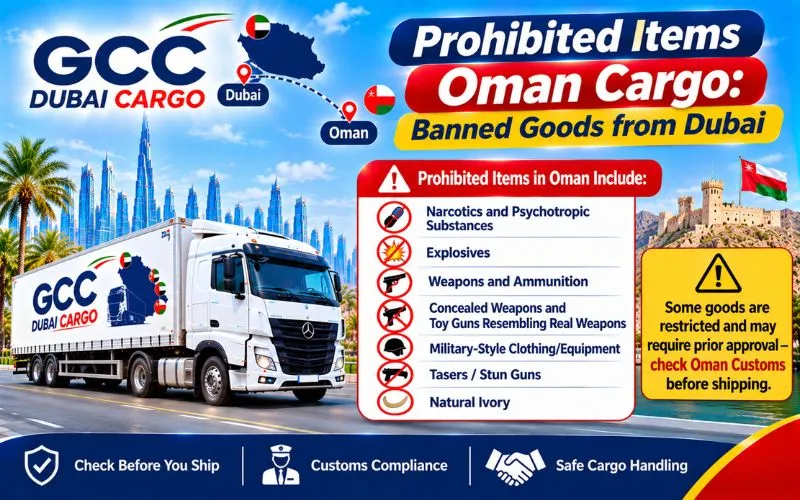
Weapons, Ammunition and Explosives
Weapons and ammunition are highly controlled products.
Items requiring particular caution include:
Firearms and ammunition
Explosive materials
Fireworks
Concealed weapons
Sharp objects designed as disguised weapons
Certain military equipment
Toy weapons that resemble real firearms
Omani customs authorities have also highlighted concerns involving stun devices, disguised weapons and military-style clothing.
Do not include weapons-related products in ordinary household or commercial cargo without confirming their legal status and any applicable authorization.
Even decorative products or replicas should not automatically be assumed acceptable.
Narcotics and Controlled Substances
Illegal narcotics and controlled drugs are among the most serious prohibited categories.
Customers should never conceal controlled substances inside household cartons, furniture, appliances or commercial packages.
Prescription medicines require a separate assessment because not every pharmaceutical product has the same legal status.
A medicine prescribed for personal use should not automatically be treated as ordinary household cargo. Check its active ingredients, intended use and applicable approval requirements before arranging transportation.
Counterfeit and Intellectual Property Violations
Counterfeit products can create serious customs problems.
Examples include:
Fake branded clothing
Imitation watches
Counterfeit footwear
Unauthorized branded accessories
Fake electronic products
Products using protected trademarks without authorization
Oman Customs identifies counterfeit and falsified products, including goods that violate intellectual property rights, as unacceptable imports.
A commercial invoice does not make counterfeit merchandise legitimate.
Businesses sending retail stock should verify product authenticity and ensure that the goods are accurately described.
Gambling Equipment and Prohibited Publications
Gambling equipment and certain materials prohibited under applicable Omani laws also require attention.
The nature and purpose of a product matter. A general electronic device should not automatically be classified as gambling equipment simply because it contains electronic components.
Likewise, printed materials, publications and media can be subject to restrictions relating to public order and applicable local regulations.
When shipping books, media collections or specialized equipment, check the product category rather than assuming that all items are treated alike.
Other Goods Restricted Under Omani Law
Oman Customs also applies restrictions under national legislation and international agreements.
These may involve products that violate approved specifications, intellectual property rights, international controls or other import requirements.
The official customs classification and applicable regulations should determine the status of the individual product.
Restricted Goods That May Need Special Approval
Some products are not necessarily prohibited, but they should not be dispatched until their import requirements have been checked.
Medicines and Pharmaceutical Products
Medicines need careful consideration because their ingredients, intended use and quantity can affect import requirements.
Before shipping pharmaceutical products, establish:
Exact medicine name and active ingredients
Manufacturer and packaging information
Intended use
Quantity being shipped
Whether the product is prescription-only
Whether special approval is required
Personal medicines and commercial pharmaceutical inventory should not be treated as identical shipments.
For commercial medicines, additional regulatory documentation or authorization may be necessary.
Customers should obtain confirmation from the appropriate Omani health authority before transportation.
Food, Agricultural Products and Plants
Food and agricultural shipments may require additional checks depending on the product.
Relevant considerations include:
Product ingredients
Manufacturing and expiry information
Country of origin
Packaging and labeling
Health certificates where applicable
Agricultural or phytosanitary requirements
Storage and transportation conditions
Fresh food, packaged food, seeds, plants and agricultural materials do not necessarily follow identical import procedures.
For example, a business sending packaged retail food to an Omani distributor may need to prepare different supporting information from an individual transporting ordinary household belongings.
Check the requirements for the specific product before booking road freight.
Cosmetics and Personal Care Products
Cosmetics and personal care items can be subject to product-specific requirements.
Examples include:
Skin-care products
Beauty creams
Perfumes
Hair treatments
Personal hygiene products
Commercial cosmetic inventory
The requirements may depend on ingredients, product registration, labeling, intended use and commercial quantity.
A few ordinary personal-care products should not automatically be classified in the same way as a commercial shipment containing hundreds of cosmetic units.
Businesses should confirm product compliance before arranging collection.
Telecommunications Equipment and Wireless Devices
Certain communication products require additional technical checks.
These can include:
Wireless communication equipment
Radio transmitters
Walkie-talkies
Specialized communication devices
Certain networking equipment
Devices using controlled radio frequencies
Ordinary household electronics and regulated telecommunications equipment are not necessarily treated alike.
Businesses importing specialized equipment should confirm whether technical approval or other documentation is required.
Chemicals, Batteries and Dangerous Goods
Some products create transportation safety concerns even when their import is otherwise permitted.
Examples include:
Industrial chemicals
Flammable liquids
Aerosols
Compressed gas cylinders
Certain cleaning chemicals
Damaged lithium batteries
Explosive or reactive materials
The shipping company may also have restrictions relating to dangerous goods, packaging, labeling and vehicle safety.
An item being legally importable does not automatically mean that every road cargo provider can carry it.
Always disclose the exact product, packaging and quantity before arranging collection.
Drones and Specialized Equipment
Drones and certain specialized devices may be subject to regulatory controls.
Their status can depend on intended use, technical specifications and applicable security or aviation requirements.
Customers should not assume that a small recreational drone is treated in the same way as an ordinary household electronic appliance.
Check whether the equipment requires authorization before sending it to Oman.
Are Household Goods and Personal Belongings Allowed?
Many people send furniture and personal belongings from Dubai to Oman when relocating or transferring household items.
Ordinary household products may include:
Sofas and chairs
Beds and mattresses
Dining tables
Wardrobes and cabinets
Household appliances
Clothing and personal belongings
Books and household boxes
Kitchen equipment
However, personal belongings are not automatically exempt from customs controls.
Oman Customs explains that the relevant exemption for personal effects and used household items is subject to conditions, including personal use, non-commercial quantities and applicable restrictions.
This means a household shipment should be accurately described rather than declared as miscellaneous personal cargo without an inventory.
Prepare a list showing the contents of each carton and identify larger furniture separately.
| Cargo item | Preparation |
|---|---|
| Sofa | Record quantity and dimensions |
| Bed and mattress | Identify each component |
| Washing machine | Record model and condition |
| Kitchen boxes | Describe general contents |
| Clothing cartons | Separate personal belongings |
| Electronics | Identify the type of equipment |
Avoid placing prohibited or questionable products inside otherwise acceptable household cartons.
Electronics, Furniture and Commercial Cargo
Electronics and furniture are common categories in Dubai-to-Oman cargo enquiries, but their import requirements depend on the exact products.
Ordinary furniture generally requires practical transportation preparation, while specialized electronic equipment may require additional regulatory checks.
For commercial shipments, prepare:
Product names
Quantities
Manufacturer details where relevant
Country of origin
Commercial invoice
Packing list
Applicable permits or certificates
Retail inventory should not be described simply as household belongings when it is intended for resale.
The same principle applies to office equipment, spare parts, machinery and business supplies.
Accurate cargo descriptions help distinguish ordinary merchandise from regulated products and support the customs declaration process.
How to Check an Item Before Shipping to Oman
The most reliable starting point is the official Directorate General of Customs.
Its online import and export requirements service allows users to investigate product-related restrictions, permits, approvals and procedures involving other government agencies.
Use the following approach:
Step 1: Identify the exact product.
Write down its commercial name, purpose, ingredients or technical specifications.
Step 2: Establish its classification.
For commercial goods, obtain the appropriate HS code where possible. A general product name may not provide enough information to determine the correct requirements.
Step 3: Check the Oman Customs requirements service.
Search for the applicable import conditions and identify any required approvals.
Step 4: Confirm with the relevant authority.
If the product is regulated, verify the documentation and approval process with the competent government authority.
Step 5: Check carrier acceptance.
Confirm whether the transportation provider can accept the product under its operating and safety rules.
Step 6: Keep supporting documents ready.
Prepare the relevant invoices, packing details, permits and product information before collection.
This process is especially important for medicines, chemicals, food, wireless equipment and commercial products.
Documents Needed for Restricted Cargo
Documentation varies according to the goods, their origin, intended use and applicable import requirements.
Depending on the shipment, the following documents may be relevant:
| Document | Purpose |
|---|---|
| Commercial invoice | Describes the goods and their declared value |
| Packing list | Identifies packages, quantities and contents |
| Certificate of origin | Establishes origin where applicable |
| Import permit | Provides required authorization for controlled products |
| Product certificate | Supports applicable product compliance |
| Health certificate | May be required for certain food or agricultural products |
| Transport documents | Identify the shipment and transportation details |
| Receiver information | Supports the destination clearance process |
Not every shipment requires every document.
Oman Customs also explains that foreign invoices or supporting documents may need Arabic translation where required.
Commercial cargo manifests and transportation information may also be required as part of the customs process.
Customers should check the requirements for their particular shipment rather than prepare an assumed universal document package.
Preparing Your Dubai Shipment Before Pickup
Correct preparation begins before the cargo is loaded.
For residential collections, confirm that the building permits the planned collection arrangements. Apartment buildings may require advance approval for loading bays, service elevators or vehicle access.
For villas, warehouses and offices, check parking and loading space.
When arranging cargo services in Dubai, provide practical collection details alongside the cargo description.
A useful preparation checklist includes:
Create a complete cargo inventory.
Separate personal and commercial goods.
Identify products requiring approval.
Measure furniture and oversized items.
Record approximate weights.
Photograph unusual or specialized equipment.
Protect fragile furniture and glass.
Secure cartons and label packages.
Keep invoices and permits accessible.
Confirm building access and loading arrangements.
Provide the receiver’s full delivery information.
For shared-load transportation, clear package identification is particularly useful because different customers’ goods may be transported together.
For full truckload movements, the cargo inventory should still identify every product and package accurately.
How Prohibited Items Can Affect Road Cargo to Oman
Road freight involves transportation from the UAE toward the Oman border and onward to the destination.
When cargo contains questionable or incorrectly declared goods, several problems may arise.
Customs inspection: Authorities may examine shipments and request additional information.
Missing approvals: Restricted goods may require permits or supporting certificates before clearance.
Incorrect declarations: Differences between the actual cargo and the invoice or packing list can create complications.
Shipment detention: Cargo may be held while its contents and import status are assessed.
Rejection or other enforcement action: Goods that cannot legally enter Oman may be refused, confiscated or dealt with under applicable regulations.
These outcomes depend on the nature of the goods and the relevant laws. No transportation company can guarantee that customs authorities will approve a shipment.
Customers should disclose questionable items before collection rather than waiting for an issue to arise at the border.
Common Shipping Mistakes and How to Avoid Them
Mistake 1: Assuming that everything purchased in Dubai can enter Oman.
Solution: Check the destination country’s import requirements for each regulated product.
Mistake 2: Hiding medicines inside household cartons.
Solution: Identify medicines separately and verify their import conditions.
Mistake 3: Using vague descriptions such as miscellaneous goods.
Solution: Prepare a clear inventory with product names and quantities.
Mistake 4: Treating commercial stock as personal belongings.
Solution: Identify whether the goods are intended for personal use, business use or resale.
Mistake 5: Sending restricted electronics without checking approvals.
Solution: Provide technical specifications and verify any applicable requirements.
Mistake 6: Preparing invoices after cargo collection.
Solution: Arrange the relevant commercial documents before dispatch.
Mistake 7: Assuming carrier acceptance means customs approval.
Solution: Check both transportation acceptance and Omani import requirements independently.
These simple checks can reduce preventable shipping problems and help customers make better transportation decisions.
How GCC Dubai Cargo Can Help with Permitted Cargo to Oman
Once the contents of a shipment have been identified and applicable restrictions have been checked, customers can plan the appropriate transportation arrangement.
GCC Dubai Cargo focuses on cargo and road transportation services from Dubai to GCC destinations.
For customers sending permitted goods to Oman, the transportation discussion should begin with the shipment’s actual requirements.
Useful information to provide includes:
Collection location in Dubai
Delivery city in Oman
Personal or commercial shipment type
Cargo inventory
Total weight
Package dimensions
Number of cartons or pallets
Any unusually large or heavy items
Applicable permits and supporting documents
Residential or commercial delivery requirements
The choice between full truckload (FTL) and less-than-truckload (LTL) transportation can depend on cargo volume, dimensions and delivery requirements.
Household furniture, commercial stock and industrial equipment may also require different loading arrangements.
GCC Dubai Cargo can discuss the appropriate road cargo arrangement based on the shipment information supplied.
Before requesting a quote, make sure all products are accurately identified and that restricted goods have been checked with the relevant authorities.
Contact GCC Dubai Cargo to discuss your permitted shipment from Dubai to Oman and provide the cargo details needed for a suitable transportation quotation.
Frequently Asked Questions | Prohibited Items Oman Cargo
Prohibited categories can include narcotics, certain weapons and explosives, counterfeit products, gambling equipment and other goods prohibited under Omani laws. The exact status should be checked against current customs requirements.
Some restricted products may be imported after obtaining the required permits, certificates or government approvals. Requirements depend on the product and its intended use. Approval should be confirmed before dispatch.
Ordinary furniture and personal belongings may be eligible for transportation, subject to applicable customs requirements. Prepare an accurate inventory and distinguish personal effects from commercial merchandise. Any restricted products must be checked separately.
Some products in these categories require special approvals, permits, registration or certificates. Requirements vary by product, ingredients, technical specifications and intended use. Check the applicable rules before arranging transportation.
Authorities may detain or confiscate prohibited goods and take further action under applicable regulations. Depending on the circumstances, the shipment may also experience delays, rejection or additional costs. Accurate declarations and pre-shipment verification are important.
Plan Your Dubai-to-Oman Cargo Shipment Carefully
Checking prohibited and restricted items before shipping is an essential part of international cargo preparation. Whether you are sending household furniture, personal belongings, business inventory or commercial equipment, understanding the applicable import requirements helps you prepare the correct shipment information.
GCC Dubai Cargo encourages customers to identify their goods accurately, verify restricted products with Oman Customs and prepare supporting documents before collection.
For permitted cargo, contact GCC Dubai Cargo to discuss road transportation from Dubai to Oman and request a quotation based on your shipment details.
Made Easy
GCC Cargo Destinations
Fast, secure, and reliable cargo delivery from Dubai to GCC countries.
Let's help you!
Need reliable cargo delivery from Dubai to GCC? Get in touch with our team today.
WhatsApp Now
+971 54 143 5685
Quick Links
© 2026 GCC Dubai Cargo. All Rights Reserved.
