
Cargo Delivery Time Dubai to GCC: Country by Country
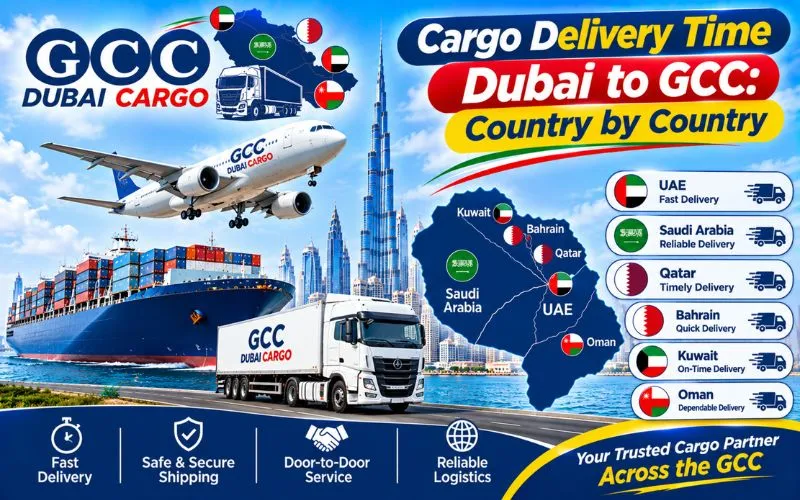
When sending cargo from Dubai to another GCC country, one of the first questions is how long the shipment will take to arrive. The answer depends on the destination, transportation route, cargo size, customs processing and final delivery arrangements.
A shipment going to Muscat may follow a much shorter road journey than one travelling to Jeddah or Kuwait City.
For individuals sending furniture and personal belongings, delivery timing helps with relocation planning. For businesses, it affects inventory availability, warehouse schedules and customer commitments.
GCC Dubai Cargo helps customers explore cargo transportation from Dubai to Saudi Arabia, Oman, Qatar, Bahrain and Kuwait. This guide explains the expected road freight timelines, destination differences and factors that can influence when cargo reaches its receiver.
One important distinction is that road transit time and complete door-to-door delivery time are not always identical. Pickup arrangements, packing, loading, customs procedures and unloading can all influence the overall schedule. Therefore, customers should confirm the estimated timeline for their exact shipment before arranging transportation.
How Long Does Road Cargo Take from Dubai to GCC Countries?
Road cargo delivery from Dubai to GCC destinations can range from relatively short regional movements to longer cross-border journeys involving multiple customs procedures.
The following table provides useful planning benchmarks based on published transportation schedules. Maersk’s UAE inland transportation information publishes different corridor estimates for individual destinations, illustrating why a single delivery estimate should not be applied to every GCC country.
| Destination | Published road transit benchmark |
|---|---|
| Saudi Arabia – Riyadh | 2–3 days |
| Saudi Arabia – Dammam | 2–3 days |
| Saudi Arabia – Jeddah | 6–7 days |
| Oman – Muscat | 1–2 days |
| Oman – Sohar | 1–2 days |
| Qatar | 4–5 days |
| Bahrain | 4–5 days |
| Kuwait | 7–8 days |
Source: Maersk's published UAE inland-service corridor information. These are provider-specific service estimates, not GCC Dubai Cargo delivery promises or guaranteed door-to-door schedules. The applicable service, cargo origin, destination and operating conditions must be confirmed.
These figures are useful starting points, but actual delivery schedules can differ. A shipment collected from a Dubai apartment may need additional preparation compared with palletized commercial goods ready for loading at a warehouse.
Customers should also check whether the quoted time includes pickup, border clearance and final residential or commercial delivery.
Dubai to Saudi Arabia: Delivery Time by Major City
Saudi Arabia is a major destination for household and commercial cargo leaving Dubai. However, the country covers a large geographical area, so the delivery schedule depends heavily on the receiving city.
Road shipments generally enter Saudi Arabia through the UAE–Saudi land border at Al Ghuwaifat–Al Batha before continuing toward their destination.
Riyadh and Central Saudi Arabia
Riyadh is an important destination for residential relocations, retail inventory, office equipment and commercial supplies.
Maersk publishes a two-to-three-day road transit benchmark for its UAE–Riyadh corridor. Actual collection-to-delivery time may be longer depending on dispatch arrangements, customs and the receiver’s location.
For residential cargo, customers should provide the building address, apartment details and access arrangements. Businesses should confirm warehouse receiving hours and unloading arrangements.
Dammam, Khobar and Jubail
Eastern Saudi Arabia is relevant for industrial supplies, machinery, commercial stock and household deliveries.
Dammam and Khobar are important locations for customers arranging goods for residential and business addresses. Jubail may require additional delivery coordination when cargo is intended for an industrial facility.
Maersk publishes a two-to-three-day benchmark for its Dammam corridor. This should not automatically be applied to every address in the Eastern Province.
Jeddah, Mecca and Medina
Western Saudi Arabia requires a longer inland journey from the UAE compared with destinations in the east.
Jeddah is relevant for furniture shipments, commercial inventory, retail products and household relocations. Maersk’s published UAE–Jeddah road corridor estimate is six to seven days, demonstrating the importance of checking the destination city rather than using a single Saudi delivery figure.
For Mecca, Medina and Taif, the receiving address and any applicable vehicle-access or delivery restrictions should be checked before dispatch.
Customers planning cargo from Dubai to Saudi Arabia can explore the destination-specific service information before requesting a quotation.
Dubai to Oman: Delivery Time and Destination Differences
Oman shares a land border with the UAE, making road transportation a practical option for many household and commercial shipments.
The route and final destination are important when calculating the delivery schedule.
Muscat, Sohar and Northern Oman
Muscat is a common destination for furniture, personal belongings, office equipment and business stock.
Sohar is relevant for industrial and commercial deliveries, including supplies intended for businesses and warehouse locations.
Maersk publishes a one-to-two-day transit benchmark for its UAE–Muscat and UAE–Sohar corridors. These estimates are useful for initial planning but should be checked against the actual pickup and delivery requirements.
Salalah and Southern Oman
Salalah is located much farther south than Muscat and Sohar. Customers should therefore request a destination-specific estimate instead of assuming that the northern Oman schedule applies.
A household shipment, commercial consignment or bulky equipment delivery may require different loading and unloading arrangements.
The cargo from Dubai to Oman service page provides a more focused starting point for customers arranging this route.
Dubai to Qatar: Why the Road Route Takes Longer Than Expected
Qatar is an important destination for household relocations, business supplies, retail stock and commercial equipment.
Unlike Oman and Saudi Arabia, Qatar does not share a direct land border with the UAE. Road shipments travelling from Dubai to Qatar normally pass through Saudi Arabia before entering Qatar.
This means the journey involves more than one international border process.
The route generally includes:
Cargo collection and preparation in Dubai.
Transportation toward the UAE–Saudi border.
Applicable customs and transit procedures.
Road transportation across Saudi Arabia.
Processing at the Saudi–Qatar border.
Final transportation to the receiving address in Qatar.
Doha is the main destination for many residential and commercial shipments. Deliveries to warehouses, offices and other locations outside central Doha should be assessed separately.
Maersk publishes a four-to-five-day benchmark for its UAE–Qatar road corridor. This is a useful example of why a customer should not calculate the complete delivery schedule using driving distance alone.
Before booking cargo from Dubai to Qatar, customers should provide accurate cargo descriptions and confirm the receiver’s information.
Dubai to Bahrain: Transit Through Saudi Arabia
Bahrain is another destination where route geography influences delivery planning.
Road cargo from Dubai normally travels through Saudi Arabia before reaching Bahrain via the King Fahd Causeway.
This route can be used for various shipment types, including household furniture, packaged goods, commercial stock and office equipment.
Manama is a major delivery destination. However, a shipment going to a specific warehouse, residential property or commercial facility may need additional unloading coordination.
The receiving party should be ready to accept the cargo and provide any required site-access details.
Maersk lists a four-to-five-day transit benchmark for its UAE–Bahrain corridor. Actual schedules can vary according to border processing, Saudi transit arrangements, causeway conditions and final delivery requirements.
Customers researching cargo from Dubai to Bahrain should confirm the expected schedule using their exact destination and shipment details.
Dubai to Kuwait: What Determines the Delivery Schedule?
Kuwait requires a longer road journey from Dubai, with shipments travelling through Saudi Arabia before reaching the Kuwait border.
Kuwait City is a common destination for household goods, retail products, office equipment, business inventory and industrial supplies.
The transportation schedule depends on the selected route, border processing, shipment readiness and the delivery location.
Maersk publishes a seven-to-eight-day transit benchmark for its UAE–Kuwait road corridor. This is notably longer than its published Oman and Riyadh estimates and highlights the importance of destination-specific planning.
Businesses should confirm warehouse receiving hours, unloading arrangements and the availability of suitable equipment for bulky cargo.
Customers arranging cargo from Dubai to Kuwait should share their complete shipment information when requesting a delivery estimate.
What Is Included in a Cargo Delivery Estimate?
One of the most common misunderstandings in international cargo transportation is assuming that the stated transit time covers every activity from the moment a customer makes an enquiry.
In reality, a shipment can pass through several stages.
| Stage | What happens |
|---|---|
| Booking and preparation | Cargo information and transportation arrangements are confirmed. |
| Pickup | Goods are collected from the Dubai address. |
| Packing and loading | Items are protected, organized and loaded as required. |
| Documentation | Applicable shipment paperwork is prepared and checked. |
| Road transportation | Cargo moves toward the destination country. |
| Border processing | Applicable export, transit and import procedures are completed. |
| Final delivery | Cargo reaches the receiving address and unloading is arranged. |
Some of these activities may overlap, depending on the shipment and transportation arrangements.
When requesting a quote, ask whether the estimated schedule begins at pickup, truck departure or completion of customs formalities.
This simple question helps prevent misunderstandings.
FTL vs LTL: Which Option Has a More Predictable Schedule?
Transportation method can influence how quickly cargo is dispatched.
Full Truckload (FTL)
Full Truckload means a truck is dedicated to one customer’s shipment.
It can be suitable for:
Complete household relocations.
Large furniture shipments.
Commercial inventory.
Industrial machinery.
Heavy or bulky cargo.
Large quantities of business supplies.
Because the shipment does not need to share truck space with unrelated consignments, there may be fewer consolidation activities.
However, FTL does not remove customs procedures or guarantee a particular arrival date.
Less Than Truckload (LTL)
Less Than Truckload allows multiple shipments to share available truck space.
It can be suitable for:
Household cartons.
Smaller furniture consignments.
Retail stock.
Office supplies.
Smaller commercial shipments.
LTL can involve additional time for cargo consolidation, scheduled departures and unloading arrangements.
For customers comparing options, the most important question is whether the saving from shared transportation justifies the potentially different dispatch schedule.
How Cargo Type and Shipment Size Affect Delivery
Two shipments travelling to the same city may need different transportation arrangements.
Household cargo: Furniture, beds, sofas, cabinets, mattresses, appliances and personal belongings require suitable loading and unloading planning.
Commercial cargo: Retail inventory, packaged products, spare parts and office equipment may require accurate quantities and commercial documentation.
Heavy cargo: Machinery, generators, industrial equipment and oversized goods may require additional vehicle planning and loading arrangements.
Fragile cargo: Glass, electronics, appliances and furniture with delicate surfaces should be properly protected before collection.
Customers should provide the actual weight and dimensions rather than relying on rough estimates.
Large items may occupy more truck space than their weight suggests, affecting vehicle selection and transportation arrangements.
Customs Documentation and Border Processing
Documentation is an important part of cross-border cargo delivery.
The paperwork required depends on the destination country, cargo type, product classification and whether the shipment is personal or commercial.
Potentially relevant documents include:
Commercial invoice.
Packing list.
Transport documentation.
Certificate of origin, where applicable.
Importer or receiver details.
Product-specific permits or certificates, where required.
Customs declarations and applicable transit documents.
Not every shipment requires every document.
For example, a business shipment of packaged products may need different supporting information from a household relocation containing used furniture and personal belongings.
Incorrect quantities, incomplete descriptions or differences between the actual cargo and paperwork can create additional checks.
Customers should confirm the applicable requirements before dispatch rather than assuming that one documentation checklist works for every GCC destination.
Dubai Pickup and Final Delivery: Details That Affect Scheduling
Delivery planning begins at the pickup address.
Dubai shipments can originate from apartments, villas, offices, shops and warehouses. Each location may have different access conditions.
Before collection, confirm:
Whether the building allows commercial loading.
Whether a service elevator needs to be reserved.
Whether building management approval is required.
Whether the truck can park near the loading entrance.
Whether underground parking has vehicle-height restrictions.
Whether furniture can pass through doors and elevators.
Whether stairs or long carrying distances are involved.
For final delivery, customers should provide equivalent information about the receiving property.
A truck may reach a destination city without being able to unload immediately because the receiver has not arranged access.
For more information about origin-side arrangements, customers can explore the available cargo services in Dubai.
Common Reasons GCC Cargo Arrives Later Than Expected
Several practical problems can affect an otherwise straightforward shipment.
| Potential problem | Practical solution |
|---|---|
| Incomplete shipment documents | Check cargo descriptions, quantities and applicable paperwork before dispatch. |
| Border inspections | Allow a reasonable planning buffer and provide accurate shipment information. |
| Public holidays | Confirm operating schedules before selecting a pickup date. |
| LTL consolidation | Ask about the planned dispatch schedule. |
| Incorrect cargo dimensions | Measure bulky goods before requesting a quote. |
| Limited destination access | Confirm truck access and unloading arrangements. |
| Receiver unavailable | Arrange a suitable delivery date and contact person. |
| Fragile cargo poorly packed | Protect vulnerable items before loading. |
Customers should also avoid making fixed relocation or stock-replenishment commitments based solely on the shortest advertised transit estimate.
A realistic delivery window is more useful than an optimistic promise.
How to Prepare Your Shipment Before Collection
Good preparation helps make the transportation process easier to coordinate.
Use this checklist before arranging pickup:
Create an inventory of all items.
Separate personal and commercial cargo.
Measure sofas, beds, cabinets and other large items.
Estimate the total shipment weight.
Photograph unusual, valuable or oversized items.
Protect glass and fragile surfaces.
Secure cartons and label their contents.
Keep related paperwork together.
Confirm the Dubai pickup address and access.
Confirm the destination address and receiver details.
Check whether the receiver can unload the shipment.
Identify any products that may require additional documentation or approval.
For furniture shipments, measure both the item and the access route. A large wardrobe may fit inside a truck but fail to pass through the receiving property’s elevator or entrance.
These small checks can prevent avoidable delivery complications.
What Information Should You Provide for an Accurate Delivery Estimate?
Customers do not need to wait until the shipment is fully packed to start discussing transportation. However, accurate information helps produce a more useful estimate.
When contacting GCC Dubai Cargo, prepare the following:
| Information | Why it matters |
|---|---|
| Pickup location in Dubai | Helps assess collection arrangements. |
| Destination country and city | Determines the route and destination requirements. |
| Cargo description | Helps identify the nature of the shipment. |
| Approximate weight | Supports vehicle and capacity planning. |
| Cargo dimensions | Helps calculate the space required. |
| Number of cartons or items | Provides a clearer shipment inventory. |
| Personal or commercial shipment | Helps identify applicable documentation. |
| FTL or LTL preference | Helps determine transportation arrangements. |
| Pickup readiness date | Helps plan collection and dispatch. |
| Delivery address | Helps assess final-mile requirements. |
| Special handling requirements | Identifies fragile, heavy or oversized items. |
Also mention whether you need pickup from a residential property, office or warehouse.
If the shipment includes machinery, unusually large furniture or regulated products, disclose this before transportation is arranged.
Planning a shipment from Dubai?
The more accurate your information, the easier it is to assess the delivery requirements before booking.
Frequently Asked Questions | Cargo Delivery Time Dubai to GCC
Delivery time depends on the destination and selected transportation service. Published Maersk corridor estimates include one to two days for Muscat, two to three days for Riyadh, four to five days for Qatar and Bahrain, and seven to eight days for Kuwait. These are provider-specific benchmarks, not guaranteed delivery times for every shipment.
These countries do not share a direct land border with the UAE. Road shipments normally travel through Saudi Arabia before reaching Qatar, Bahrain or Kuwait. The additional transit and border procedures can influence the overall delivery schedule.
FTL may offer a more direct dispatch schedule because the truck is dedicated to one shipment. LTL involves shared truck space and may require consolidation before departure. However, customs processing, route conditions and destination delivery can affect both options.
Yes. Delivery to Dammam may require a different schedule from delivery to Jeddah, while Muscat and Salalah also involve different distances. Customers should provide the exact city and delivery address when requesting an estimate.
The starting point depends on the transportation quotation. Some estimates begin when the truck departs, while others may include pickup and border processing. Always confirm whether the stated delivery window includes collection, loading, customs clearance and final unloading.
Made Easy
GCC Cargo Destinations
Fast, secure, and reliable cargo delivery from Dubai to GCC countries.
Let's help you!
Need reliable cargo delivery from Dubai to GCC? Get in touch with our team today.
WhatsApp Now
+971 54 143 5685
Quick Links
© 2026 GCC Dubai Cargo. All Rights Reserved.
