
Cargo Documents for Saudi Arabia: Complete Checklist from Dubai
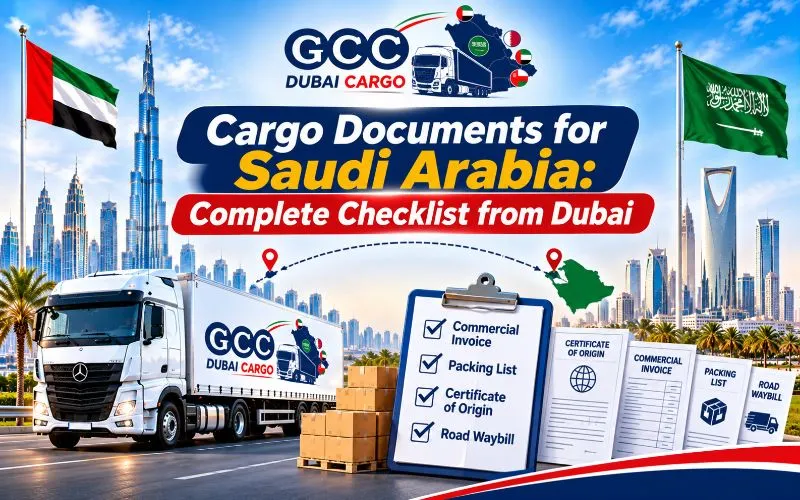
Shipping cargo from Dubai to Saudi Arabia requires more than arranging a truck and preparing your goods. The shipment information and supporting documents must also be ready before transportation begins.
Incorrect product descriptions, missing receiver details or paperwork that does not match the actual cargo can create problems during customs procedures.
Whether you are sending furniture to Riyadh, commercial stock to Jeddah, machinery to Dammam or household belongings to another Saudi destination, preparing the correct documentation is an important part of the shipping process.
This guide explains the main cargo documents to consider when shipping from Dubai to Saudi Arabia. It covers commercial invoices, packing lists, certificates of origin, transport paperwork, importer information and additional product-specific requirements.
It also explains how households and businesses can organize their shipment details before arranging cargo from Dubai to Saudi Arabia with GCC Dubai Cargo.
Why Cargo Documentation Matters When Shipping from Dubai to Saudi Arabia
Saudi Arabia has import procedures that require appropriate shipment information and supporting documents. The paperwork helps identify the goods, establish their declared value and origin, and provide information about the importer and transportation.
For road cargo from Dubai, documentation preparation should begin before the goods are collected.
A business shipping several cartons of retail products has different paperwork considerations from a family sending furniture and personal belongings. Machinery, electronic products and other regulated goods may also have additional requirements.
Proper preparation helps customers:
Provide accurate information about the shipment.
Identify documents that may be required for their products.
Give the Saudi receiver time to prepare.
Reduce the risk of discrepancies between paperwork and physical cargo.
Help the relevant customs broker review the shipment.
Arrange transportation with a clearer understanding of the shipment.
The exact requirements depend on the goods, their origin, the import arrangement and applicable Saudi regulations.
Essential Documents to Prepare Before Shipping
The following documents are important starting points when planning a shipment to Saudi Arabia. Not every document applies in exactly the same way to every road shipment, so confirm the applicable requirements with the importer or customs broker.
Commercial Invoice
A commercial invoice describes the transaction and provides information about the goods being shipped.
For commercial cargo, it generally identifies the exporter, importer, products, quantities and declared values.
Review the following information:
Exporter’s name and address.
Saudi buyer or consignee details.
Invoice number and date.
Description of each product.
Quantity of each item.
Unit value and total value.
Currency.
Country of origin, where applicable.
Other product information required for customs classification.
Descriptions should be specific enough to identify the actual products.
For example, writing only “general goods” does not explain whether a shipment contains electronic accessories, furniture parts or retail products.
If a company is sending different products, list them separately rather than combining unrelated goods under one unclear description.
The invoice should accurately represent the actual shipment.
Packing List
A packing list explains how the goods are arranged into packages, cartons or other shipping units.
It is particularly useful for mixed shipments containing different products, package sizes or measurements.
A practical packing list can include:
Total number of packages.
Package or carton identification.
Contents of each package.
Quantity of individual items.
Package dimensions.
Net weight and gross weight, where available.
Marks or labels identifying the packages.
For example, a business sending 15 cartons of spare parts should prepare an inventory that explains the contents and quantities rather than simply writing “15 cartons.”
The packing list should match the physical cargo. If the final shipment contains more cartons or different products than originally recorded, update the information before dispatch.
Saudi ZATCA’s land-port customs guidance also identifies a packing list for consignments containing multiple items or different measurements. Requirements should be confirmed for the particular shipment.
Certificate of Origin
A certificate of origin identifies the country where the goods originate.
It can be relevant when goods are exported from Dubai to Saudi Arabia, particularly for commercial shipments and customs assessment.
An important distinction is that goods shipped from the UAE are not automatically UAE-origin goods. A product purchased in Dubai may have been manufactured in another country.
The origin information should therefore reflect the actual origin of the product, not simply the country from which it is dispatched.
Saudi ZATCA’s import instructions list a certificate of origin among the import documents but state that it is unnecessary when the country of origin is clearly established.
Do not assume that the certificate is either compulsory or unnecessary for every shipment. Confirm the acceptable origin evidence and documentation with the Saudi importer or customs broker.
Road Transport and Shipment Documents
A road shipment also needs appropriate transportation documentation.
The exact transport document depends on the transport arrangement and the customs procedure. A bill of lading is commonly associated with sea freight, while road transportation uses the applicable road consignment or transport documentation.
Before the cargo leaves Dubai, confirm:
Shipper information.
Consignee information.
Shipment description.
Number of packages.
Cargo weight.
Collection and delivery details.
Transport information.
Any reference numbers required by the transport or customs parties.
The transport information should be consistent with the commercial shipment details.
Information Required from the Saudi Importer or Receiver
Documentation is not only the responsibility of the person arranging the shipment in Dubai. The Saudi receiver may also need to provide information or complete import-related procedures.
Before arranging pickup, confirm the following details:
| Information | Why It Matters |
|---|---|
| Receiver's Full Name | Identifies the consignee |
| Saudi Delivery Address | Establishes the final destination |
| Contact Number | Supports delivery coordination |
| Importer or Company Details | Helps establish the importing party |
| Commercial Registration Details, Where Applicable | Supports relevant business import procedures |
| Product Information | Helps determine applicable import requirements |
| Required Authorizations | Supports customs or broker arrangements |
For commercial shipments, the Saudi importer should confirm that the goods can be imported under the applicable business and product requirements.
For personal shipments, the receiver should confirm which identification and supporting information is appropriate for the nature of the belongings.
Avoid using incomplete receiver details or an informal product description when preparing shipping paperwork.
Additional Documents That May Apply to Certain Products
Some products have requirements beyond ordinary shipment documentation.
Saudi Arabia’s Zakat, Tax and Customs Authority explains that importers may need additional documents depending on the nature of the imported goods.
Product Conformity and Registration
Certain regulated products may require conformity documentation or registration with the relevant Saudi authority.
For example, some products may be subject to IECEE-related requirements or product registration.
The SABER platform is also relevant to regulated product conformity procedures.
The importer should check whether the specific product requires a conformity certificate, shipment certificate, self-declaration or another applicable procedure.
Do not assume that every product needs the same SABER documentation.
Special Permits and Approvals
Some categories of goods may require approval from the relevant government authority before importation.
The requirements depend on product classification and applicable regulations.
Before sending goods such as regulated electronics, food products, chemicals, medical-related products or other controlled categories, confirm the applicable conditions.
A general cargo quotation does not establish that a particular product is approved for import.
The Saudi importer or customs broker should verify the current requirements using the Saudi customs tariff and the relevant regulatory authority.
Documents for Commercial Cargo from Dubai to Saudi Arabia
Businesses shipping stock, equipment, spare parts or wholesale products should prepare detailed commercial shipment information.
Commercial cargo may include:
Retail inventory.
Wholesale products.
Office equipment.
Business supplies.
Machinery parts.
Packaged goods.
Industrial materials.
For these shipments, the commercial invoice and packing list should describe the actual products and quantities.
The business should also confirm the product origin, applicable tariff classification and any required conformity or import approvals.
For mixed commercial shipments, separate product descriptions are especially important.
For example, a shipment containing electrical accessories, spare parts and office supplies should not be recorded under one broad description if the products have different classifications.
Businesses should ask their Saudi receiver to review the paperwork before the goods are loaded in Dubai.
Documents and Preparation for Household Goods and Personal Belongings
Household cargo needs careful inventory preparation.
A family sending furniture and personal belongings from Dubai to Riyadh, Jeddah or another Saudi city should create a clear record of the items.
The inventory may include:
Sofas and chairs.
Beds and mattresses.
Tables and cabinets.
Household appliances.
Clothing cartons.
Kitchen items.
Personal belongings.
Other furniture and household equipment.
Record the quantity and description of each item.
For larger furniture, include dimensions where possible. Take photographs of unusual, valuable or fragile items before packing.
Personal belongings should not automatically be treated as commercial stock. Equally, customers should not assume that household goods are exempt from all customs procedures.
The receiver should confirm the applicable personal-effects conditions, supporting documents and any eligibility requirements before collection.
Paperwork Considerations for FTL and LTL Road Cargo
The transportation arrangement can affect how shipment details are organized.
Full Truckload Cargo
FTL means a dedicated truck arrangement for a shipment.
A business sending machinery, a large furniture consignment or substantial commercial stock may consider this option.
The shipment information should clearly record the complete cargo description, package count, measurements, weight and receiver details.
Where several products are loaded together, the commercial documentation should identify them properly.
Less Than Truckload Cargo
LTL refers to a shipment that uses part of the available truck capacity.
This arrangement may suit customers sending a smaller quantity of goods.
Even when a shipment shares transportation capacity, its own cargo description and applicable documentation must be accurate.
Do not assume that combining different customers’ goods removes the need to identify each shipment separately.
How to Prepare an Accurate Cargo Inventory in Dubai
A reliable inventory is one of the most useful preparation steps before arranging cargo transportation.
Start by separating the goods into categories.
For example, a commercial shipment may contain cartons of products, machinery components and office equipment. A household shipment may contain furniture, appliances and personal boxes.
Record the following:
| Inventory Detail | Preparation |
|---|---|
| Item Description | Use a clear product name |
| Quantity | Count individual items |
| Package Count | Record the number of cartons or units |
| Dimensions | Measure larger packages and furniture |
| Weight | Provide available weight information |
| Condition | Record existing damage where relevant |
| Photographs | Photograph unusual or fragile cargo |
| Destination | Confirm the Saudi receiver and address |
Do not estimate measurements when accurate figures can be collected.
If a sofa, cabinet or machine has unusual dimensions, provide those measurements before requesting transportation.
This helps assess loading arrangements, truck capacity and destination access.
How to Check Your Cargo Documents Before Pickup
Document preparation should be completed before the collection is arranged.
For Dubai pickups, consider the actual collection environment.
A shipment collected from an apartment may require different loading arrangements from cargo collected at a warehouse or commercial loading bay.
Check whether:
Building management approval is needed.
A service elevator must be booked.
Large furniture can fit through access points.
The loading area is available.
Vehicle parking is suitable.
The cargo can be moved safely from the property.
The final package count matches the inventory.
For more information about local preparation and available arrangements, see our cargo services in Dubai.
Before collection, compare the cargo inventory, invoice, packing list and transport information.
Any change to the shipment should be reflected in the relevant paperwork.
Saudi Arabia Customs Clearance and Pre-Arrival Preparation
Saudi import procedures require the importer to arrange the appropriate customs documentation and declaration.
ZATCA’s official import instructions identify the commercial invoice, bill of lading and certificate of origin as import documents, with product-specific requirements where applicable.
The importer can complete relevant clearance procedures through the Fasah platform or work with a customs broker.
There is an important timing consideration: ZATCA’s published import instructions refer to completing the customs declaration and supporting procedures at least 48 hours before arrival, while a separate ZATCA announcement dated November 26, 2024, discusses a 72-hour pre-arrival submission requirement.
Because these published instructions differ, the importer or customs broker should confirm the current applicable deadline for the particular shipment and entry procedure before dispatch.
The important preparation principle is to avoid waiting until the cargo reaches the border before checking the documents.
Common Documentation Mistakes That Can Delay a Shipment
Several paperwork problems can create unnecessary complications.
Incorrect product descriptions
A vague description may make it difficult to identify the goods.
Solution: Record the actual product names and relevant details.
Different quantities on the invoice and packing list
The documents may show different quantities.
Solution: Compare the final inventory against both documents before dispatch.
Incorrect country of origin
The shipping location may be confused with the manufacturing origin.
Solution: Verify the actual origin of the goods.
Missing receiver information
The Saudi consignee details may be incomplete.
Solution: Confirm the receiver’s name, address and contact information before collection.
Unverified product approvals
A product may have additional import requirements that were not checked.
Solution: Ask the importer or customs broker to verify applicable approvals before shipping.
Unrecorded cargo changes
Additional cartons or replacement items may be loaded without updating the paperwork.
Solution: Update the inventory and relevant documents to reflect the final shipment.
Practical Documentation Examples for Different Saudi Destinations
The destination city should be recorded accurately, but the document requirements are not determined by the city name alone.
The type of goods and applicable import procedures remain important.
For example:
Riyadh: A household shipment may contain furniture and personal boxes, while a business shipment may contain retail inventory or office equipment. The inventory and receiver address should reflect the actual delivery.
Jeddah: Commercial cargo intended for a warehouse should identify the business receiver and delivery location clearly.
Dammam and Al Khobar: Industrial shipments may include machinery parts, tools or equipment. Product descriptions, dimensions and any applicable approvals should be checked before dispatch.
Jubail: Businesses sending industrial materials or equipment should confirm the product classification and relevant import requirements with the receiver.
Makkah and Madinah: Customers arranging household or commercial deliveries should provide accurate destination and receiver information, alongside the applicable shipment documents.
If you are planning a shipment to one of these destinations, the cargo from Dubai to Saudi Arabia service page provides further route-related information.
How Documentation Affects Cargo Quotations
A cargo quotation requires accurate shipment information.
Although documents do not determine every transportation cost, the details recorded in them can help clarify what is being transported and how it should be handled.
Important quotation factors include:
Total shipment weight.
Cargo volume.
Number of packages.
Individual item dimensions.
Destination city.
FTL or LTL requirements.
Loading and unloading arrangements.
Residential or commercial delivery access.
Heavy or oversized items.
Packing requirements.
Customs-related documentation and product approvals.
When requesting a quotation from GCC Dubai Cargo, provide the cargo inventory, photographs, pickup location and Saudi delivery address.
For commercial cargo, also provide available invoice and packing information.
This makes it easier to understand the shipment before discussing transportation arrangements.
Preparing Your Dubai-to-Saudi Shipment Step by Step
Use the following preparation sequence:
Identify whether the shipment contains household belongings, commercial goods or a combination.
Create a detailed inventory.
Count packages and measure large items.
Collect the commercial invoice where applicable.
Prepare the packing list according to the actual cargo.
Confirm country-of-origin information.
Collect the applicable road transport documentation.
Obtain importer and receiver information.
Check product-specific requirements with the Saudi importer or customs broker.
Compare all documents against the final cargo before loading.
Confirm Dubai pickup and Saudi delivery arrangements.
Ensure applicable customs procedures are prepared before the shipment reaches the entry point.
This process helps customers organize their shipment without assuming that one document checklist applies to every type of cargo.
Frequently Asked Questions | Cargo Documents for Saudi Arabia from Dubai
The applicable documents may include a commercial invoice, transport document, certificate of origin and packing list, depending on the shipment and customs procedure. Certain products may also require additional certificates, registration or permits. Confirm the exact requirements with the Saudi importer or customs broker.
Not necessarily. Saudi ZATCA's import instructions state that a certificate of origin is unnecessary when the country of origin is clearly established. The acceptable evidence should be confirmed for the particular shipment.
Not automatically. Personal belongings and commercial goods can have different documentation and import considerations. Household shipments should have a clear inventory, while the receiver should confirm the applicable personal-effects requirements.
Responsibilities can be shared between the exporter, shipper, importer and customs broker. The exporter supplies accurate shipment information and applicable export paperwork, while the Saudi importer or appointed broker handles the relevant import procedures and confirms additional requirements.
Yes. Incorrect descriptions, inconsistent quantities, inaccurate values or missing supporting information can create questions during customs review. Check the invoice, packing list, cargo inventory and transport information before dispatch.
Arrange Your Cargo from Dubai to Saudi Arabia with GCC Dubai Cargo
Preparing the correct documents is an important step in organizing a road cargo shipment from Dubai to Saudi Arabia.
Before requesting transportation, collect your cargo inventory, package quantities, measurements, photographs, pickup details and Saudi receiver information. For commercial goods, also prepare the available invoice, packing list and applicable product documentation.
GCC Dubai Cargo provides cargo and road freight services from Dubai for customers planning shipments to Saudi Arabia and other GCC destinations.
For shipment enquiries and quotations:
Business: GCC Dubai Cargo
WhatsApp: +971 54 143 5685
Email: info@gccdubaicargo.com
Website: https://gccdubaicargo.com/
Share your shipment details so the transportation requirements can be reviewed before arranging your cargo.
Made Easy
GCC Cargo Destinations
Fast, secure, and reliable cargo delivery from Dubai to GCC countries.
Let's help you!
Need reliable cargo delivery from Dubai to GCC? Get in touch with our team today.
WhatsApp Now
+971 54 143 5685
Quick Links
© 2026 GCC Dubai Cargo. All Rights Reserved.
