
Cargo from Dubai to Makkah

Sending cargo from Dubai to Makkah requires more than simply putting items on a truck. The shipment needs to be described accurately, prepared for a cross-border road journey, matched with an appropriate transportation option, and planned around the final delivery address.
For a household shipment, that may mean preparing furniture, appliances, cartons and personal belongings. For a business, it may involve pallets, retail stock, office equipment, spare parts or other commercial goods. Large or heavy items require additional attention to dimensions, loading access and vehicle capacity.
GCC Dubai Cargo provides a Dubai-origin cargo solution for customers planning transportation toward Saudi Arabia. Before requesting a quotation, it is useful to know exactly what you are shipping, how much space it occupies, where it will be collected and what type of delivery location is waiting in Makkah.
This guide explains the practical considerations involved in cargo from Dubai to Makkah, from preparing the shipment in Dubai to arranging the final delivery.
Shipping Cargo from Dubai to Makkah
Makkah, also written as Mecca, is a major destination in western Saudi Arabia. A shipment going there is part of a cross-border UAE-to-Saudi transportation movement, so the customer needs to consider both the physical movement of the cargo and the documentation associated with entering Saudi Arabia.
For customers comparing route options, our broader cargo from Dubai to Saudi Arabia page provides country-level information, while this page focuses specifically on the practical requirements of shipping toward Makkah.
Road transportation can be suitable for many different shipment sizes, particularly where the cargo is too large for an ordinary parcel service or where multiple cartons, furniture pieces or pallets need to move together.
The first step is always to establish the shipment details.
A useful cargo description should include:
- Type of goods
- Number of cartons, pallets or individual pieces
- Approximate total weight
- Dimensions of large items
- Packaging condition
- Pickup location in Dubai
- Final delivery location in Makkah
- Receiver information
- Photos where the cargo is unusually large, fragile or difficult to describe
Accurate information helps determine the appropriate transportation arrangement and makes quotation discussions more straightforward.
What Makes a Makkah Cargo Shipment Different?
A Makkah shipment should be planned around the actual destination rather than treated as a generic Saudi shipment.
The final address may be a residence, business, warehouse or another approved delivery location. Each can create different unloading requirements.
For example, a family sending furniture may need to consider:
- Building entrance
- Parking access
- Elevator availability
- Stair access
- Furniture dimensions
- Distance between vehicle and entrance
- Whether large furniture can enter the building
A business shipment may instead require:
- Warehouse access
- Loading or unloading area
- Receiving hours
- Pallet access
- Site contact information
- Space for unloading
Providing this information before transportation is arranged can help avoid practical problems at the destination.
Residential and Personal Shipments
Household cargo can include furniture, appliances, clothing, cartons, personal effects and other belongings.
The customer should create an inventory instead of describing the shipment simply as “household items.” A list such as five cartons, one sofa, one bed, one wardrobe and two tables provides much more useful information.
Large furniture should be measured before pickup, especially if it needs to pass through elevators, corridors or doors.
Commercial and Business Cargo
Commercial cargo may include:
- Retail inventory
- Packaged products
- Office equipment
- Business supplies
- Spare parts
- Tools
- Machinery
- Pallets and cartons
Commercial shipments also need accurate product descriptions and documentation. The physical cargo should match the information supplied for transportation and customs purposes.
Cargo You Can Prepare for the Makkah Route
The suitable transportation arrangement depends on the actual cargo rather than simply its category.
Household Furniture and Personal Belongings
Common household items can include:
- Sofas
- Beds
- Mattresses
- Tables
- Chairs
- Cabinets
- Wardrobes
- Appliances
- Household cartons
- Personal belongings
Furniture should be protected against movement, rubbing and impact during loading and transportation. Remove or secure loose components where appropriate and protect surfaces that can scratch easily.
Glass, mirrors and other fragile components need additional attention.
Commercial Stock and Business Supplies
Businesses may send:
- Retail stock
- Packaged goods
- Office supplies
- Electronics
- Spare parts
- Business equipment
- Product cartons
- Palletized goods
Commercial cargo should be counted carefully before dispatch. If ten cartons are listed but only nine are physically presented for loading, the discrepancy can create unnecessary questions later.
Heavy, Bulky and Fragile Items
Large or heavy cargo needs more planning than ordinary cartons.
Examples include:
- Machinery
- Industrial equipment
- Large furniture
- Construction-related equipment
- Heavy tools
- Oversized commercial items
For these shipments, provide dimensions and approximate weight as early as possible.
Fragile items such as glass, electronics, appliance components and polished furniture surfaces should also be identified before loading.
Choosing LTL or FTL for Dubai to Makkah Cargo
One of the most important decisions is whether the shipment requires dedicated truck capacity or can move as part of a consolidated load.
When LTL May Fit
LTL — less-than-truckload — generally refers to cargo that does not require the full capacity of a truck.
It may be relevant when the shipment consists of a smaller quantity of cartons, pallets or other cargo.
The shipment still needs accurate dimensions and weight because available space and handling requirements depend on the physical cargo.
LTL can be considered for shipments such as:
- Several cartons of commercial stock
- A limited number of pallets
- Personal belongings
- Smaller furniture consignments
- Business supplies
When FTL May Be More Suitable
FTL — full truckload — is intended for shipments requiring dedicated truck capacity.
It may be appropriate where the shipment is large enough to justify a dedicated vehicle or where the customer has specific loading and delivery requirements.
Examples can include:
- Large furniture movements
- Multiple pallets
- Business inventory
- Machinery
- Heavy equipment
- Large commercial consignments
The correct option depends on cargo volume, weight, dimensions, destination requirements and the transportation arrangement available for the shipment.
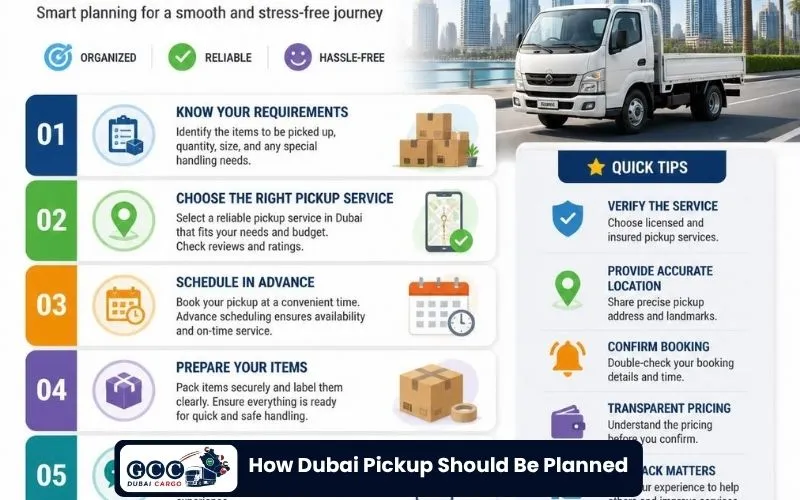
How Dubai Pickup Should Be Planned
The pickup location can affect how easily large cargo is collected.
Dubai shipments may originate from:
- Apartments
- Villas
- Offices
- Warehouses
- Shops
- Commercial buildings
- Industrial locations
Before pickup, check whether the building has a designated loading area.
For apartment or office shipments, customers should confirm:
- Whether service elevators are available
- Whether elevator booking is required
- Whether building management approval is needed
- Where the vehicle can park
- How far the cargo must be carried
- Whether stairs are involved
- Whether large furniture can fit through entrances and elevators
Building rules can vary, so customers should confirm specific requirements directly with their building or community management.
For businesses and warehouses, check loading-bay availability and whether the vehicle can access the premises.
If you are arranging local preparation or collection in Dubai, you can also review our cargo services in Dubai page.
Preparing Furniture and Large Items
Furniture can be deceptively difficult to transport because its dimensions may be more important than its weight.
Before pickup:
- Measure large furniture.
- Record length, width and height.
- Photograph unusual or oversized pieces.
- Remove loose accessories.
- Protect surfaces against scratches.
- Secure drawers and doors where appropriate.
- Separate fragile components.
- Check whether the furniture can pass through the pickup building.
- Check the destination access requirements.
Do not rely only on the statement that an item is “one sofa” or “one wardrobe.” Two sofas of the same general type can have very different dimensions and packing requirements.
Cargo Information Needed for a Quote
A useful quotation request should contain enough information to understand the physical shipment.
| Information | What to Provide |
|---|---|
| Cargo Type | Furniture, cartons, machinery, commercial goods, etc. |
| Quantity | Number of pieces, cartons or pallets |
| Weight | Approximate total weight |
| Dimensions | Length × width × height of large items or packages |
| Packaging | Carton, pallet, crate, wrapped furniture, etc. |
| Condition | New, used, assembled or disassembled |
| Pickup | Dubai location and building/site type |
| Destination | Makkah delivery address |
| Receiver | Name and contact details |
| Photos | Useful for unusual, large or fragile cargo |
| Special Requirements | Loading, access or handling considerations |
Providing these details at the quotation stage reduces the need for repeated questions and allows the shipment to be evaluated according to its actual characteristics.
Documents and Saudi Customs Preparation
Cross-border cargo requires attention to documentation. The exact requirements can vary according to the goods, shipment type, importer, product and applicable Saudi regulations.
Current ZATCA guidance lists a commercial invoice and bill of lading among import documents, while a certificate of origin may also apply depending on the circumstances.
ZATCA also states that additional documents can be required according to the nature of the goods, including product-specific approvals or registrations.
For some land-import situations, ZATCA guidance also refers to documents such as an original invoice, certificate of origin and packing list depending on the shipment.
Customers should therefore prepare information such as:
- Commercial invoice where applicable
- Packing list where applicable
- Transport documentation
- Certificate of origin where applicable
- Importer or receiver information
- Product-specific permits or approvals where applicable
- Accurate cargo descriptions
Do not assume that every shipment requires every document.
Personal and commercial shipments can have different requirements. Restricted products may also require approvals from relevant authorities.
ZATCA’s personal-import guidance notes that restricted goods can require permits and documentation from competent authorities.
For current requirements, the importer or customs representative should verify the applicable Saudi rules before dispatch.
From Dubai Pickup to Makkah Delivery
A typical shipment journey can be understood in several practical stages.
1. Identify the Cargo
Prepare an inventory and establish the number of pieces, dimensions and approximate weight.
2. Assess Pickup Access
Check the Dubai building, warehouse or loading location.
3. Prepare the Cargo
Pack cartons, protect furniture and secure fragile items.
4. Confirm Transportation Requirements
Determine whether the shipment is better suited to an LTL or FTL arrangement based on its characteristics.
5. Prepare Documentation
Make sure shipment descriptions, quantities and commercial information are accurate.
6. Arrange Loading
Cargo should be presented in a condition suitable for loading, with access confirmed.
7. Cross-Border Transportation
The cargo moves by road toward Saudi Arabia subject to the applicable transportation and customs procedures.
8. Customs Procedures
Required declarations, documents and approvals are handled according to the shipment and applicable requirements.
9. Continue Toward Makkah
Once the applicable border procedures are completed, transportation continues toward the destination.
10. Final Delivery
The receiver should be available and the delivery location should be ready to accept the shipment.
This preparation is especially important for large furniture, commercial pallets and shipments where unloading access is limited.

Makkah Delivery Considerations
The delivery address should be treated as part of the shipment plan.
For residential delivery, confirm:
- Full address
- Receiver name
- Receiver contact number
- Building entrance
- Parking possibilities
- Elevator access
- Stairs
- Large-item access
For commercial delivery, confirm:
- Business name
- Warehouse or site address
- Receiving contact
- Loading area
- Delivery hours
- Pallet or equipment access
- Site restrictions
If the delivery location is difficult to access, provide this information before transportation is arranged.
A truck may be able to reach the general area while still having difficulty reaching the actual unloading point.
Common Shipping Problems and Practical Solutions
Problem: Large furniture dimensions were not provided
Solution: Measure the item before requesting the quotation and provide photographs where useful.
Problem: The Dubai building has restricted loading access
Solution: Confirm parking, loading-bay and elevator requirements with building management before pickup.
Problem: The shipment inventory does not match the actual cargo
Solution: Count cartons and pieces immediately before loading and update the shipment information if anything changes.
Problem: Fragile goods are packed loosely
Solution: Use appropriate protective packaging and identify fragile components before loading.
Problem: The Makkah destination cannot easily receive a large vehicle
Solution: Explain the access conditions in advance and provide the most accurate delivery location possible.
Problem: Commercial documents describe the goods incorrectly
Solution: Check product descriptions, quantities and shipment information before dispatch.
Problem: A customer assumes every Saudi shipment has the same customs requirements
Solution: Check requirements according to the actual product, shipment type and applicable Saudi regulations rather than relying on a generic document list.
What Affects Dubai to Makkah Cargo Cost?
There is no responsible single price for every Dubai-to-Makkah shipment because cargo characteristics can vary significantly.
Quotation factors can include:
- Total weight
- Cargo volume
- Number of pieces
- Dimensions
- Destination
- LTL or FTL requirement
- Vehicle capacity
- Loading requirements
- Packing requirements
- Residential or commercial delivery
- Accessibility at pickup
- Accessibility at destination
- Heavy or oversized cargo
- Fragile cargo requirements
- Customs-related requirements
- Special handling requirements
For example, two customers may both say they are shipping “furniture,” but one may have three dismantled tables while another has a complete household with sofas, wardrobes and appliances.
Their transportation requirements can therefore be very different.
When requesting a quote, give the cargo information in as much practical detail as possible.
Example Shipment Planning Scenarios
Family Furniture Shipment
A family moving selected household items from Dubai to Makkah could prepare an inventory covering beds, sofa sets, tables, appliances and cartons.
The most important preparation points would include furniture measurements, packaging, total quantity, Dubai pickup access and Makkah delivery access.
Retail Stock Shipment
A retailer sending stock could have cartons or pallets containing packaged products.
The customer should prepare quantities, dimensions, weight and commercial documentation, while ensuring the receiver and destination information are accurate.
Office Equipment Movement
A company moving desks, chairs, cabinets, computers or other office items should create an itemized inventory and consider both building access in Dubai and receiving arrangements in Makkah.
Heavy Equipment Shipment
A contractor sending machinery or heavy equipment should provide accurate dimensions and weight before requesting transportation.
Photos can also be useful when the equipment is unusually shaped or requires specific loading arrangements.
These are planning examples only and are not descriptions of GCC Dubai Cargo customer shipments.
Dubai to Makkah Cargo Preparation Checklist
Before confirming transportation, review this checklist:
Cargo
- Cargo type identified
- Number of pieces counted
- Cartons/pallets counted
- Approximate weight recorded
- Large items measured
- Fragile items identified
- Photos taken where useful
Dubai Pickup
- Full pickup address confirmed
- Parking checked
- Loading area checked
- Elevator requirements checked
- Building approval confirmed where necessary
- Stairs or difficult access identified
Documentation
- Commercial information reviewed
- Packing list prepared where applicable
- Transport documentation considered
- Certificate of origin checked where applicable
- Product-specific requirements checked
Makkah Delivery
- Full delivery address confirmed
- Receiver contact confirmed
- Building/site access considered
- Unloading area identified
- Receiving arrangements confirmed
A well-prepared shipment gives the transportation provider a much clearer picture of what needs to move.
Other Saudi and GCC Cargo Routes
Customers shipping beyond Makkah may also need information about other GCC destinations.
For broader Saudi transportation requirements, see our cargo from Dubai to Saudi Arabia page.
For other GCC destinations, relevant route information is available for cargo from Dubai to Bahrain, cargo from Dubai to Oman, cargo from Dubai to Kuwait and cargo from Dubai to Qatar.
Each route has its own destination and documentation considerations, so customers should use route-specific information rather than assuming that one GCC shipment works exactly like another.
Frequently Asked Questions
Provide the cargo type, number of pieces or cartons, approximate weight, dimensions of large items, packaging details, Dubai pickup location and Makkah delivery address. Photos are also useful for oversized, fragile or unusual cargo.
Furniture and personal belongings can be considered for cross-border cargo transportation, subject to the applicable shipment and customs requirements. Prepare an itemized inventory and measure large furniture before requesting a quotation.
The appropriate option depends on the shipment's size, weight, volume and transportation requirements. Smaller consignments may be considered for LTL, while larger shipments requiring dedicated truck capacity may be more suitable for FTL.
Requirements depend on the cargo and import circumstances. Saudi ZATCA guidance identifies documents such as a commercial invoice and bill of lading, with certificate-of-origin and product-specific requirements applying where relevant.
Confirm the complete address, receiver contact details, vehicle access, unloading area, building entrance and elevator or stair conditions. Large furniture should be measured before dispatch so the customer can assess whether it can reach the final location.
Made Easy
GCC Cargo Destinations
Fast, secure, and reliable cargo delivery from Dubai to GCC countries.
Let's help you!
Need reliable cargo delivery from Dubai to GCC? Get in touch with our team today.
WhatsApp Now
+971 55 735 4528
© 2026 GCC Dubai Cargo. All Rights Reserved.