
Cargo from Dubai to Mesaieed

Sending cargo from Dubai to Mesaieed requires more than simply arranging a truck. The right transportation plan depends on what you are shipping, how much space it needs, where it will be collected in Dubai, and whether the final destination is a home, warehouse, business location, or industrial site.
Mesaieed is particularly important for commercial and industrial logistics in Qatar. QatarEnergy describes Mesaieed Industrial City as a major industrial area south of Doha, with activities connected to petrochemicals, chemicals, fertilizers, metals and other industries. Mesaieed Port also supports the industrial area and handles different forms of commercial and industrial cargo.
For customers arranging cargo from Dubai to Mesaieed, this means the shipment should be planned around the actual destination rather than treated as an ordinary delivery to central Doha.
Whether you are moving furniture, personal belongings, retail stock, office equipment, machinery, spare parts or larger commercial cargo, accurate shipment information at the beginning makes the transportation process easier to plan.
Why Mesaieed Requires Destination-Specific Cargo Planning
Mesaieed is not simply another residential delivery point in Qatar. Mesaieed Industrial City has a significant industrial role, while the wider area also includes residential facilities and services.
QatarEnergy identifies the area as a base for gas processing, refining, petrochemical and metals industries, while Mesaieed Port serves the industrial and commercial ecosystem.
That creates different delivery requirements.
A household shipment may need delivery to a residence and may involve furniture, appliances and personal boxes. A business shipment may instead be going to a warehouse, supplier, factory, project location or industrial facility.
Before requesting a quotation, it is useful to identify:
- The exact delivery address
- Whether the destination is residential or commercial
- Whether it is inside an industrial area
- Whether a truck can reach the loading or unloading point
- Whether security or site access arrangements apply
- Whether unloading equipment or additional handling needs to be considered
- Whether the shipment is personal or commercial
If the receiver is inside an industrial facility, the customer should confirm any site-specific access, vehicle, security or delivery requirements with the receiving location before transportation is arranged.
What You Can Ship from Dubai to Mesaieed
Cargo requirements vary considerably, so the shipment should be described accurately rather than simply called “general cargo.”
Depending on applicable regulations and the transportation arrangement, customers may need to move:
- Household furniture
- Personal belongings
- Appliances
- Cartons and packaged goods
- Office equipment
- Retail inventory
- Business supplies
- Spare parts
- Machinery
- Industrial equipment
- Construction-related materials
- Large or bulky items
- Fragile goods
The important point is to provide enough information for the cargo to be assessed properly.
For example, two shipments containing ten cartons may require completely different transportation planning if one consists of lightweight household goods and the other contains dense machinery components.
Road Freight from Dubai to Mesaieed
For a Dubai-to-Mesaieed shipment that moves by land, the transportation plan involves more than the road journey itself. The shipment has to be prepared at origin, loaded appropriately, documented for cross-border movement and delivered according to the destination requirements.
Road freight can be considered for both personal and commercial cargo where the shipment is suitable for land transportation.
The quotation and transportation arrangement can depend on:
- Cargo volume
- Weight
- Dimensions
- Number of packages
- Cargo type
- Pickup location
- Delivery location
- FTL or LTL requirements
- Loading requirements
- Packing requirements
- Heavy or oversized characteristics
- Customs and documentation requirements
The exact route and border procedures can also depend on the shipment and current operating requirements. Customers should therefore avoid planning around an assumed delivery schedule until the shipment has been assessed and the applicable arrangements confirmed.
FTL Cargo for Larger Shipments
FTL, or Full Truckload, is generally considered when a shipment requires a substantial portion or all of a truck’s available capacity.
This can be relevant for:
- Large commercial shipments
- Multiple pallets
- Machinery
- Business inventory
- Large furniture moves
- Construction-related cargo
- Bulky equipment
One of the practical advantages of an FTL arrangement is that the shipment can be planned around the available truck capacity rather than combining it with smaller consignments.
The correct choice still depends on cargo dimensions, weight, loading requirements and the overall transportation plan.
LTL Cargo for Smaller Consignments
LTL, or Less Than Truckload, is intended for shipments that do not require an entire truck.
It may be relevant when a customer has:
- A limited number of cartons
- Several pallets
- Partial commercial stock
- Furniture from a smaller relocation
- Smaller business consignments
LTL can be useful when the shipment does not justify dedicated truck capacity, but the final quotation should be based on the actual shipment details.
For either FTL or LTL, accurate measurements are important. Saying that cargo is “small” or “large” is less useful than providing dimensions, weight and the number of packages.
Planning Your Dubai Pickup
The pickup point in Dubai can affect the practical side of the shipment.
A cargo collection from a villa is different from collection from a high-rise apartment, office, warehouse or industrial property.
Customers should check:
- Vehicle access
- Parking availability
- Loading-bay access
- Building security procedures
- Service-elevator availability
- Elevator booking requirements
- Stairs
- Narrow entrances
- Distance between the vehicle and the cargo
- Dimensions of large furniture or equipment
For apartment buildings and managed properties, building management may have its own requirements for moving large items. Customers should confirm these requirements directly with the relevant building or community management.
For local preparation and pickup requirements, you can also review our cargo services in Dubai page.
Apartment, Villa and Office Pickup
Furniture and household shipments often create access problems before the cargo even reaches the truck.
Measure large items such as:
- Sofas
- Beds
- Cabinets
- Tables
- Wardrobes
- Refrigerators
- Washing machines
Do not measure only the item itself. Doorways, corridors, elevators, staircases and building entrances can determine whether a large item can be moved safely.
Office shipments may require similar planning for desks, cabinets, computers and other equipment.
Warehouse and Industrial Pickup
Warehouse and industrial collections require different information.
Before pickup, confirm:
- Loading-bay location
- Operating or receiving hours
- Vehicle access
- Cargo readiness
- Pallet condition
- Forklift requirements, if applicable
- Loading responsibilities
- Required shipment documents
Providing these details early helps prevent a situation where the cargo is ready but the vehicle cannot reach the loading area as expected.

Preparing Cargo Before Loading
A good shipment starts with an accurate inventory.
Before pickup, prepare a list showing:
- Description of each major item
- Number of cartons or packages
- Approximate weight
- Dimensions of large pieces
- Pallet quantity, where applicable
- Personal or commercial status
- Any unusual handling requirements
Photographs can also be useful when an item is unusually large, fragile, irregularly shaped or difficult to describe.
For fragile goods, use suitable protective packaging and identify vulnerable items clearly. Furniture surfaces should be protected from scratches, while cartons should be properly closed and secured.
Do not assume that a carrier can determine the cargo’s characteristics after arrival at pickup. The more accurate the information provided beforehand, the easier it is to plan the shipment.
Household and Furniture Cargo to Mesaieed
Household cargo can include furniture, appliances, clothing, kitchenware, personal boxes and other belongings.
A household shipment may require additional preparation because furniture dimensions and access conditions can affect loading.
Before arranging the move, separate:
Large items
- Beds
- Sofas
- Dining tables
- Cabinets
- Wardrobes
- Mattresses
Smaller household goods
- Clothes
- Books
- Kitchen items
- Decorative items
- Household boxes
Potentially fragile goods
- Glass items
- Electronics
- Mirrors
- Appliances
- Delicate furniture surfaces
A detailed packing list is especially useful for household shipments because it helps the sender and receiver understand what is being transported.
Customers moving household items should also distinguish used personal belongings from new commercial goods where relevant, because documentation and customs treatment can differ.
Commercial and Industrial Cargo to Mesaieed
Mesaieed’s industrial environment makes commercial cargo an important part of the destination’s logistics needs.
A business may need to move:
- Retail stock
- Office equipment
- Spare parts
- Machinery components
- Industrial supplies
- Packaged products
- Equipment
- Construction-related materials
For commercial shipments, descriptions should be specific enough for documentation and customs processing.
For example, “parts” is less useful than a clear product description that identifies what the goods actually are.
Businesses should also make sure the quantity, value, country of origin and other shipment information are consistent across the relevant documents.
Customers shipping regularly between Dubai and Qatar may find it useful to prepare a standard shipment information sheet containing the product descriptions, dimensions, weights, quantities and receiver details.
Heavy, Bulky and Fragile Cargo
Heavy and bulky cargo requires early planning.
Examples include:
- Machinery
- Industrial equipment
- Large furniture
- Construction equipment
- Heavy commercial items
- Oversized components
Provide exact dimensions and approximate weight wherever possible.
For irregular cargo, photographs can help explain the shape and loading requirements.
Fragile cargo requires a different preparation approach. Electronics, glass, appliances and finished furniture may need protective packaging appropriate to their characteristics.
Do not describe cargo simply as “fragile” and assume that is enough. Explain what the item is, how it is packaged, whether it is palletized and whether it has unusual dimensions.
Documents for Cargo Moving to Qatar
Documentation depends on the cargo, its commercial or personal nature, and applicable Qatar requirements.
Qatar’s General Authority of Customs states that commercial import procedures can involve documents including a detailed original invoice and certificate of origin, while land imports can involve a manifest and, where applicable, a packing list.
Restricted goods may require additional approvals or authorizations.
For a shipment from Dubai to Mesaieed, customers should be prepared to discuss documents such as:
- Commercial invoice
- Packing list
- Certificate of origin where applicable
- Land transport/manifest documentation
- Importer or receiver information
- Customs declaration information
- Product-specific permits or approvals where applicable
Not every shipment requires every document.
Requirements can vary according to the cargo, product classification, value, origin, personal or commercial status and applicable regulations.
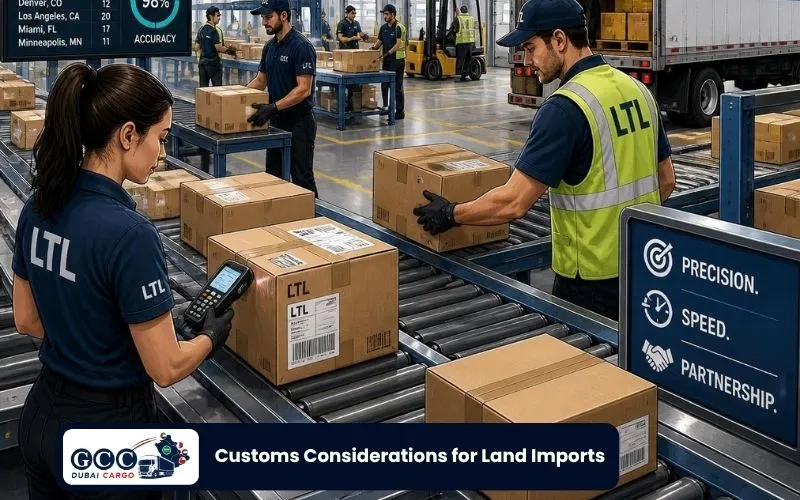
Customs Considerations for Land Imports
Customs clearance is an important part of any cross-border cargo movement.
Qatar Customs specifically lists a manifest for land importation among the relevant documentation, alongside other documents that can apply depending on the import. The authority also states that goods may be inspected or examined based on risk assessment.
This is why shipment information should be accurate before dispatch.
Check that:
- Product descriptions are correct
- Quantities match the actual cargo
- Invoice information is consistent
- Packing lists reflect the shipment
- Receiver/importer details are accurate
- Required permits are identified for regulated goods
The applicable customs requirements should always be confirmed for the particular shipment rather than relying on a generic checklist.
Delivery to Mesaieed Industrial City and Other Locations
The final delivery address matters.
Mesaieed Industrial City is approximately 40 km south of Doha and supports a broad industrial base. QatarEnergy describes the area as including facilities associated with petrochemicals, chemicals, fertilizers, metals and other industrial activities.
A commercial shipment may therefore be destined for:
- Industrial facilities
- Warehouses
- Business premises
- Supplier locations
- Project sites
- Commercial properties
Residential shipments may instead go to homes or accommodation in the wider Mesaieed area.
For industrial delivery, provide the receiver’s exact instructions before dispatch. This may include site contact details, delivery reference numbers, access instructions and any requirements communicated by the receiving facility.
A truck arriving at the general Mesaieed area is not the same thing as completing delivery to a specific industrial site.
What Affects Dubai to Mesaieed Cargo Pricing?
There is no single cargo price that applies to every shipment.
A quotation may be affected by:
| Pricing Factor | Why It Matters |
|---|---|
| Cargo Weight | Helps determine transportation requirements |
| Cargo Volume | Indicates how much truck capacity is required |
| Dimensions | Important for large or irregular cargo |
| Cargo Type | Different goods may require different preparation |
| FTL or LTL | Determines how truck capacity is used |
| Pickup Location | Access can affect loading arrangements |
| Delivery Location | Residential and industrial sites may have different requirements |
| Packing | Additional preparation can affect the quotation |
| Heavy or Oversized Cargo | May require additional planning |
| Loading Requirements | Special loading conditions can change the scope |
| Documentation | Shipment type can affect customs preparation |
| Delivery Requirements | Site access and unloading conditions may matter |
For an accurate quotation, provide the cargo description, number of packages, dimensions, approximate weight, pickup address, destination address and whether the shipment is personal or commercial.
Common Problems and Practical Solutions
Problem: Large furniture dimensions were not provided
Solution: Measure large furniture before requesting the quotation. Include length, width and height where practical.
Problem: The Mesaieed delivery location has restricted access
Solution: Provide the exact delivery address and any known site instructions before dispatch. Confirm access requirements with the receiving facility.
Problem: The cargo description is too general
Solution: Replace descriptions such as “goods,” “parts” or “equipment” with specific product descriptions.
Problem: Documents do not match the cargo
Solution: Compare the invoice, packing list and actual shipment before loading.
Problem: A fragile item is not properly protected
Solution: Use suitable protective packaging and identify fragile items before loading.
Problem: A large item cannot pass through the building entrance
Solution: Check door, elevator, staircase and corridor dimensions before pickup.
Problem: The receiver is unavailable
Solution: Confirm the receiver’s contact information and delivery instructions before the cargo leaves Dubai.
Your Shipment Journey from Dubai to Mesaieed
A practical Dubai-to-Mesaieed shipment can be planned around several stages.
1. Identify the cargo
Prepare an inventory of what you want to send.
2. Collect shipment details
Record dimensions, approximate weight, quantity and cargo type.
3. Confirm the pickup
Explain whether the cargo is coming from an apartment, villa, office, warehouse or industrial location.
4. Prepare the cargo
Pack, label and secure the shipment appropriately.
5. Review documentation
Prepare the applicable invoices, packing list, origin information and other required documents.
6. Arrange loading
Confirm access, loading area and any equipment or site requirements.
7. Cross-border transportation
The cargo moves by the agreed land transportation arrangement toward Qatar.
8. Customs processing
The applicable export and import procedures are completed according to the shipment and current requirements.
9. Mesaieed delivery planning
The receiving address, contact person and access instructions are used to coordinate the final stage.
10. Final delivery
The cargo is delivered to the agreed residential, commercial, warehouse or industrial destination.
For customers also considering other Qatar destinations, our broader cargo from Dubai to Qatar page provides country-level route information.
What to Send for a Cargo Quotation
You can make the quotation process easier by preparing the following information:
Cargo details
- What are you shipping?
- How many packages are there?
- What are the approximate dimensions?
- What is the approximate total weight?
- Is the cargo palletized?
- Is anything particularly fragile, heavy or oversized?
Dubai pickup details
- Pickup area
- Building or warehouse type
- Loading access
- Floor number if applicable
- Elevator availability
- Any known loading restrictions
Mesaieed delivery details
- Exact destination
- Residential, commercial or industrial delivery
- Receiver name
- Receiver contact details
- Warehouse or site information where applicable
- Known delivery instructions
Shipment classification
Also clarify whether the cargo is:
- Personal
- Household
- Commercial
- Industrial
- Heavy or bulky
- Fragile
This information gives a cargo provider a much better basis for assessing the shipment than a simple request for a “Dubai to Mesaieed cargo price.”
Frequently Asked Questions
Yes, household cargo can be assessed for transportation from Dubai to Mesaieed. Furniture, appliances, personal belongings and household boxes should be described accurately, with dimensions supplied for large items. Packing and building-access requirements should also be considered before pickup.
Road freight can be considered for suitable commercial cargo moving from Dubai to Mesaieed. Because Mesaieed has a major industrial environment, commercial customers should provide the exact receiving location, cargo dimensions, weight, product descriptions and site access information before transportation is arranged.
Useful information includes the cargo description, number of packages, dimensions, approximate weight, pickup location in Dubai, delivery address in Mesaieed and whether the shipment is personal or commercial. For unusual cargo, photographs can also help explain its size or shape.
Requirements depend on the shipment. Qatar Customs identifies documents such as a detailed invoice, certificate of origin and land-import manifest among the documentation that can apply, while packing lists and additional approvals may be relevant depending on the goods.
Measure large items, protect fragile surfaces, secure cartons and provide photographs or descriptions for unusual cargo. Also check building access, elevators, loading bays and other pickup restrictions before the collection is scheduled.
Plan Your Cargo from Dubai to Mesaieed
A successful shipment starts with accurate information. Before requesting transportation, identify the cargo, measure larger items, prepare the applicable documents and confirm both pickup and delivery access.
For Mesaieed shipments, destination planning is especially useful because the receiving point may be a residence, warehouse, business premises or industrial facility.
GCC Dubai Cargo can assess your shipment based on the cargo details you provide and help determine the appropriate transportation arrangement for your Dubai-to-Mesaieed requirement.
Made Easy
GCC Cargo Destinations
Fast, secure, and reliable cargo delivery from Dubai to GCC countries.
Let's help you!
Need reliable cargo delivery from Dubai to GCC? Get in touch with our team today.
WhatsApp Now
+971 55 735 4528
© 2026 GCC Dubai Cargo. All Rights Reserved.