
Cargo Rates from Dubai to GCC Countries (2026)
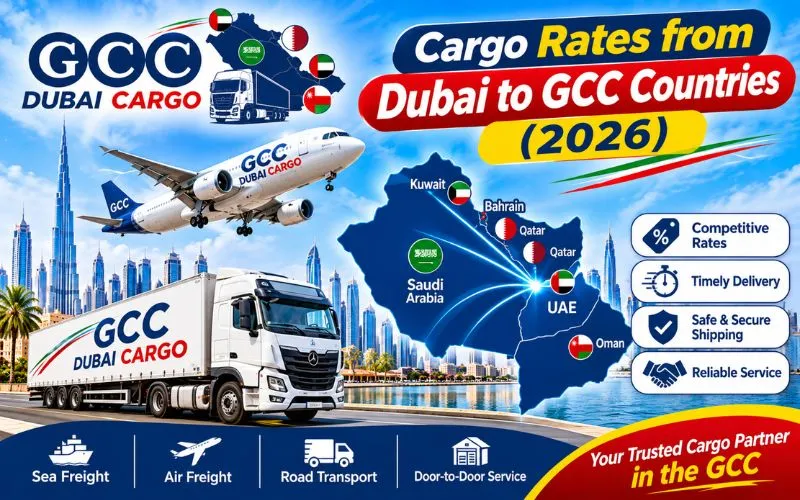
Shipping cargo from Dubai to Saudi Arabia, Oman, Qatar, Bahrain or Kuwait requires more than comparing a price per kilogram. The final transportation cost depends on your shipment’s weight, dimensions, destination, cargo type and delivery requirements. Choosing between a dedicated truck and shared-load transportation can also make a difference.
If you are planning to move household furniture, personal belongings, commercial stock, machinery or warehouse supplies, understanding these factors will help you request a more suitable quotation.
GCC Dubai Cargo provides a starting point for customers looking into cargo transportation from Dubai to GCC destinations. This guide explains how international road cargo pricing works in 2026, what makes different routes and shipments cost more or less, and what information you should prepare before requesting a quote.
Rather than publishing unverified price estimates, we explain the elements that determine your actual shipping charges so you can compare transportation options more confidently.
Understanding GCC Cargo Rates from Dubai in 2026
There is no single transportation rate that applies to every shipment from Dubai to the GCC.
A small collection of household cartons requires a different transportation arrangement from a full truck carrying commercial inventory. Similarly, sending furniture to a residential property may involve different handling and delivery requirements from transporting pallets to a warehouse.
Cargo quotations generally consider:
Total shipment weight.
Cargo volume and dimensions.
Number of packages or pallets.
Pickup location in Dubai.
Destination country and delivery city.
Required truck type and capacity.
FTL or LTL transportation.
Loading and unloading requirements.
Packing and special handling.
Applicable customs and documentation requirements.
Final delivery arrangements.
For example, a shipment weighing 500 kg might occupy considerably more space than another shipment with the same weight. This can influence the transportation arrangement and the final quotation.
The best way to understand your actual cargo cost is to provide complete shipment details instead of relying on a general per-kilogram estimate.
What Determines the Final Cost of a GCC Shipment?
Understanding the main pricing factors makes it easier to compare quotations and avoid unexpected adjustments.
Actual Weight, Cargo Volume and Dimensions
Weight and volume are two important considerations in road freight calculations.
Actual weight refers to the physical weight of the cargo. Volume describes how much space the shipment occupies.
For individual cartons, dimensions should be measured using length, width and height. For palletized shipments, provide the complete dimensions of each loaded pallet.
The total volume can be calculated using:
If you have ten identical cartons, their combined volume is 4.8 CBM.
This information helps a cargo provider understand how much truck space your shipment may require.
Do not assume that every road freight company uses the same chargeable-weight formula. Ask the provider how weight and volume are assessed for the particular service.
Destination, Delivery Address and Route Requirements
The destination country is another important pricing factor.
Transportation from Dubai to an accessible commercial delivery point may require a different arrangement from delivery to a residential building or a remote industrial location.
The final destination matters because transportation planning may involve:
Different road distances.
Cross-border transit arrangements.
Applicable customs procedures.
Delivery vehicle access.
Local unloading requirements.
Special handling or transfer arrangements.
A quotation should identify the actual delivery city and, where possible, the final delivery address.
Cargo Type, Packing and Handling
Different goods require different preparation and loading arrangements.
For example:
Household furniture may need protective wrapping.
Electronics require suitable packaging and careful placement.
Commercial cartons need accurate package counts.
Machinery may require information about lifting and loading.
Oversized items may require a suitable vehicle arrangement.
If cargo needs additional packing, special loading equipment or extra handling, disclose this before requesting the quotation.
Dubai to GCC Cargo Rate Comparison by Country
Each GCC destination has different transportation and delivery considerations. The following comparison explains what customers should consider when requesting cargo rates.
| Destination | Important delivery markets | Pricing considerations |
|---|---|---|
| Saudi Arabia | Riyadh, Jeddah, Dammam, Khobar | Distance, final city, cross-border arrangements and cargo size |
| Oman | Muscat, Sohar, Salalah | Delivery location, route and vehicle requirements |
| Qatar | Doha and surrounding commercial areas | Transit arrangements through Saudi Arabia and final delivery |
| Bahrain | Manama and other delivery areas | Saudi transit, causeway arrangements and delivery access |
| Kuwait | Kuwait City and surrounding areas | Longer road routing, Saudi transit and final delivery |
These are route-planning considerations, not a ranking of the cheapest and most expensive destinations. Actual quotations depend on the shipment and service scope.
Shipping from Dubai to Saudi Arabia
Saudi Arabia is an important destination for personal and commercial shipments leaving Dubai.
Customers may send household furniture, appliances, retail inventory, office equipment, spare parts and industrial supplies.
Different delivery cities can create different transportation requirements.
Riyadh: Relevant for residential shipments, retail distribution and commercial warehouse deliveries.
Jeddah: Important for household deliveries, business stock and commercial distribution.
Dammam: Relevant for Eastern Province businesses, industrial supplies and warehouse cargo.
Al Khobar: Customers should provide the exact residential or commercial delivery location.
Jubail: Industrial cargo may require advance coordination for site access and unloading.
For an individual route guide, see cargo from Dubai to Saudi Arabia.
When requesting a quotation, provide the Saudi delivery city, complete address, shipment dimensions and any special unloading requirements.
Shipping from Dubai to Oman
Oman is another important road cargo destination from Dubai.
Customers may arrange transportation for furniture, personal belongings, household cartons, business inventory and commercial supplies.
Muscat and Sohar are relevant delivery markets for different residential and commercial requirements. Salalah may involve different distance and delivery considerations compared with destinations closer to the UAE.
Before requesting a rate, confirm:
Exact destination city.
Residential or commercial delivery.
Total cargo volume.
Whether the shipment is palletized.
Vehicle access at the delivery location.
Read more about cargo from Dubai to Oman for route-specific information.
Shipping from Dubai to Qatar
Cargo moving from Dubai to Qatar requires consideration of the Saudi transit route for road transportation.
This makes accurate shipment documentation and route planning particularly important.
Customers may send:
Household furniture.
Personal belongings.
Commercial stock.
Office supplies.
Packaged products.
Suitable machinery and equipment.
Doha is a major destination for residential and commercial shipments. Customers delivering to warehouses or business premises should provide their receiving location and unloading requirements.
When requesting a quotation, clarify the complete transportation scope, including applicable border procedures and final delivery.
For further information, visit cargo from Dubai to Qatar.
Shipping from Dubai to Bahrain
Bahrain-bound road shipments generally travel through Saudi Arabia and the King Fahd Causeway.
This means the quotation should consider more than the basic distance from Dubai to the destination.
Customers should provide:
Cargo weight and dimensions.
Number of cartons or pallets.
Bahrain delivery city and address.
Cargo description.
Required delivery arrangement.
Applicable documentation details.
Furniture, personal belongings, commercial products and warehouse stock can have different handling requirements.
Explore cargo from Dubai to Bahrain for more destination-specific information.
Shipping from Dubai to Kuwait
Kuwait is another destination where road transportation planning must account for Saudi transit.
Businesses may require cargo transportation for commercial inventory, spare parts, office supplies, packaged products and equipment.
Residential customers may also need to move furniture, appliances and personal belongings.
The final cost can be affected by shipment volume, truck requirements, destination access and applicable cross-border procedures.
For warehouse shipments, confirm whether the receiving facility has a suitable loading bay and unloading equipment.
See cargo from Dubai to Kuwait for additional route information.
How FTL and LTL Change Your Road Freight Quotation
The transportation arrangement can make a significant difference to your cargo quotation.
Two common options are Full Truckload (FTL) and Less Than Truckload (LTL).
When a Dedicated Truck Makes Financial Sense
FTL means Full Truckload.
A dedicated truck is arranged for a particular shipment rather than sharing the vehicle’s capacity with unrelated consignments.
It may be appropriate for:
Large commercial consignments.
Multiple pallets.
Heavy machinery.
Business inventory.
Large furniture shipments.
Bulk supplies.
Shipments requiring a substantial portion of vehicle capacity.
The quotation depends on the route, vehicle capacity, cargo weight, loading requirements and delivery arrangements.
A dedicated vehicle may be more practical when a shipment occupies considerable truck space.
When Shared-Load Transportation Is More Practical
LTL means Less Than Truckload.
This option is suitable for shipments that do not require an entire truck.
For example, a customer sending several cartons or a limited number of pallets may prefer to explore shared-load transportation.
LTL can help customers avoid paying for unused truck capacity, subject to availability and the provider’s consolidation arrangements.
However, customers should also consider:
Consolidation requirements.
Loading and unloading arrangements.
Handling of individual consignments.
Destination delivery coordination.
The effect of consolidation on scheduling.
The cheapest option is not automatically the most suitable. Compare the complete service and quotation before making a decision.
Household, Commercial and Heavy Cargo: Why Rates Differ
The cargo category influences the type of transportation and handling required.
Household cargo
Furniture, beds, sofas, tables, mattresses, cabinets, appliances and personal belongings need accurate dimensions and suitable packing.
A large sofa may occupy more vehicle space than several compact cartons, even when its physical weight is relatively low.
Commercial cargo
Retail inventory, packaged products, office equipment, spare parts and business supplies may be shipped in cartons or pallets.
Businesses should prepare an inventory showing quantities, package dimensions and cargo descriptions.
Heavy and bulky cargo
Machinery, industrial equipment, oversized furniture and construction-related materials may require specific vehicle capacity and loading arrangements.
Customers should disclose individual item weights, dimensions, lifting requirements and loading-site conditions.
Fragile cargo
Glass, electronics, delicate appliances and furniture surfaces require suitable protective packaging.
Photographs and clear descriptions can help communicate handling requirements before the quotation is prepared.
Road Freight vs Air Freight vs Sea Freight
Choosing a transportation method involves balancing cost, shipment size and delivery requirements.
| Transportation method | Suitable shipments | Main pricing considerations |
|---|---|---|
| Road freight | Household and commercial GCC cargo | Route, weight, volume and truck capacity |
| Air freight | Urgent and suitable smaller shipments | Chargeable weight, destination and urgency |
| Sea freight | Suitable bulk and containerized shipments | Container size, CBM, port handling and route |
For many cross-border GCC shipments, road transportation is worth comparing because it can accommodate different cargo sizes and vehicle arrangements.
Air freight may be appropriate when delivery speed is the main priority.
Sea freight can be considered for suitable large commercial shipments, depending on the origin, destination and port arrangements.
Always compare the complete cost rather than looking at the basic transportation charge alone.
What Is Included in a Cargo Quotation?
Customers should understand exactly what they are paying for.
A quotation may contain different service components depending on the requested transportation arrangement.
| Quotation component | What to clarify |
|---|---|
| Dubai pickup | Whether collection is included |
| Packing | Whether materials and packing labour are included |
| Loading | Whether loading charges apply |
| Main transportation | Vehicle type and transportation scope |
| Documentation | Which documents or preparation services are covered |
| Customs-related charges | Which clearance services and government charges are included or excluded |
| Destination delivery | Whether final-address delivery is included |
| Unloading | Whether unloading or special equipment is included |
Ask for clarification wherever a service is not clearly identified.
For example, a basic transportation quotation might not include residential collection, packing materials or destination unloading.
An itemized quotation helps customers compare providers more accurately.
Dubai Pickup and GCC Delivery: Costs Customers Should Consider
Cargo collection from Dubai can involve different arrangements depending on the pickup location.
A shipment collected from a warehouse with an accessible loading bay may require a different arrangement from furniture collected from an apartment building.
Before collection, consider:
Building security and visitor access.
Parking and vehicle restrictions.
Loading-bay availability.
Service elevator booking.
Building management approval.
Staircase access.
Distance between the property and loading vehicle.
Large furniture dimensions.
Availability of loading assistance.
For residential collections, measure large furniture and confirm whether items can pass through doors, corridors and elevators.
Customers arranging collection from offices or warehouses should confirm operating hours and loading access.
The same principle applies to the destination. A vehicle may need additional coordination if the receiving property has restricted access.
For more information about local cargo services in Dubai, customers can explore the available service information.
Customs Documents and Other Potential Shipping Charges
Cross-border cargo transportation involves documentation and customs procedures that depend on the destination and type of goods.
Possible documents include:
Commercial invoice.
Packing list.
Transport documents.
Certificate of origin, where applicable.
Customs declaration.
Importer or receiver information.
Product-specific permits or approvals, where required.
Not every shipment requires every document.
Personal belongings, commercial inventory, machinery, food products and regulated items may have different documentation requirements.
The customer should provide accurate descriptions, quantities and declared values.
Also clarify whether customs clearance assistance, duties, taxes and other applicable charges are included in the quotation.
Never assume that customs charges are automatically included in the basic road freight rate.
For products subject to specific import controls, check the relevant destination country’s current official requirements before dispatch.
Common Pricing Mistakes and How to Avoid Them
Customers sometimes receive an initial quotation that changes after the cargo details are reviewed.
The following mistakes can be avoided with better preparation.
Problem: Only the shipment weight is provided.
Solution: Provide dimensions and approximate volume as well. Large, lightweight cargo may occupy significant truck space.
Problem: The final delivery city is not confirmed.
Solution: Provide the actual destination rather than only naming the destination country.
Problem: Large furniture measurements are missing.
Solution: Measure sofas, beds, cabinets and appliances before arranging collection.
Problem: Customers compare incomplete quotations.
Solution: Check whether pickup, packing, loading, customs-related services and final delivery are included.
Problem: Commercial and personal goods are mixed without proper descriptions.
Solution: Prepare a clear inventory and identify the nature of the goods.
Problem: The delivery property has restricted access.
Solution: Disclose loading restrictions, parking limitations and unloading requirements before dispatch.
These steps help customers make better comparisons and reduce avoidable quotation adjustments.
How to Request Cargo Rates from GCC Dubai Cargo
If you are planning to send cargo from Dubai to a GCC destination, provide enough information for the shipment to be assessed properly.
Your quotation request should include:
Pickup location: Dubai residential property, office or warehouse.
Destination: Saudi Arabia, Oman, Qatar, Bahrain or Kuwait.
Delivery city: The exact city and, if available, the complete address.
Cargo description: Furniture, household goods, commercial stock, machinery or other items.
Shipment quantity: Number of cartons, pallets and large items.
Weight: Total actual shipment weight.
Dimensions: Package measurements and approximate CBM.
Transportation preference: FTL, LTL or another suitable arrangement.
Additional requirements: Packing, loading, unloading and special handling.
Documentation: Available invoices, packing lists and applicable product information.
GCC Dubai Cargo can use these details as the starting point for reviewing your transportation requirements and preparing a suitable quotation.
For the most useful comparison, request clarification about the complete service scope and any charges that may apply separately.
Planning a GCC shipment? Contact GCC Dubai Cargo through gccdubaicargo.com with your cargo details and destination to enquire about transportation options.
Frequently Asked Questions About Cargo Rates from Dubai to GCC Countries
Cargo rates depend on shipment weight, volume, dimensions, destination, cargo type and transportation requirements. Road freight quotations may also consider vehicle capacity, pickup arrangements, border procedures and final delivery. Providing complete shipment information helps obtain a more relevant quotation.
Two shipments can weigh the same but occupy different amounts of truck space. A shipment containing bulky furniture may require more space than compact commercial cartons. Delivery location, packaging, handling requirements and transportation arrangements can also affect the final price.
LTL may be suitable for smaller shipments that do not require an entire truck. FTL can be more appropriate when cargo occupies a substantial portion of vehicle capacity or requires a dedicated vehicle. The better option depends on shipment volume, route, handling and the complete quotation.
Not necessarily. Some quotations include certain customs-related services and destination delivery, while others list them separately. Customers should confirm pickup, documentation, customs assistance, applicable duties or taxes, unloading and final delivery before accepting a quotation.
Provide the Dubai pickup address, destination country and city, cargo description, number of packages, actual weight, dimensions, approximate CBM and delivery address. Also disclose any special packing, loading, unloading or handling requirements. Accurate information makes it easier to assess the appropriate transportation arrangement.
Made Easy
GCC Cargo Destinations
Fast, secure, and reliable cargo delivery from Dubai to GCC countries.
Let's help you!
Need reliable cargo delivery from Dubai to GCC? Get in touch with our team today.
WhatsApp Now
+971 54 143 5685
Quick Links
© 2026 GCC Dubai Cargo. All Rights Reserved.
