
Dubai to Bahrain Cargo Rates per KG (2026)
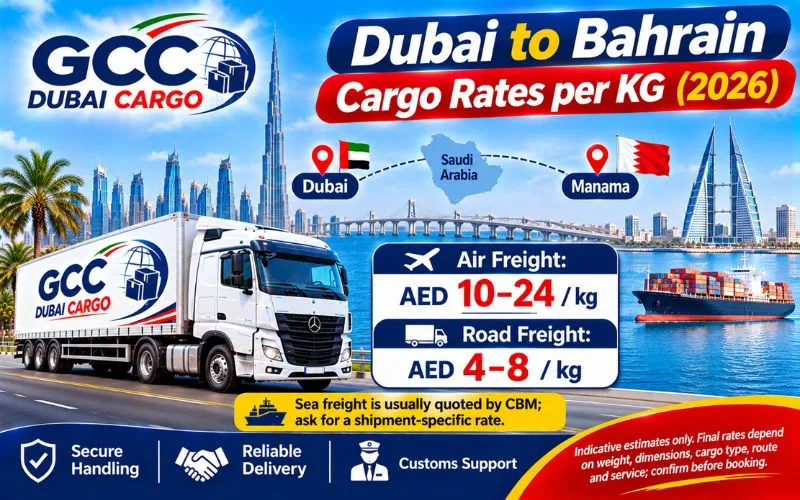
If you are planning to send cargo from Dubai to Bahrain, understanding the transportation cost per kilogram is an important first step.
Whether you are shipping household belongings, furniture, business stock or commercial equipment, the final price depends on more than the weight shown on a weighing scale.
Dubai to Bahrain cargo rates in 2026 can vary according to shipment dimensions, total volume, transportation arrangement, pickup requirements and the final delivery location.
A small parcel, a collection of household furniture and a commercial pallet shipment cannot necessarily be priced using the same per-kg calculation.
GCC Dubai Cargo helps customers understand the information required to arrange cargo transportation from Dubai to Bahrain.
This guide explains how road freight quotations are calculated, when shared-load or dedicated transportation may be appropriate, and what to prepare before requesting a price.
Rather than relying on an unverified fixed rate, you can use the information below to understand your shipment’s cost factors and request a quotation based on its actual requirements.
What Determines the Cost of Shipping Cargo from Dubai to Bahrain?
Cargo transportation charges depend on several details that determine how much space, handling and transportation capacity a shipment requires.
For a Dubai-to-Bahrain shipment, the main pricing considerations include:
Total shipment weight.
Number of cartons, pallets or individual items.
Length, width and height of larger packages.
Type of goods being transported.
Shared-load or dedicated-truck requirements.
Dubai pickup location.
Bahrain delivery address.
Loading and unloading arrangements.
Packing requirements.
Applicable customs and documentation requirements.
For example, a business sending several compact cartons may have a different quotation from a household shipping a sofa, mattress and appliances, even when both shipments have similar actual weights.
The difference is that the second shipment may occupy considerably more truck space.
Actual Weight and Volumetric Weight
Actual weight is the physical weight of the shipment measured using a weighing scale.
Volumetric weight represents the space occupied by the cargo. It becomes particularly relevant when packages are large but relatively light.
For example, consider two hypothetical shipments:
| Shipment | Actual weight | Cargo characteristics |
|---|---|---|
| Shipment A | 50 kg | Compact, densely packed cartons |
| Shipment B | 50 kg | Large, lightweight household items |
Both shipments weigh 50 kg, but Shipment B may require substantially more loading space.
Different transport services use different pricing methods. Air freight commonly uses chargeable weight, while road freight quotations may consider weight, volume, pallet space, truck capacity or a combination of these factors.
Do not automatically apply an air-freight volumetric formula to a road-freight quotation. Ask the transport provider how your particular shipment will be assessed.
Cargo Volume and Shipment Density
Cargo density describes the relationship between the weight of goods and the space they occupy.
This is useful when deciding how to transport household and commercial items.
For example:
Compact cartons may use relatively little space.
Mattresses and sofas can occupy considerable space.
Machinery may be heavy but require specialized loading arrangements.
Palletized commercial goods may be assessed according to their footprint and stacking limitations.
Provide accurate dimensions before requesting a quotation. This helps avoid pricing changes caused by incorrect shipment information.
Why There Is No Single Per-Kilogram Rate for Every Shipment
Customers often search for a simple answer such as the cost of sending 10 kg, 30 kg or 100 kg from Dubai to Bahrain.
However, a universal road-cargo rate per kilogram would not accurately represent every shipment.
A quotation for a small package may include minimum handling or collection charges. A larger commercial consignment may be assessed according to truck-space requirements and transportation arrangements.
The following comparison explains why different shipments require different pricing assessments.
| Shipment type | Main pricing consideration |
|---|---|
| Small parcel | Minimum charge and package dimensions |
| Several cartons | Combined weight and total volume |
| Household belongings | Furniture dimensions and handling |
| Commercial pallets | Weight, pallet space and loading |
| Machinery | Weight, dimensions and equipment requirements |
| Full truckload | Vehicle capacity and dedicated transportation |
Important: GCC Dubai Cargo should confirm the applicable rate for each shipment rather than publishing unsupported price promises.
When requesting a quotation, ask whether the amount is calculated per kilogram, per shipment, per pallet or according to the required truck capacity.
Choosing the Right Transportation Arrangement for Bahrain
The transportation arrangement can significantly influence the total cost of sending goods from Dubai to Bahrain.
For customers shipping different quantities, the two important road-freight concepts are less-than-truckload and full-truckload transportation.
Shared-Load Road Freight (LTL)
Less-than-truckload transportation is relevant when a shipment does not require an entire truck.
Under a shared-load arrangement, cargo from different shipments may occupy available vehicle space, subject to the transport provider’s arrangements and cargo compatibility.
This can be worth considering for:
Household cartons.
Personal belongings.
Small furniture consignments.
Retail stock.
Business supplies.
Smaller commercial shipments.
The advantage is that customers do not necessarily need to pay for an entire dedicated vehicle when their cargo occupies only part of its capacity.
However, the final price depends on shipment size, available space, handling and the agreed transportation arrangement.
Dedicated Truck Transportation (FTL)
Full-truckload transportation involves arranging a vehicle for a shipment that requires dedicated truck capacity.
It may be appropriate for:
Large furniture consignments.
Multiple pallets of business inventory.
Industrial equipment.
Heavy commercial shipments.
Large-volume household relocations.
Goods requiring a dedicated loading arrangement.
FTL does not automatically mean a lower per-kilogram price. Its financial suitability depends on how much truck capacity is needed and the total transportation cost.
If your shipment is large enough to occupy substantial vehicle space, compare a dedicated-truck quotation against the available shared-load option.
When to Compare Road and Air Freight
Road freight is worth considering when transporting furniture, household belongings, commercial stock or larger shipments where truck capacity is important.
Air freight may be more suitable for smaller, urgent or time-sensitive consignments, depending on the cargo and service availability.
| Consideration | Road freight | Air freight |
|---|---|---|
| Large furniture | Often worth considering | May be unsuitable |
| Commercial cartons | Suitable depending on shipment | Suitable depending on size |
| Heavy equipment | Requires suitable vehicle arrangements | Subject to aircraft restrictions |
| Urgent small packages | Compare available services | Often worth evaluating |
| Pricing basis | Weight, volume and transport capacity | Commonly chargeable weight |
The correct choice depends on the cargo, required delivery arrangement and quotation, not simply the advertised price per kilogram.
How Shipment Size Changes Your Cargo Quotation
Different shipment categories create different transportation requirements.
Understanding these differences helps customers request a realistic quotation.
Small Packages and Personal Shipments
Small packages may contain clothing, accessories, personal belongings, documents or permitted household products.
When requesting a quotation, provide:
Number of packages.
Weight of each package.
Package dimensions.
Description of contents.
Pickup location in Dubai.
Recipient details in Bahrain.
A small parcel quotation should not be compared directly with a shared road-freight rate for commercial cargo.
Household Goods and Furniture
Families relocating or sending belongings to Bahrain may need transportation for sofas, beds, cabinets, mattresses, tables, chairs and appliances.
Furniture dimensions are particularly important.
A sofa weighing 40 kg may occupy more vehicle space than several compact cartons weighing considerably more.
Before requesting a quotation:
Prepare an inventory of furniture and household items.
Measure large pieces individually.
Record the number of cartons.
Identify glass or breakable components.
Photograph unusual or oversized items.
Confirm whether dismantling is necessary.
Protect furniture surfaces with suitable wrapping and separate fragile items from heavier goods.
Commercial Stock and Heavy Cargo
Businesses may need to transport retail inventory, packaged products, office supplies, spare parts, machinery or industrial equipment.
Commercial cargo quotations should include the shipment’s weight, dimensions, quantity, packaging type and intended delivery location.
For heavier equipment, provide photographs and any available handling information.
A pallet shipment delivered to a commercial warehouse may have different access and unloading requirements from an individual residential delivery.
Dubai Pickup Requirements That Can Affect Your Cost
The pickup location in Dubai is an important part of the quotation.
A shipment collected from an accessible warehouse may involve different arrangements from furniture collected inside a high-rise apartment.
Before scheduling collection, consider the following.
Apartment buildings
Is a service elevator available?
Does building management require advance approval?
Can large furniture fit inside the elevator?
Is there a suitable loading area?
Villas and residential properties
Is there sufficient parking for the collection vehicle?
Are there stairs or narrow access points?
Is the distance between the property and loading area significant?
Offices and warehouses
Is a loading bay available?
Are there vehicle-height restrictions?
Can the cargo be collected during the required access hours?
Is loading equipment needed?
Confirm building and community requirements with the relevant management before collection.
For a broader understanding of local transportation arrangements, explore cargo services in Dubai.
Providing accurate pickup information can help avoid unnecessary collection delays and changes to the original quotation.
Shipping to Manama and Other Bahrain Destinations
The final delivery address is another important part of the Dubai-to-Bahrain pricing process.
Bahrain is a relatively compact destination, but delivery arrangements still differ according to the receiving location and type of property.
Manama and Muharraq
Manama is an important destination for residential belongings, business supplies, retail products and commercial deliveries.
Muharraq also has residential and commercial destinations.
Provide the complete delivery address and recipient contact details so the transportation arrangement can be assessed correctly.
Riffa and Residential Deliveries
Customers sending furniture, household cartons and appliances to Riffa should provide information about property access.
For example, a large furniture delivery may require confirmation of stairway dimensions, elevator availability and the unloading location.
Do not assume that a vehicle can access every residential property directly.
Hidd and Sitra for Commercial Cargo
Hidd and Sitra are relevant locations when planning commercial or industrial deliveries.
Businesses shipping equipment, spare parts, packaged products or warehouse stock should provide the exact receiving location and unloading requirements.
Industrial deliveries may require site access arrangements, loading equipment or coordination with warehouse personnel.
For additional information about the route and available service arrangements, see cargo from Dubai to Bahrain.
The Road Route and Customs Considerations for Bahrain
Road cargo moving from Dubai to Bahrain involves international transportation through Saudi Arabia and the land connection between Saudi Arabia and Bahrain.
The King Fahd Causeway is the important land connection between the two countries.
Bahrain’s official government portal identifies the causeway among the country’s land customs entry points.
This means customers should consider more than the physical transportation distance when arranging their shipments.
The cargo description, declared value, shipment purpose and applicable transit and import procedures may influence documentation and clearance requirements.
Customers should also understand that a quotation for road transportation and a quotation covering all customs-related costs are not necessarily the same thing.
Ask for clarification about which services and charges are included.
Documents to Prepare Before Dispatch
Documentation requirements depend on the cargo type, shipment purpose and applicable regulations.
Commonly relevant documents may include:
| Document | Why it may be needed |
|---|---|
| Commercial invoice | Describes goods and their declared value |
| Packing list | Identifies packages, quantities and contents |
| Transport documents | Records transportation and shipment details |
| Certificate of origin | Establishes origin where applicable |
| Product-specific permits | Supports regulated or controlled goods where required |
| Receiver information | Identifies the importer or receiving party |
The GCC Unified Customs Regulation discusses customs declarations and supporting documentation, including invoices and proof of origin in applicable circumstances.
Not every shipment requires every document.
For example, a personal-effects shipment and a commercial inventory shipment may have different documentary requirements.
Before dispatch, check the current requirements with the relevant customs authority or qualified clearance provider.
Also make sure that the declared descriptions, quantities and values accurately reflect the cargo being transported.
How to Reduce Your Dubai-to-Bahrain Shipping Expenses
Reducing cargo transportation costs starts with preparing accurate shipment information and choosing an appropriate transport arrangement.
Here are practical ways to avoid unnecessary expenses.
1. Consolidate compatible shipments
If you have several cartons or small consignments, consider whether combining them into one shipment is more economical than arranging separate collections.
2. Measure cargo before requesting a quotation
Incorrect dimensions can result in a revised quotation when the actual cargo is inspected.
Measure large furniture, appliances and commercial equipment individually.
3. Use suitable packaging
Avoid oversized cartons containing only a small quantity of goods. Properly sized packaging can help use available vehicle space more efficiently.
4. Separate different cargo categories
Keep household belongings, commercial stock and fragile goods clearly identified.
This makes inventory preparation and documentation easier.
5. Confirm delivery access
Provide accurate information about the receiving property, warehouse or industrial site.
Unexpected access restrictions can create additional handling arrangements.
6. Compare LTL and FTL quotations
For larger consignments, compare shared-load transportation with dedicated truck arrangements.
Do not select a transport method based only on the lowest advertised per-kg figure.
Common Pricing Problems and How to Avoid Them
Some shipment problems arise because customers provide incomplete information when requesting a quotation.
| Common problem | Recommended solution |
|---|---|
| Cargo dimensions were not provided | Measure large packages and furniture before requesting a price |
| Actual weight is different from the estimate | Weigh cartons and provide realistic weight information |
| Furniture does not fit through an elevator | Check elevator and furniture dimensions before collection |
| Pickup vehicle cannot access the building | Confirm parking and loading arrangements with management |
| Shipment contents are incorrectly described | Prepare an accurate inventory before dispatch |
| Commercial invoice information is incomplete | Check item descriptions, quantities and declared values |
| Delivery location is unclear | Provide the complete Bahrain address and receiver's telephone number |
| Fragile items are inadequately packed | Use suitable protective packaging and identify breakable contents |
These precautions help make the original quotation more representative of the actual transportation requirements.
Is Your Shipment Better Suited to LTL or FTL?
The right choice depends on the amount of cargo you need to transport and the vehicle space required.
Consider these examples:
Example 1: A small household shipment
A customer wants to send several cartons of clothes, kitchen items and personal belongings from Dubai to Manama.
A shared-load arrangement may be worth considering if suitable space and service arrangements are available.
Example 2: A family sending furniture
A family needs to transport a sofa, bed, mattress, dining table and household cartons.
The dimensions of the furniture become important because the shipment may occupy considerable vehicle space.
Example 3: A business sending inventory
A retailer wants to send multiple pallets of packaged products to a Bahrain warehouse.
The quotation should consider pallet dimensions, total weight, loading requirements and warehouse access.
Example 4: A company transporting machinery
A company needs to move industrial equipment from Dubai to a commercial facility in Bahrain.
Weight, dimensions, equipment handling and suitable transportation capacity should be assessed before dispatch.
These are illustrative situations, not claims about completed GCC Dubai Cargo customer shipments.
For customers comparing other regional destinations, GCC Dubai Cargo also provides information about cargo from Dubai to Saudi Arabia, cargo from Dubai to Oman, cargo from Dubai to Qatar and cargo from Dubai to Kuwait.
Frequently Asked Questions | Dubai to Bahrain Cargo Rates per KG (2026) Guide
The cost of sending 1 kg from Dubai to Bahrain depends on the selected transportation service, minimum shipment charges, package dimensions, contents and delivery requirements. Small parcel courier pricing should not be confused with road-freight pricing. Contact GCC Dubai Cargo with your package details to obtain a shipment-specific quotation.
Two shipments may have identical actual weights but occupy different amounts of vehicle space. A compact carton and a large mattress can weigh the same while requiring very different loading capacity. Packaging, shipment volume, handling and delivery locations can also influence the final transportation quotation.
LTL may be suitable when your shipment occupies only part of a truck because you do not necessarily need to arrange dedicated vehicle capacity. FTL may be more appropriate for large consignments requiring substantial truck space. Compare both quotations according to your cargo volume and transportation requirements.
Not necessarily. Some quotations cover transportation only, while others may include pickup, loading, destination delivery or specified customs-related services. Always request clarification about included and excluded charges before confirming your shipment. Applicable duties, taxes and clearance requirements should also be checked according to the goods being transported.
Provide the cargo description, actual weight, number of packages, dimensions, Dubai pickup address and Bahrain delivery address. For furniture, machinery and oversized items, photographs and individual measurements are particularly useful. Also explain whether the shipment contains personal belongings or commercial goods and whether packing or loading assistance is required.
Request Your Dubai-to-Bahrain Cargo Quotation
Planning to transport household belongings, furniture, commercial inventory or heavy cargo from Dubai to Bahrain?
GCC Dubai Cargo can assess your shipment requirements and help you understand the appropriate transportation arrangement.
Before requesting a quotation, prepare your cargo weight, dimensions, item description, pickup location and Bahrain delivery address.
Whether you are sending a few cartons or arranging transportation for a larger commercial consignment, providing accurate information helps establish a clearer understanding of the transportation requirements.
Made Easy
GCC Cargo Destinations
Fast, secure, and reliable cargo delivery from Dubai to GCC countries.
Let's help you!
Need reliable cargo delivery from Dubai to GCC? Get in touch with our team today.
WhatsApp Now
+971 54 143 5685
Quick Links
© 2026 GCC Dubai Cargo. All Rights Reserved.
