
Oman Customs Documents Required for Cargo from Dubai
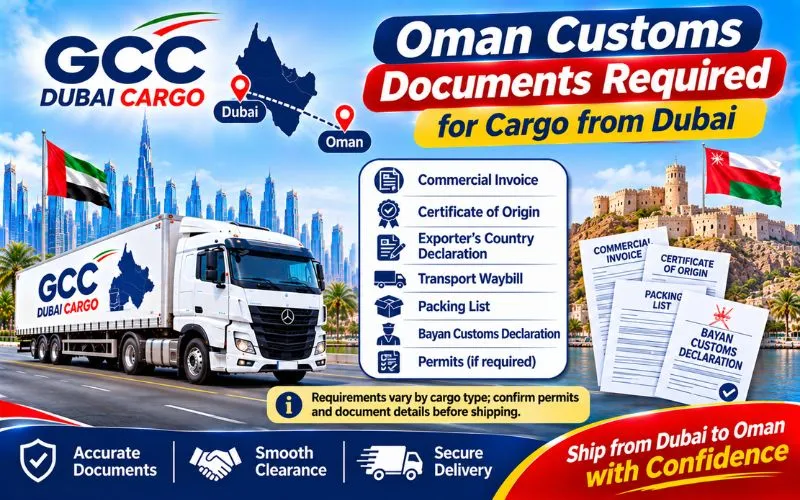
Sending cargo from Dubai to Oman requires more than arranging a truck and preparing goods for transportation.
The shipment must also have suitable customs documentation so the authorities can identify the products, verify their declared information and process the applicable import and export procedures.
If you are sending furniture, household belongings, commercial stock, machinery or packaged products, understanding the Oman Customs Documents Required for Cargo from Dubai can help you prepare before collection.
Commonly relevant documents include a commercial invoice, packing list, UAE export declaration, certificate of origin where applicable and a road transportation document. Certain products may also need additional permits or regulatory approvals.
However, the exact paperwork depends on the nature of the cargo, its origin, the importer and the applicable customs procedure.
At GCC Dubai Cargo, customers arranging cargo from Dubai to Oman should consider documentation alongside cargo weight, dimensions, pickup arrangements and the final delivery address.
Preparing these details early makes it easier to identify potential paperwork problems before transportation begins.
Why Customs Documents Matter When Sending Cargo to Oman
Customs documents explain what is being transported, who is sending it, who will receive it and where the goods originated.
When a shipment moves from Dubai into Oman, the documentation supports the relevant UAE export and Omani import procedures. Customs authorities may use the information to classify goods, check declared values, identify restricted products and determine applicable duties or taxes.
For example, consider a Dubai-based business sending 30 cartons of electrical components to a buyer in Muscat.
The customs paperwork should identify the products correctly, show the relevant quantities and declared values, identify their country of origin and provide the receiver’s information.
If the invoice describes electrical components but the packing list identifies a different product or quantity, the discrepancy may require clarification.
This is why documentation should be prepared using the actual cargo inventory rather than estimates.
Oman operates its customs single-window platform, Bayan, for customs declarations and related trade procedures. The system supports importers, exporters and authorized representatives in submitting declarations and applicable permits.
Essential Documents to Prepare Before Cargo Leaves Dubai
The following documents are important categories to review when arranging road cargo from Dubai to Oman. Not every document applies identically to every shipment.
1. Commercial Invoice
A commercial invoice describes the goods being shipped and provides the financial information associated with the transaction.
It is particularly important for commercial cargo because customs authorities use it to understand the shipment’s declared value and product details.
A commercial invoice generally contains:
Exporter’s or seller’s full name and address.
Importer’s or buyer’s details.
Invoice number and date.
Detailed product descriptions.
Quantity of each product.
Unit price and total declared value.
Currency.
Country of origin.
HS code where applicable.
Relevant transaction and delivery information.
Example: A Dubai supplier sending 100 cartons of spare parts to a Sohar distributor should provide a meaningful description of the spare parts rather than simply writing “general goods.”
The invoice value should reflect the actual transaction or the appropriate declared valuation basis.
If the cargo contains different product categories, list them separately where required.
Avoid using vague descriptions such as miscellaneous items, household material or mixed products when more precise descriptions are available.
2. Packing List
A packing list explains how the cargo is physically arranged.
It helps the relevant parties identify the packages, their contents and their physical characteristics.
Depending on the shipment, the packing list may include:
Total number of cartons or packages.
Description of goods inside each package.
Package identification numbers.
Gross weight.
Net weight where relevant.
Dimensions.
Pallet quantities.
Packaging type.
For example, a furniture shipment might contain:
| Package | Description | Quantity |
|---|---|---|
| 1 | Sofa | 1 |
| 2 | Dining table | 1 |
| 3 | Dining chairs | 6 |
| 4 | Household cartons | 8 |
The actual packing list should describe the packed shipment accurately.
For commercial cargo, package counts and weights should be checked against the invoice and applicable transportation documents.
3. UAE Export Customs Declaration
Cargo leaving Dubai for Oman may require an appropriate UAE export declaration.
This document records the customs export procedure and identifies the goods being moved outside the UAE.
Dubai Customs provides export declaration services through Dubai Trade. The applicable declaration type depends on the shipment and its customs status.
The exporter or appointed customs representative should confirm:
Correct declaration type.
Exporter details.
Consignee information.
Product descriptions.
Declared values.
Relevant HS classifications.
Supporting paperwork.
Any applicable restrictions or permits.
A shipment being exported from Dubai is not necessarily UAE-origin cargo.
For example, goods originally manufactured in another country and stored in Dubai do not automatically become UAE-origin products.
The actual country of origin must be represented accurately.
4. Certificate of Origin
A Certificate of Origin (COO) identifies the country where the goods were manufactured or obtained under the applicable origin rules.
It can be important for customs assessment and determining whether particular preferential tariff arrangements apply.
For goods manufactured in the UAE, the relevant certificate may be obtained through the appropriate authorized issuing body.
For imported goods being re-exported from Dubai, the original manufacturing country should not be replaced with the UAE simply because the cargo is dispatched from Dubai.
Whether a separate certificate is required and which issuing authority is acceptable should be confirmed for the specific shipment.
Oman Customs identifies a manufacturer’s country-of-origin certificate among the supporting documents for its customs declaration service.
5. Road Transportation Document
A road transportation document records the movement of cargo by truck.
Depending on the carrier and transportation arrangement, this may be called a road consignment note, truck waybill or another applicable transport document.
It generally identifies:
Sender.
Receiver.
Transport company or carrier.
Cargo description.
Number of packages.
Collection information.
Destination.
Relevant shipment references.
For road freight, it is important that the transportation paperwork identifies the same shipment described in the customs documents.
Do not confuse a road consignment note with a bill of lading or airway bill. Those documents relate to different transportation arrangements.
6. Importer and Consignee Details
The Oman receiver’s information is another important part of shipment preparation.
For a commercial shipment, confirm the receiving company’s legal details and any applicable customs registration or importer information.
For personal shipments, confirm the receiver’s identity and contact information according to the applicable clearance procedure.
Oman Customs provides for personal imports and personal effects under specific conditions, including identification requirements and limits concerning personal nature and non-commercial quantities.
The receiver should be ready to respond to requests for additional information if customs or the appointed clearance representative needs clarification.
Documents Required for Different Types of Oman Shipments
The paperwork can differ depending on what you are transporting.
A shipment of used household furniture is not identical to a commercial consignment of electrical equipment. Understanding these differences helps customers avoid preparing irrelevant paperwork while overlooking important requirements.
Household Furniture and Personal Belongings
Individuals moving furniture and personal belongings from Dubai to Oman should prepare an accurate inventory.
Common household cargo includes:
Sofas and armchairs.
Beds and mattresses.
Dining tables and chairs.
Wardrobes and cabinets.
Washing machines and refrigerators.
Personal clothing.
Kitchen equipment.
Household cartons.
A practical household inventory should describe each major item and identify the number of cartons or packages.
Customers should also provide information about whether the belongings are used personal effects or newly purchased products.
This distinction matters because customs treatment can depend on the nature, origin and circumstances of the shipment.
Oman Customs describes conditions for certain personal effects and used household items, including personal use, non-commercial quantities, supporting documentation and compliance with applicable restrictions. This should not be interpreted as an automatic exemption for every household shipment.
For furniture transportation, photograph unusual or valuable items before packing. Record large dimensions and identify fragile surfaces.
If you are arranging cargo services in Dubai, include the collection address, building access and approximate cargo volume when requesting transportation details.
Commercial Goods and Business Inventory
Commercial shipments generally require more structured documentation.
Examples include:
Retail products.
Business inventory.
Office supplies.
Electrical components.
Spare parts.
Packaged products.
Manufacturing materials.
Wholesale goods.
The commercial invoice and packing list should identify the shipment accurately.
Businesses should check whether the Oman importer has the relevant registration and whether the product requires any additional import approval.
For example, a Dubai distributor shipping packaged products to a Muscat retailer should confirm the product descriptions, origin, quantities, applicable HS codes and any category-specific approvals before dispatch.
A general cargo description should not replace proper product identification.
Machinery, Heavy Cargo and Industrial Equipment
Machinery and oversized equipment may require additional shipment information.
Before arranging transportation, prepare:
Equipment name and description.
Manufacturer information where relevant.
Model or serial number where applicable.
Weight.
Length, width and height.
Country of origin.
Declared value.
Relevant technical information.
Applicable permits or approvals.
Industrial equipment may be subject to product-specific regulatory requirements.
Customers should also consider whether the truck, loading equipment and delivery site can accommodate the cargo.
For a machine being delivered to an industrial facility in Sohar, the receiving party should confirm unloading arrangements, site access and any necessary handling equipment before dispatch.
Fragile and Product-Specific Shipments
Glass products, electronics, sensitive equipment and certain appliances require careful preparation.
Their documentation should describe the products correctly rather than relying on generic terms.
Certain categories may require additional approvals.
For example, DHL’s Oman shipping guidance identifies additional regulatory considerations for particular electronic, medical, food and telecommunications products. These examples demonstrate why the actual product classification must be checked before shipment.
Fragile cargo should also be appropriately protected against movement, vibration and impact during road transportation.
When Does Oman Customs Require Additional Permits?
Some goods cannot be imported under the same conditions as ordinary unrestricted cargo.
Depending on the product, additional approvals may be necessary from the relevant Omani authority.
Examples of categories that can require further checks include:
Food products.
Chemicals.
Medicines and medical equipment.
Telecommunications equipment.
Certain electrical products.
Agricultural products.
Controlled or restricted goods.
The specific approval depends on the product, HS classification and applicable regulations.
For instance, a business exporting electronic equipment should not assume that an ordinary commercial invoice is sufficient for every item.
The importer should check whether the product requires a permit or approval before the goods leave Dubai.
Oman Customs’ Bayan declaration service expressly provides for attaching permits when imported goods require them.
A useful precaution is to obtain written confirmation from the importer or authorized clearance representative before collection.
Do not assume that permission for one product automatically covers another product in the same cargo.
How to Make Sure Your Cargo Documents Match
One of the most practical ways to reduce documentation problems is to compare all shipment information before dispatch.
The invoice, packing list, customs declaration and transport paperwork should describe the same physical cargo.
Use this checklist:
| Information | What to verify |
|---|---|
| Exporter | Correct sender details |
| Importer | Correct Oman receiver details |
| Product description | Matches actual goods |
| Quantity | Matches physical inventory |
| Package count | Matches packed cargo |
| Weight | Correct declared shipment weight |
| HS code | Appropriate classification |
| Country of origin | Correct manufacturing origin |
| Declared value | Accurate and supportable |
| Destination | Correct Oman delivery details |
Consider a shipment containing 50 cartons.
If the commercial invoice shows 50 cartons but the packing list shows 48, the difference should be resolved before dispatch.
Similarly, if the invoice describes new electronic products but the physical cargo contains used equipment, the discrepancy must be clarified.
Do not alter paperwork simply to make different documents appear consistent. Correct the underlying information first.
Preparing Your Shipment at a Dubai Pickup Location
Documentation preparation should begin before the truck arrives.
The physical pickup arrangement can influence the information required for accurate shipment planning.
For residential pickups, customers should consider:
Apartment or villa access.
Service elevator availability.
Building management approval.
Parking arrangements.
Loading distance.
Furniture dimensions.
Staircase access.
Number of cartons.
Fragile items.
For commercial pickups, consider:
Warehouse loading bays.
Goods availability.
Pallet dimensions.
Forklift requirements.
Loading appointments.
Security access.
Package identification.
These details are particularly important for furniture, machinery and large commercial consignments.
A shipment may have complete paperwork but still be difficult to load if the vehicle cannot access the collection point or the furniture cannot fit through the available elevator.
Before arranging pickup, prepare a cargo inventory and confirm the collection arrangements with the relevant building or warehouse management.
What Happens to Your Documents During Road Transportation?
A Dubai-to-Oman road shipment involves several connected stages.
Cargo details are collected
The sender provides the inventory, product descriptions, weights, dimensions and receiver information.
Documentation is reviewed
The applicable invoice, packing list, origin evidence and other supporting documents are checked.
UAE export procedures are arranged
The relevant export declaration and supporting documentation are prepared.
Cargo is collected and loaded
The physical shipment is checked against the prepared inventory.
Road transportation begins
The cargo moves towards the appropriate UAE–Oman crossing under the applicable transportation and customs arrangements.
Oman import clearance takes place
The relevant customs declaration, supporting documents and permits are submitted as applicable.
Final delivery is arranged
Following the required clearance and release procedures, cargo proceeds towards the confirmed delivery location.
Oman’s Bayan platform supports customs declarations, manifests and applications for permits and licenses. It also supports electronic processing before goods arrive.
The exact process depends on the shipment, its customs status and the transportation arrangement.
For customers arranging cargo from Dubai to Oman, providing accurate paperwork before pickup helps the relevant parties identify documentation issues earlier.
Common Documentation Mistakes That Can Delay Oman Cargo
Several avoidable errors can complicate cross-border transportation.
Problem: Vague product descriptions
Solution: Describe each product clearly and avoid unnecessary general terms.
Problem: Incorrect package quantities
Solution: Count the cartons and packages after packing and update the inventory accordingly.
Problem: Incorrect country of origin
Solution: Identify the actual manufacturing origin instead of assuming that all cargo dispatched from Dubai is UAE-origin.
Problem: Missing product permits
Solution: Check product-specific import restrictions with the Oman importer before collection.
Problem: Receiver information is incomplete
Solution: Confirm the receiver’s legal name, contact number, delivery address and applicable customs details.
Problem: Invoice and packing list do not match
Solution: Compare the final documents against the physical shipment before dispatch.
Problem: Household and commercial goods are mixed without explanation
Solution: Separate the inventory into appropriate categories and provide accurate descriptions.
Problem: Oversized equipment is not properly measured
Solution: Record dimensions and weight before selecting the transportation arrangement.
These checks are especially valuable for shipments containing multiple product categories or goods collected from different locations.
How FTL and LTL Shipments Affect Document Preparation
The transportation arrangement can influence how cargo is identified and organized.
Full Truckload (FTL)
FTL means a dedicated truck is arranged for a shipment or a customer’s cargo.
This can be suitable for:
Large furniture movements.
Industrial machinery.
Commercial inventory.
Multiple pallets.
Large consignments.
The documentation should identify the complete cargo load and its relevant shipment details.
Less Than Truckload (LTL)
LTL refers to cargo that uses only part of a truck’s available capacity.
It may suit customers sending:
Several cartons.
Smaller furniture consignments.
Limited business inventory.
Partial pallet loads.
Smaller commercial shipments.
When cargo is consolidated, package identification and shipment separation become particularly important.
Each customer’s cargo must remain identifiable in the relevant shipment and customs documentation.
Choosing FTL or LTL does not remove the need to comply with applicable Oman import requirements.
Information to Provide When Requesting a Dubai-to-Oman Cargo Quote
When contacting GCC Dubai Cargo, customers should provide sufficient information to understand both the transportation requirements and the documentation involved.
Use this preparation checklist:
Dubai pickup address.
Oman delivery city and address.
Personal or commercial shipment type.
Detailed cargo inventory.
Number of cartons or packages.
Estimated or actual weight.
Cargo dimensions.
Photographs of unusual or oversized goods.
Whether the cargo is new or used.
Country of origin where known.
Commercial invoice, if applicable.
Packing list, if available.
Product permits or approvals, where applicable.
Receiver’s contact information.
Loading and unloading requirements.
For example, a customer sending furniture to Muscat should provide the furniture inventory, approximate dimensions, number of cartons and receiver details.
A company sending commercial stock to Sohar should also provide the invoice, product descriptions, quantities, origin information and relevant product classifications.
These details help establish what type of transportation and documentation review may be appropriate.
If you are also researching other GCC destinations, you can explore cargo from Dubai to Saudi Arabia, cargo from Dubai to Bahrain, cargo from Dubai to Kuwait and cargo from Dubai to Qatar.
Arrange Your Oman Cargo with Better Documentation Preparation
Preparing the right documents is an important part of sending cargo from Dubai to Oman.
Before transportation begins, identify the goods, prepare an accurate inventory, confirm the receiver’s information and check which customs documents and product approvals apply.
Individuals sending furniture and personal belongings should pay attention to the distinction between used personal effects and commercial goods. Businesses should ensure their invoices, packing lists, product descriptions, origin information and applicable permits are accurate.
GCC Dubai Cargo provides a point of contact for customers arranging cargo transportation from Dubai to GCC destinations. When requesting a quote, share your cargo details, pickup address, Oman delivery location and available documentation so the shipment requirements can be assessed.
Frequently Asked Questions | Oman Customs Documents for Cargo from Dubai
Commonly relevant documents include a commercial invoice, packing list, UAE export customs declaration, applicable certificate of origin and road transportation document. Additional permits may be necessary for regulated products. The exact requirements depend on the cargo, its origin, customs procedure and the Oman importer.
Not necessarily in an identical form for every shipment. Oman Customs identifies a manufacturer's country-of-origin certificate among the supporting documents for customs declarations. The acceptable evidence and whether a separate certificate is required should be confirmed for the particular goods and clearance arrangement. Do not confuse the country from which cargo is dispatched with its manufacturing origin.
Customers should prepare an accurate inventory identifying furniture, appliances, cartons and other personal belongings. Identification and supporting invoices or other documents may also be required depending on the clearance procedure. Oman Customs has specific conditions for certain used household items and personal effects, including personal use and non-commercial quantities.
For commercial imports, the receiver or appointed clearance representative should confirm the applicable importer registration and Bayan declaration arrangements. Personal shipments may follow different procedures. It is sensible to verify the receiver's details and clearance responsibilities before cargo leaves Dubai.
Yes. Incorrect descriptions, inconsistent quantities, inaccurate declared values, missing supporting documents or absent product-specific approvals can require clarification or additional customs procedures. Preparing and checking the paperwork against the actual cargo before dispatch can help reduce avoidable problems.
Made Easy
GCC Cargo Destinations
Fast, secure, and reliable cargo delivery from Dubai to GCC countries.
Let's help you!
Need reliable cargo delivery from Dubai to GCC? Get in touch with our team today.
WhatsApp Now
+971 54 143 5685
Quick Links
© 2026 GCC Dubai Cargo. All Rights Reserved.
