
Prohibited Items GCC Cargo: What You Cannot Ship from Dubai
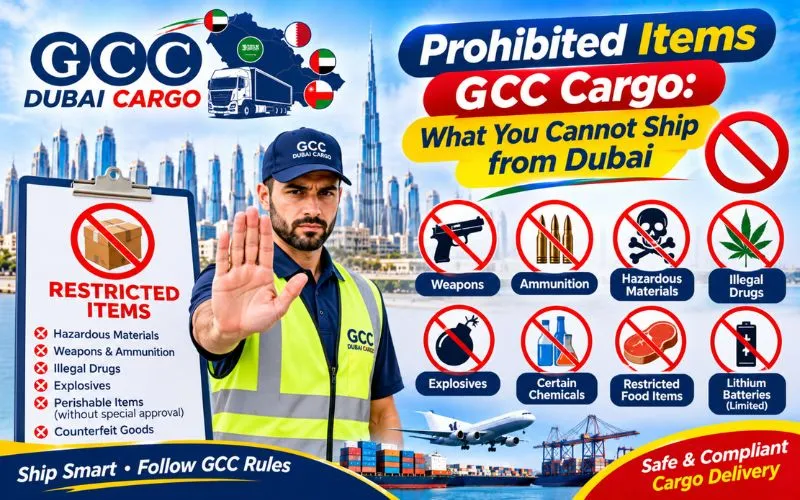
Sending cargo from Dubai to another GCC country requires more than packing your belongings and arranging a truck.
Before transporting household furniture, personal belongings, electronics, business inventory or industrial equipment, you must check whether the goods are permitted for export from the UAE, accepted for transportation and allowed into the destination country.
Some products are prohibited completely, while others require permits, additional documentation or specific transportation arrangements.
Everyday items such as medicines, perfumes, batteries, cleaning chemicals and certain food products can also create problems if their contents are not declared correctly.
For customers arranging GCC road cargo, checking these requirements before pickup can help prevent rejected shipments, customs complications and unnecessary transportation expenses.
At GCC Dubai Cargo, the sensible starting point is to identify everything included in the shipment, review potentially restricted products and confirm cargo acceptance before transportation is arranged.
This guide explains what you cannot ship from Dubai to GCC destinations, which everyday products need additional checks and how to prepare your shipment responsibly.
Before Booking GCC Cargo, Understand What Can and Cannot Travel
A common mistake is assuming that anything legally purchased in Dubai can automatically be transported to Saudi Arabia, Oman, Qatar, Bahrain or Kuwait.
In reality, three separate considerations affect cargo acceptance.
UAE export requirements: The goods must be legally permitted to leave the UAE. Certain products require approval from the relevant government authority.
Destination import requirements: The receiving GCC country determines which products can enter its territory and which require additional permission.
Transportation safety requirements: A cargo operator must consider whether the goods can safely travel using the selected transportation method.
These requirements are not interchangeable.
For example, an electronic device may be legally traded but contain a battery requiring transportation classification. A medicine may be available in Dubai but contain an ingredient controlled by the destination country.
Before booking cargo services in Dubai, customers should identify unusual products rather than describing an entire shipment simply as household goods or general merchandise.
Prohibited, Restricted and Dangerous Goods: Three Different Categories
Understanding the difference between these classifications helps customers make better shipping decisions.
| Category | Meaning | What the customer should do |
|---|---|---|
| Prohibited goods | Products that cannot legally be exported or imported under applicable rules | Exclude them from the shipment |
| Restricted goods | Products requiring permits, approvals or additional conditions | Verify requirements before dispatch |
| Dangerous goods | Products presenting transportation safety risks | Declare their composition and confirm acceptance |
| Carrier-restricted goods | Items a particular transportation provider does not accept | Check the operator's acceptance policy |
Why these classifications matter
A product can be legal in both the UAE and the destination country but still be unacceptable under a particular carrier’s transportation policy.
Similarly, an item being accepted by a transport company does not mean customs authorities will automatically approve its importation.
The UAE Government explains that restricted goods require approval from the appropriate authorities, whereas prohibited goods are subject to applicable import and export bans.
This distinction should guide every shipment assessment.
Items You Should Never Include in a GCC Cargo Shipment
Certain categories deserve particular attention before household or commercial cargo is packed.
The exact legal classification must still be checked against the UAE’s current export rules and the destination country’s regulations.
Narcotics and Controlled Substances
Illegal narcotics and prohibited controlled substances must never be included in a cargo shipment.
This also means customers should not assume that products marketed as herbal remedies, wellness supplements or traditional treatments are automatically acceptable.
Some medicines and health products contain ingredients that are controlled or require special authorization.
Before sending any medication, check its active ingredients, product name, dosage and legal status in the destination country.
Never conceal controlled products inside furniture, clothing, food cartons or personal belongings.
Weapons, Ammunition and Explosives
Firearms, ammunition, explosives, fireworks and similar products are subject to serious legal and transportation restrictions.
Examples include:
Firearms and ammunition.
Explosive materials.
Fireworks and pyrotechnic products.
Certain military equipment.
Stun devices and prohibited weapons.
Items designed to disguise or conceal weapons.
Do not assume that an item is acceptable simply because it is described as sporting equipment, a decorative object or a collectible.
Certain regulated equipment may have specific licensing arrangements, but customers must verify its legal status before requesting transportation.
Counterfeit Products and Prohibited Publications
Counterfeit branded products, pirated goods and products that violate applicable intellectual property laws can create customs problems.
Printed materials, photographs, publications and recorded media may also be restricted depending on their content and destination regulations.
Customers sending retail inventory should ensure that products are genuine and supported by accurate commercial documentation.
Other Legally Prohibited Commodities
Additional prohibited categories can include certain gambling equipment, prohibited wildlife products, radioactive materials, hazardous waste and products restricted under international agreements.
The exact list differs between jurisdictions and product classifications.
For this reason, customers should not rely on an informal list found online when deciding whether an unusual product can be exported.
Everyday Products That Need Special Attention
Not everything requiring additional checks is an obviously dangerous or illegal product.
Several common household and commercial goods can fall under regulatory or transportation restrictions.
Medicines and Health Products
Medicines should be checked individually before being included in a GCC shipment.
Important considerations include:
Active pharmaceutical ingredients.
Whether the medicine is prescription-only.
Whether it contains controlled substances.
Quantity being transported.
Whether the shipment is personal or commercial.
Destination-country import authorization.
Medical devices, supplements, veterinary products and healthcare supplies can also require product-specific approval.
For example, Saudi Arabia’s ZATCA publishes information on restricted and prohibited goods, while its personal-importation guidance addresses permits and supporting documentation for restricted products.
Keep medicines in their original packaging and prepare relevant prescriptions or approvals where applicable.
Do not mix unidentified medicines with ordinary household cartons.
Perfumes, Aerosols and Flammable Liquids
Perfumes, deodorants, hairsprays, spray paints and other aerosol products may present transportation risks because of their chemical composition, pressure or flammability.
Other products needing attention include:
Nail polish and nail polish remover.
Alcohol-based solutions.
Flammable adhesives.
Certain cleaning liquids.
Paints and thinners.
Industrial solvents.
A small bottle of perfume and a large commercial quantity of flammable liquid should not automatically be treated as equivalent shipments.
Product composition, quantity, packaging and transport method all matter.
Customers should disclose these products before pickup rather than placing them inside ordinary cartons without identification.
Batteries and Electronic Equipment
Electronics are common in household relocations and commercial shipments.
However, battery configuration makes an important difference.
Products requiring assessment include:
Power banks.
Loose lithium batteries.
Laptop batteries.
Mobile phones.
Tablets and laptops.
Electric scooters.
E-bikes.
Battery-powered machinery.
The important questions include whether the battery is installed inside equipment, packed separately or damaged, and what its specifications are.
A mobile phone with an installed battery is not automatically equivalent to a carton of loose replacement batteries.
Provide the product details, battery type, quantity and relevant specifications before transportation is arranged.
Food, Plants and Agricultural Products
Food and agricultural products can be subject to import controls, health requirements and additional approvals.
Examples include:
Fresh meat and poultry.
Dairy products.
Fresh fruits and vegetables.
Seeds and seedlings.
Live plants.
Agricultural materials.
Animal-origin products.
Certain goods may require health certificates, phytosanitary documents, inspection or permission from the destination authority.
For example, Qatar Customs publishes product-level prohibited and restricted tariff information, including agricultural and food categories that involve competent government authorities.
Do not assume that sealed supermarket packaging makes every food product acceptable for cross-border cargo.
Cleaning Chemicals, Paints and Industrial Materials
Commercial and household chemicals require particular attention because some products can be corrosive, toxic, flammable or reactive.
Examples include:
Industrial cleaning agents.
Bleach and concentrated detergents.
Pool treatment chemicals.
Paints and thinners.
Lubricants.
Adhesives.
Chemical concentrates.
Pressurized gas containers.
Before requesting transportation, provide the exact product name, manufacturer information, quantity and available safety documentation.
For commercial chemicals, a Safety Data Sheet (SDS) can help identify relevant hazards and transportation classification.
An SDS does not itself establish legal permission to export or import a product.
How Cargo Restrictions Differ Across GCC Destinations
There is no single universal list covering every prohibited and restricted product across all GCC countries.
Although the countries cooperate through regional customs arrangements, national legislation and product-specific regulatory controls remain important.
Customers should check the destination before preparing their cargo.
Saudi Arabia
Saudi Arabia applies its own import restrictions and product-specific controls.
Customers arranging cargo from Dubai to Saudi Arabia should pay particular attention to controlled medicines, weapons, narcotics, prohibited publications, agricultural products and regulated electronic equipment.
Additional checks may be relevant for products such as:
Pharmaceuticals and health supplements.
Wireless communication equipment.
Agricultural seeds and plants.
Food and animal-origin products.
Drones and specialized electronic equipment.
Commercial products subject to technical approvals.
For deliveries to Riyadh, Jeddah, Dammam, Khobar or other Saudi destinations, the consignee’s import status and the intended use of the products should be established before dispatch.
A family sending furniture to Riyadh has different documentation considerations from a business supplying electronic inventory to Dammam.
Saudi Arabia’s ZATCA provides official prohibited-goods and personal-importation information. Commercial importers should also verify the requirements of the relevant product regulator.
Oman
Oman has its own import requirements covering personal belongings and commercial products.
When arranging cargo from Dubai to Oman, customers should check products involving medicines, food, agricultural materials, chemicals, electrical equipment and regulated goods.
Muscat, Sohar and Salalah can involve different final-delivery arrangements depending on whether cargo is intended for a residence, business premises or warehouse.
For personal shipments, Oman Customs explains that goods must meet applicable requirements, be of a personal nature where relevant, and comply with permits and specifications when required.
Customers should also distinguish personal household belongings from goods intended for commercial resale.
Qatar
Qatar Customs maintains separate information for prohibited goods and restricted goods.
Customers sending cargo from Dubai to Qatar should check medicines, food products, electronic equipment, wireless devices, chemicals and other regulated commodities.
Products requiring permission must receive the relevant approval before import.
For example, Qatar’s official customs guidance identifies drugs, weapons, ammunition, explosives, radioactive materials and alcoholic drinks among prohibited categories. It also explains that restricted goods may require permission from competent authorities.
For deliveries to Doha and other destinations, prepare accurate product descriptions and consignee information before transportation.
Bahrain
Bahrain applies national regulations to imported and exported personal and commercial goods.
Customers arranging cargo from Dubai to Bahrain should pay attention to medicines, food products, electrical equipment, chemicals and products subject to specific import controls.
The receiving party should verify whether additional approval or documentation is necessary.
For residential deliveries in Manama and other locations, it is also important to establish whether the cargo contains any products that require separate handling or regulatory checks.
Bahrain’s official government portal confirms that its customs controls apply to both personal and commercial shipments and take account of relevant laws and international agreements.
Kuwait
Kuwait has specific prohibited-import classifications and product-related customs requirements.
Customers planning cargo from Dubai to Kuwait should pay attention to narcotics, alcoholic beverages, pork products, gambling equipment, restricted publications and other regulated commodities.
Food products and commercial inventory should be checked by their actual composition and customs classification.
Customers sending furniture or personal belongings should also review the contents of mixed cartons rather than declaring everything under one general description.
For more detailed destination-specific guidance, see the existing Kuwait prohibited cargo requirements.
Kuwait Customs publishes a prohibited-goods tariff list, but its current online version is identified as a trial version. Confirm the applicable classification with the relevant authority before dispatch.
Are Household Furniture and Personal Belongings Allowed?
Ordinary household furniture and personal belongings are generally different from prohibited or hazardous products.
Common household cargo may include:
Sofas and armchairs.
Beds and mattresses.
Dining tables and chairs.
Cabinets and wardrobes.
Washing machines and refrigerators.
Televisions and other electronics.
Clothing and household boxes.
Books and ordinary personal belongings.
However, the contents of those cartons still matter.
A box containing clothing may also contain perfume, medication, aerosols or other restricted products.
Before packing, separate ordinary belongings from items requiring additional assessment.
Furniture preparation also matters.
Customers should:
Empty drawers and storage compartments.
Remove loose batteries from equipment where appropriate.
Identify electronic components.
Check appliances for residual liquids or chemicals.
Protect glass and fragile surfaces.
Label cartons with accurate descriptions.
For large items, measure their dimensions before pickup. This is particularly important when furniture must pass through apartment entrances, service elevators or narrow staircases in Dubai.
At the destination, confirm that the receiver has adequate unloading access and can accommodate large furniture.
Commercial and Industrial Cargo: What Businesses Should Check
Commercial shipments need accurate product information because customs classification and regulatory approvals can depend on the nature of the goods.
A business sending stock to a retailer, distributor or warehouse should prepare:
Exact product descriptions.
Item quantities.
Country of origin.
Product specifications.
HS codes where applicable.
Commercial invoice.
Packing list.
Applicable certificates and permits.
For example, a retailer sending electronic products may need to distinguish between ordinary electrical accessories, equipment containing lithium batteries and products involving wireless communication technology.
An industrial supplier transporting machinery should identify any batteries, lubricants, fuel residues, chemical components or pressurized systems.
Heavy cargo also requires accurate measurements and weight information.
A large machine is not automatically prohibited because of its size. However, hazardous components or regulated materials associated with that machine may require separate assessment.
Businesses should never describe an entire mixed shipment simply as machinery, spare parts or general stock when more precise product information is available.
Does FTL or LTL Transportation Change What You Can Ship?
Full Truckload (FTL) and Less Than Truckload (LTL) describe transportation arrangements, not exemptions from customs or safety requirements.
FTL cargo
FTL involves arranging truck capacity for a dedicated shipment.
It may suit businesses transporting larger quantities, machinery, commercial stock or household relocation cargo.
However, using a dedicated truck does not make a prohibited product legal or automatically make dangerous goods acceptable.
LTL cargo
LTL involves transporting smaller shipments alongside other compatible cargo.
This arrangement requires particular attention to accurate declarations, packaging integrity and compatibility between different shipments.
Products that can leak, react, ignite or contaminate nearby goods require additional assessment.
Before choosing either option, provide the complete cargo inventory and identify any products with special transportation requirements.
The appropriate arrangement depends on the cargo’s legal status, safety classification, dimensions, weight and delivery requirements.
What Happens When Restricted Items Are Found?
If a shipment contains an undeclared or unacceptable product, the consequences can extend beyond the individual item.
Depending on the circumstances and applicable regulations, the shipment may face:
Additional inspection.
Customs detention.
Requests for supporting documentation.
Rejection or refusal of the product.
Storage or handling expenses.
Return transportation arrangements.
Confiscation or other enforcement action where applicable.
Delays affecting other goods in the shipment.
For mixed household or commercial cargo, this can create additional complications because one problematic product may affect the assessment of the entire consignment.
The best prevention is accurate disclosure before pickup.
If an item is identified as restricted after collection, do not attempt to conceal it or change its description. Contact the relevant transportation and customs representatives to determine the appropriate next step.
Documents to Prepare Before Sending GCC Cargo
Not every shipment requires the same paperwork. Documentation depends on the cargo type, destination, personal or commercial purpose and applicable regulations.
The following documents may be relevant.
| Document | When it may be needed |
|---|---|
| Commercial invoice | Commercial shipments and customs valuation |
| Packing list | Identifying cartons, products and quantities |
| Transport document | Recording shipment and transportation details |
| Certificate of origin | Where required to establish product origin |
| Import permit | For products subject to destination approval |
| Export approval | Where UAE authorities require authorization |
| Safety Data Sheet | Assessing chemical and hazardous product classification |
| Health or phytosanitary certificate | Certain food, plant and animal products |
| Prescription or medical authorization | Certain pharmaceutical products |
Keep shipment descriptions accurate
Descriptions such as “personal items”, “household goods” or “commercial products” may be insufficient when customs authorities need to identify individual products.
Instead of writing:
Miscellaneous goods.
General electronics.
Kitchen products.
Industrial materials.
Use specific descriptions, quantities and product details.
For commercial shipments, ensure the invoice, packing list and actual cargo contents agree.
For personal shipments, prepare an inventory that clearly separates furniture, appliances, clothing and other belongings.
Where a certificate or permit is required, verify its validity and applicability to the actual product and destination.
How to Screen Your Shipment Before Dubai Pickup
A little preparation before collection can prevent significant complications later.
Use the following procedure when preparing household, commercial or industrial cargo.
Step 1: Create a complete cargo inventory
List the contents of each carton and identify unusual products separately.
Do not combine medicines, batteries, chemicals and ordinary household belongings under one general description.
Step 2: Identify products requiring additional checks
Pay particular attention to:
Medicines and supplements.
Perfumes and aerosols.
Batteries and power banks.
Cleaning products.
Food and agricultural products.
Electronic communication equipment.
Industrial chemicals.
Machinery containing hazardous components.
Step 3: Record important product information
For uncertain products, provide the exact brand, model, ingredients, quantity and available technical documentation.
Photographs of labels and packaging can help clarify product identity.
Step 4: Check the destination
Determine whether the goods are permitted in the receiving GCC country and whether the importer needs additional authorization.
Step 5: Confirm transportation acceptance
An item might be legally permitted but unsuitable for the selected road-freight service.
Obtain confirmation before including it in the shipment.
Step 6: Prepare packaging and documents
Pack acceptable products appropriately, protect fragile items and prepare the applicable inventory and commercial paperwork.
Step 7: Confirm pickup and delivery access
For Dubai apartments, villas, offices and warehouses, check parking, loading bays, security procedures and elevator availability.
At the destination, confirm the receiver’s contact information, unloading arrangements and vehicle access.
This preparation is particularly useful for mixed household shipments and businesses sending multiple product categories.
Common Cargo Mistakes and How to Prevent Them
Some shipment problems arise because customers do not recognize potentially restricted products until transportation is being arranged.
| Common problem | Practical solution |
|---|---|
| Perfume is packed inside household cartons without declaration | List perfumes separately and confirm acceptance |
| Loose lithium batteries are mixed with electronics | Identify battery type, quantity and configuration |
| Medicines are described only as personal belongings | Provide product names and check destination requirements |
| Chemical containers have unclear labels | Supply product details and available safety documentation |
| Commercial stock is described as miscellaneous goods | Prepare a detailed commercial invoice and packing list |
| Furniture contains undisclosed products in storage compartments | Empty and inspect drawers before loading |
| Cargo dimensions are missing | Measure large items before requesting a quotation |
| The receiving warehouse has restricted vehicle access | Confirm unloading arrangements before dispatch |
| The documents describe different quantities from the actual cargo | Reconcile the inventory, invoice and packing list |
Why early identification matters
Consider a family moving furniture and personal belongings from Dubai to Muscat.
The main shipment may consist of beds, wardrobes, clothing and appliances. However, several cartons also contain perfume, cleaning liquids and medicines.
If these products are not identified before collection, the shipment may need additional assessment after packing.
A similar problem can occur when a business sends electronic stock containing different battery configurations.
In both cases, accurate information before transportation is more useful than trying to resolve an unclear declaration at the border.
What Determines the Cost of Transporting Acceptable Cargo?
Customers sometimes assume that prohibited or restricted products are simply subject to an additional transportation charge.
That is not necessarily the case.
A prohibited product cannot be made acceptable by paying a higher freight rate. A restricted product may require regulatory approval before transportation can proceed.
For goods confirmed as acceptable, the quotation can depend on:
Total shipment weight.
Cargo volume.
Individual item dimensions.
Destination country and delivery location.
FTL or LTL transportation requirements.
Packaging and loading arrangements.
Heavy or oversized cargo requirements.
Residential or commercial delivery access.
Additional documentation requirements.
Any approved special handling arrangements.
To request a meaningful quotation, provide the pickup location in Dubai, destination city, cargo inventory, approximate weight, dimensions and photographs where useful.
Identify any unusual products separately.
This allows the transportation requirements to be assessed before a quotation and collection arrangement are finalized.
Arrange a Cargo Assessment Before Your Shipment Leaves Dubai
Planning a GCC shipment becomes easier when the cargo is identified before collection.
Whether you are sending household furniture to Saudi Arabia, commercial stock to Qatar, personal belongings to Oman or equipment to Bahrain or Kuwait, the first step is confirming what the shipment contains.
GCC Dubai Cargo provides a Dubai-based cargo service focus for customers planning transportation to GCC destinations.
Before requesting transportation, prepare the following information:
Pickup location in Dubai.
Destination country and city.
Personal or commercial shipment purpose.
Complete cargo inventory.
Approximate shipment weight and volume.
Dimensions of large or unusual items.
Photographs of products requiring assessment.
Available invoices, permits or product documentation.
Receiver contact information and delivery access details.
If your cargo includes medicines, batteries, perfumes, chemicals, food products or industrial materials, mention them separately.
This helps establish whether additional checks are necessary before the shipment is considered for transportation.
Contact GCC Dubai Cargo to discuss your cargo requirements before packing and collection.
Providing accurate product information at the beginning helps avoid preventable complications during the shipping process.
Frequently Asked Questions | Prohibited Items GCC Cargo
Common prohibited categories include illegal narcotics, unauthorized weapons and explosives, counterfeit goods, certain gambling equipment, prohibited publications and other products banned under applicable export or destination-country regulations.
Additional restrictions may apply to food, medicines, agricultural products, chemicals and electronic equipment. The exact requirements depend on the destination and product classification.
These products require individual assessment rather than automatic acceptance or rejection.
Medicines may need prescriptions or import authorization. Perfumes can contain flammable ingredients, while lithium batteries require checks based on their type, configuration and condition.
Provide the product details and quantity before arranging transportation.
No. Although GCC countries share regional customs arrangements, each destination has applicable national laws, product-specific restrictions and approval procedures.
A product permitted in one country may be restricted or prohibited in another. Always verify the requirements of the actual receiving country.
FTL and LTL describe how cargo space is arranged, not whether a product is legally acceptable.
A restricted product may require approval and specific transportation conditions regardless of whether it occupies a dedicated truck or shares space with other shipments.
The cargo must be assessed before selecting the transportation arrangement.
Depending on the product and applicable regulations, authorities may detain, reject or confiscate the goods and take other enforcement action.
The shipment may also experience inspection delays, additional handling expenses or return arrangements.
Accurate declarations, pre-shipment product checks and appropriate documentation help reduce the risk of these problems.
Made Easy
GCC Cargo Destinations
Fast, secure, and reliable cargo delivery from Dubai to GCC countries.
Let's help you!
Need reliable cargo delivery from Dubai to GCC? Get in touch with our team today.
WhatsApp Now
+971 54 143 5685
Quick Links
© 2026 GCC Dubai Cargo. All Rights Reserved.
