
Prohibited Items Saudi Arabia Cargo: Banned Goods from Dubai
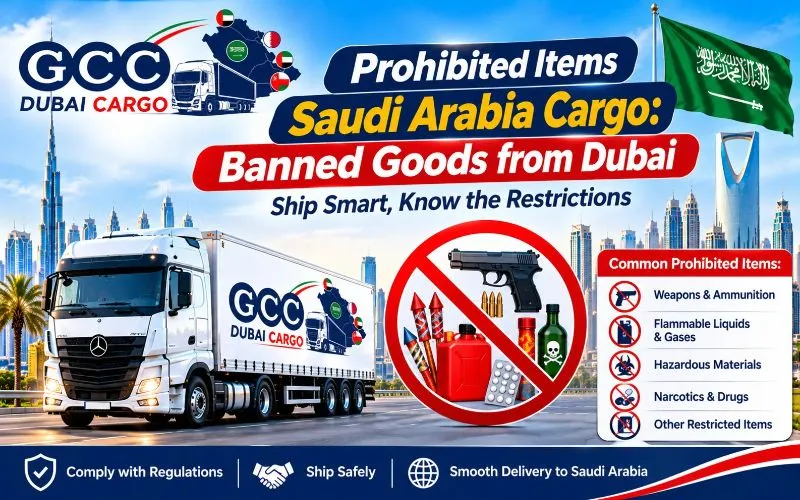
Shipping cargo from Dubai to Saudi Arabia requires more than arranging a truck and preparing boxes. Before sending household belongings, commercial stock, electronics or other products, it is important to check whether the goods are permitted to enter Saudi Arabia.
Some products are prohibited, while others may require special approvals, registrations or supporting documents.
A shipment can contain ordinary-looking products that need additional checks. Medicines, cosmetics, wireless equipment, batteries, food products and certain chemicals are examples of goods that should be reviewed before transportation.
A product being available for purchase in Dubai does not automatically mean it can be imported into Saudi Arabia.
This guide explains the prohibited items in Saudi Arabia, products that may need approval, and practical checks customers should complete before arranging cargo collection.
Whether you are sending personal belongings to Riyadh, business inventory to Jeddah or equipment to Dammam, checking your cargo beforehand can help prevent avoidable customs and transportation problems.
If you are planning cargo from Dubai to Saudi Arabia, prepare an accurate inventory and identify any questionable products before requesting transportation from GCC Dubai Cargo.
Understanding Prohibited and Restricted Items in Saudi Arabia
Before checking individual products, understand the difference between prohibited and restricted goods.
These categories have different implications for customers shipping from Dubai.
| Category | Meaning | What the Customer Should Do |
|---|---|---|
| Prohibited Goods | Goods that cannot legally be imported under the applicable prohibition | Remove them from the shipment |
| Restricted Goods | Goods subject to specific import conditions or government controls | Check approval requirements before shipping |
| Transport-Restricted Goods | Products that a particular carrier or transport method may not accept | Confirm carrier acceptance and handling requirements |
| Regulated Commercial Products | Products subject to standards, registration or conformity requirements |
For example, weapons and narcotics fall within serious prohibited or controlled categories. Certain medicines, food products and technical equipment may require additional regulatory checks.
Saudi Arabia’s Zakat, Tax and Customs Authority (ZATCA) publishes information about prohibited goods, while Saudi Post (SPL) provides its own prohibited-item guidance for postal services.
These lists serve different purposes. A postal carrier’s acceptance policy should not automatically be treated as the complete legal import list for commercial road freight.
You should check the actual product, its intended use, classification and applicable import requirements before dispatch.
Goods You Should Not Include in Cargo to Saudi Arabia
Certain categories deserve particular attention when preparing cargo in Dubai.
The following are important examples, not a substitute for checking the complete applicable Saudi regulations.
Narcotics and Controlled Substances
Illegal drugs, narcotics and intoxicating substances are among the most serious prohibited categories.
Customers should not include:
Illegal narcotic substances.
Controlled drugs without lawful authorization.
Intoxicating substances prohibited under Saudi regulations.
Drug-related products prohibited by applicable laws.
Unidentified substances that cannot be properly declared.
Never place medicines, powders, tablets or chemical substances into a shipment without identifying exactly what they are.
Some legitimate medicines are subject to separate import controls. They should not automatically be treated as illegal narcotics, but their import conditions must be checked.
Alcohol and Pork Products
Alcoholic beverages and pork products are important categories to check before shipping.
Do not include alcoholic drinks or pork products in ordinary cargo without assuming they will be accepted because they are commercially packaged or sealed.
Saudi Post’s published prohibited-item information specifically identifies alcohol and prohibited goods, including certain food products.
Customers should also check food ingredients and product descriptions rather than relying only on the outer packaging.
For example, a mixed food shipment should have a clear inventory showing its actual contents.
Weapons, Ammunition and Explosives
Weapons and explosive materials require particularly strict attention.
Examples include:
Firearms and ammunition.
Explosive materials.
Fireworks and firecrackers.
Gunpowder.
Certain weapon components.
Electric shock weapons.
Other prohibited security-related equipment.
ZATCA identifies weapons, ammunition and fireworks in its published prohibited-item guidance.
Do not assume that an item is acceptable simply because it is described as sporting equipment, a collectible or a toy.
If an object resembles a weapon or contains a controlled mechanism, obtain an authoritative classification before considering transportation.
Counterfeit Currency and Fake Products
Counterfeit products can create customs and intellectual property problems.
Customers should avoid including:
Counterfeit banknotes.
Fake branded handbags.
Imitation branded watches.
Products carrying unauthorized trademarks.
Counterfeit commercial stock.
Goods falsely presented as genuine branded products.
ZATCA’s personal import guidance states that counterfeit and adulterated goods, as well as goods violating intellectual property rights, cannot be imported.
Commercial businesses should maintain genuine purchase records and accurate product descriptions.
Obscene Materials and Prohibited Publications
Certain publications, media and other materials may be prohibited under Saudi regulations.
ZATCA identifies storage media containing prohibited immoral content and publications that violate the relevant Ministry of Media regulations. SPL also lists prohibited content and related products.
Customers should check books, magazines, DVDs, storage devices and similar products before adding them to a shipment.
Do not assume that a personal collection is automatically exempt from applicable restrictions.
Hidden Cameras and Surveillance Equipment
Some electronic products require additional attention because they can contain surveillance or recording features.
Examples include:
Hidden-camera pens.
Camera watches.
Concealed recording devices.
Eavesdropping equipment.
Certain surveillance equipment.
ZATCA specifically mentions products containing secret cameras and eavesdropping devices in its published list.
An ordinary electronic product and a concealed surveillance device should not be treated as the same category. Check the actual design and functionality before shipping.
Other Controlled Products
Other products may also fall under specific prohibitions or regulatory controls.
Examples appearing in official guidance include:
Certain electric shock devices.
Speed radar detectors.
Fireworks.
Nutmeg fruit and its powder.
Guru fruits.
Certain unregistered preparations and medicines.
The exact regulatory treatment depends on the product and applicable rules. Check the current official information instead of assuming that a general product description is sufficient.
Restricted Goods That May Need Special Approval
Not every controlled product is completely banned. Some goods may be importable when the importer meets the relevant conditions.
This distinction is especially important for commercial customers.
Medicines and Medical Products
Medicines should be identified by their actual names, ingredients, dosage and intended use.
Before shipping pharmaceutical or medical products, check:
Whether the product is legally permitted.
Whether it is registered or otherwise authorized.
Whether the importer is eligible to receive it.
Whether a prescription or special permit is necessary.
Whether the product needs temperature-controlled transportation.
Whether additional medical or regulatory documentation is required.
The Saudi Food and Drug Authority (SFDA) has responsibilities relating to medicines, medical devices and other regulated products.
Do not mix prescription medicines, medical equipment or commercial pharmaceutical stock with ordinary household cartons without first confirming the requirements.
Official information: Saudi Food and Drug Authority.
Food and Agricultural Products
Food shipments require product-specific checks.
Depending on the goods, relevant requirements may involve:
Food product registration.
Importer registration.
Health certificates.
Halal certificates where applicable.
Product labelling.
Expiry information.
Agricultural or veterinary documentation.
Special storage and transportation arrangements.
For example, commercial food imports are subject to SFDA requirements concerning product compliance, importer registration and accompanying documentation.
Do not assume that packaged food, fresh produce, meat, seeds or supplements all follow the same import process.
Before including food in a road cargo shipment, ask the Saudi importer to verify the relevant requirements.
Cosmetics and Personal Care Products
Cosmetics are another category that needs careful identification.
Examples include:
Skincare creams.
Perfumes.
Hair products.
Beauty preparations.
Personal care liquids.
Commercial cosmetic stock.
Check the product’s ingredients, intended use, labelling and applicable SFDA requirements.
A cosmetic product should not automatically be classified as a medicine, and not every cosmetic has identical import conditions.
Customers sending commercial quantities should confirm the applicable requirements with the Saudi importer and relevant authority before pickup.
Electronics and Wireless Equipment
Ordinary electronics may be different from controlled communication or surveillance equipment.
Examples that deserve checking include:
Wireless transmitters.
Two-way radios.
Communication equipment.
Devices containing restricted recording functions.
Certain electronic control systems.
Products covered by Saudi technical regulations.
For commercial consumer products, the SABER platform is relevant to product registration and conformity procedures.
The official platform explains its role in registering products and conformity certificates and issuing shipment certificates for applicable products.
Do not assume that every electronic product needs the same certificate. Requirements depend on its classification and the applicable technical regulations.
Drones and Special Equipment
Drones and remotely controlled equipment should be checked before transportation.
Provide the product’s:
Manufacturer.
Model number.
Intended purpose.
Technical specifications.
Wireless functions.
Battery information.
Importer details.
Some products may be subject to aviation, telecommunications, security or other regulatory requirements.
Do not dispatch a drone simply because it is available for sale in Dubai or because a previous shipment of similar equipment was accepted.
Batteries, Perfumes and Other Transport-Sensitive Goods
Some products may be subject to transportation restrictions even when their import status is different.
This is an important consideration for road freight.
| Product | What Should Be Checked |
|---|---|
| Lithium Batteries | Battery type, condition, packaging and applicable transport requirements |
| Damaged Batteries | Whether transportation is prohibited under the applicable carrier and safety rules |
| Perfumes | Alcohol content, flammability and carrier acceptance |
| Aerosol Cans | Contents, pressure and flammability |
| Paints and Adhesives | Chemical composition and hazardous classification |
| Gas Cylinders | Contents, pressure and transport authorization |
| Cleaning Chemicals | Ingredients, hazard classification and packaging |
| Fuel Products | Flammability and legal transportation restrictions |
SPL identifies flammable liquids, compressed gases, lithium batteries, radioactive materials and other hazardous substances in its prohibited-item information.
SPL
For road cargo, the correct classification and transport conditions must be checked separately from Saudi import eligibility.
For example, a perfume may be a legitimate consumer product, but its flammability and packaging can affect whether a particular transportation service accepts it.
Always disclose batteries, liquids and chemical contents before arranging collection.
Are Household Items and Personal Belongings Allowed?
Customers moving household belongings from Dubai to Saudi Arabia often have questions about furniture and personal-use items.
Ordinary household furniture and belongings are not automatically prohibited simply because they are being transported internationally.
Common household items include:
Sofas and chairs.
Beds and mattresses.
Dining tables.
Cabinets and wardrobes.
Kitchen furniture.
Household appliances.
Clothing and personal belongings.
Books and ordinary household accessories.
Properly identified household boxes.
However, individual contents still need to comply with Saudi import rules.
A carton containing ordinary clothing is different from one containing prohibited substances, restricted medicines or undeclared hazardous materials.
How to Prepare Household Cargo
Before pickup:
Prepare a list of furniture and household belongings.
Count cartons and individual packages.
Separate medicines, liquids and electronics.
Check the contents of kitchen and storage boxes.
Identify products that may need special approval.
Photograph valuable or unusual items.
Label packages clearly.
Provide the Saudi receiver’s details.
For large furniture, measure the dimensions before transportation.
Also confirm whether the Dubai collection location has a suitable loading area, service elevator and vehicle access.
Customers should check building management requirements for elevator reservations, loading permissions and parking.
Restrictions for Commercial Cargo from Dubai
Commercial cargo requires particular attention because the products may be subject to import registration, standards, permits or other regulatory requirements.
Examples include:
Retail inventory.
Electronics and accessories.
Spare parts.
Machinery.
Office equipment.
Packaged consumer products.
Construction materials.
Business supplies.
Industrial equipment.
Before arranging commercial transportation, prepare a detailed description of every product.
Avoid vague descriptions such as:
General goods.
Mixed items.
Accessories.
Spare materials.
Various products.
Instead, identify the actual product and provide relevant details.
For example, instead of writing “electronics,” describe the products as computer monitors, wireless routers or electrical components, as applicable.
Product Classification and Importer Verification
The Saudi importer should check whether the goods fall under any relevant import controls.
For applicable consumer and commercial products, SABER may be relevant to conformity certification and shipment certification.
Food, medicines, cosmetics and medical devices may involve separate SFDA requirements.
The importer should also check the relevant customs classification and any additional permissions before the goods leave Dubai.
Documents to Check Before Sending Goods to Saudi Arabia
Documentation depends on the nature of the shipment.
Not every personal shipment requires the same documents as a commercial consignment.
The following table provides a practical preparation guide.
| Document or Information | Purpose |
|---|---|
| Commercial Invoice | Identifies commercial products and their declared values |
| Packing List | Describes packages, quantities and contents |
| Certificate of Origin | Identifies where applicable goods were produced |
| Transport Document | Records relevant transportation details |
| Importer Information | Identifies the receiving business or individual |
| Product Permits | Supports products requiring authorization |
| Conformity Certificates | Supports applicable regulated commercial products |
| Health Certificates | Relevant to certain food or agricultural shipments |
| Product Specifications | Helps identify technical and regulated goods |
ZATCA’s personal import information and the SFDA’s food import guidance explain that documentation and approvals depend on the nature of the goods and the applicable import process.
Zatca+1
Make sure the invoice, packing list and actual cargo contents agree.
If a carton contains several products, list the individual contents rather than using a broad description.
How to Check an Item Before Shipping
A simple pre-shipment review can prevent many avoidable problems.
Follow these steps before arranging cargo collection.
Step 1: Identify the exact product
Write down the commercial name, model, ingredients or material composition where relevant.
Step 2: Check the prohibited goods information
Review ZATCA’s published guidance and other applicable Saudi government requirements.
Step 3: Identify restricted products
Determine whether the product needs a permit, registration, conformity certificate or special approval.
Step 4: Check transport acceptance
Ask whether the selected road freight service accepts the product, particularly if it contains liquids, batteries, chemicals or pressurized materials.
Step 5: Confirm the Saudi receiver
The importer or receiver should verify the product’s eligibility and required documentation.
Step 6: Prepare the inventory
Record product descriptions, quantities, dimensions and package counts.
Step 7: Share the details before pickup
Provide the inventory and relevant product information to your cargo service provider.
Official Resources for Checking Saudi Requirements
Use authoritative sources rather than relying entirely on old shipping articles.
These sources cover different aspects of import controls, product compliance and transportation acceptance. No single page should be treated as a complete list for every type of commercial road shipment.
Preparing Your Cargo at a Dubai Pickup Location
After checking the products, prepare the shipment properly.
Customers arranging cargo services in Dubai should provide accurate pickup information before the collection is arranged.
Important considerations include:
Whether the cargo is located in an apartment, villa, office or warehouse.
Whether a loading bay is available.
Whether building security requires advance notification.
Whether a service elevator needs to be booked.
Whether large furniture can pass through doors and corridors.
Whether the loading area can accommodate the required vehicle.
Whether the packages need additional protection.
Separate ordinary household belongings from products that require special checks.
Do not conceal liquids, batteries, medicines or other regulated goods inside unlabelled cartons.
For fragile products, use suitable protective packaging and identify breakable packages where appropriate.
Customers should also provide the Saudi delivery address and receiver’s contact information before transportation planning is finalized.
Common Mistakes That Can Cause Saudi Cargo Problems
Many shipping problems begin before a vehicle leaves Dubai.
Here are common mistakes and practical ways to avoid them.
| Common Mistake | Recommended Solution |
|---|---|
| Sending Goods Without Checking Restrictions | Review every product before booking |
| Using Vague Product Descriptions | Prepare an itemized inventory |
| Mixing Medicines with Household Items | Separate and identify medicines |
| Hiding Batteries Inside Equipment | Declare battery-containing products |
| Sending Commercial Goods Without Checking Approvals | Ask the importer to verify regulatory requirements |
| Providing Incorrect Package Quantities | Count and record each carton |
| Assuming Personal Goods Are Automatically Exempt | Check the contents and applicable import rules |
| Using Incorrect Invoice Descriptions | Match documents to actual goods |
| Ignoring Pickup Access | Confirm parking, elevators and loading arrangements |
| Failing to Provide Receiver Information | Verify the Saudi delivery contact beforehand |
One important example is a commercial shipment containing 20 different products. If the invoice only says "general merchandise," the importer may not have enough information to identify the applicable product requirements.
A detailed inventory provides a much clearer basis for checking.
What Happens When Customs Identifies a Restricted Item?
The consequences depend on the product and the applicable regulations.
Possible outcomes include:
Additional inspection.
Requests for supporting documents.
A hold while an applicable approval is verified.
Rejection of the goods.
Seizure or confiscation where legally required.
Financial penalties or further legal consequences where applicable.
Return or other disposal arrangements according to the relevant decision.
A prohibited product cannot simply be made acceptable by adding an invoice or certificate after it has been identified.
For restricted products, the importer may need to provide the relevant authorization before the goods can be released.
ZATCA’s guidance addresses prohibited goods and personal import requirements, while sector authorities administer their respective product controls.
If a questionable item is discovered before pickup, remove it from the proposed shipment until its status has been properly checked.
This is generally easier than trying to resolve a problem after the goods have entered a customs process.
Does FTL or LTL Transportation Change Import Restrictions?
Customers can have different cargo quantities and transportation requirements.
Two common road freight arrangements are FTL and LTL.
FTL (Full Truckload)
FTL is a transportation arrangement in which the truck capacity is allocated to a shipment or customer according to the agreed service.
It may be suitable for larger commercial consignments, furniture shipments and bulky cargo.
LTL (Less Than Truckload)
LTL is suitable for shipments that do not require the entire truck capacity and can be transported as part of a consolidated load, subject to the service arrangements.
However, neither FTL nor LTL changes Saudi Arabia’s import restrictions.
A prohibited product does not become acceptable because it occupies only one small carton or is transported in a dedicated truck.
Likewise, restricted goods still require their applicable approvals regardless of the transportation arrangement.
Customers should disclose all items before confirming either service.
Planning Cargo Delivery to Riyadh, Jeddah and Other Saudi Cities
The destination address is another important part of shipment planning.
Customers sending permitted cargo from Dubai may have different delivery requirements depending on whether the receiver is a household, commercial business, warehouse or industrial facility.
Riyadh: Household furniture, office equipment and retail stock may require residential, office or warehouse delivery arrangements. Confirm the unloading area and receiver’s availability.
Jeddah: Commercial shipments and household belongings should have clear delivery addresses and receiver information. Larger consignments may require advance unloading arrangements.
Dammam and Al Khobar: Businesses receiving equipment or commercial inventory should confirm site access and unloading arrangements before dispatch.
Jubail: Industrial deliveries may require additional information about the receiving facility, access procedures and the type of equipment being delivered.
Makkah and Madinah: Confirm the exact delivery location and any applicable access arrangements with the receiver before transportation is planned.
Yanbu and Taif: Provide accurate destination details, package dimensions and unloading requirements, especially for large furniture and commercial cargo.
These are delivery-planning considerations, not claims that every service is available at every destination.
How GCC Dubai Cargo Helps You Prepare Your Shipment
GCC Dubai Cargo provides cargo and road freight services from Dubai to Saudi Arabia and other GCC destinations.
Before arranging a shipment, customers should provide the information needed to understand the cargo and its transportation requirements.
This includes:
Product descriptions.
Cargo quantities.
Number of cartons or packages.
Approximate weight.
Dimensions of large items.
Photos of unusual products.
Pickup address in Dubai.
Saudi delivery address.
Receiver details.
Relevant documents and approvals.
Whether you are sending household furniture, business inventory, office equipment or other permitted cargo, an accurate inventory makes it easier to discuss the transportation requirements.
If you are unsure about a particular item, identify it before requesting collection. GCC Dubai Cargo can review the information you provide and help clarify what needs to be checked before transportation is arranged. Final import eligibility and regulatory approval must be confirmed with the relevant Saudi authority and importer.
Planning cargo from Dubai to Saudi Arabia?
Contact GCC Dubai Cargo with your cargo list, product details and destination information before booking.
WhatsApp: +971 54 143 5685
Email: info@gccdubaicargo.com
Website: www.gccdubaicargo.com
Frequently Asked Questions | Prohibited Items Saudi Arabia Cargo
Important prohibited categories include illegal narcotics, prohibited intoxicating substances, weapons and ammunition, fireworks, counterfeit currency and certain prohibited publications and surveillance devices. Alcohol and prohibited products such as certain pork goods are also identified in Saudi Post's published prohibited-item information. Always check the applicable Saudi import rules for the specific product before shipping.
These products require separate checks. Medicines and medical products may need regulatory authorization, while cosmetics must meet the applicable product requirements. Perfumes may also have transportation restrictions because of their alcohol content and flammability. Confirm import eligibility and carrier acceptance before arranging pickup.
Ordinary household furniture, clothing, beds, sofas, tables and appliances are not automatically prohibited. However, their actual contents must comply with Saudi import requirements. Check medicines, liquids, electronics and other regulated products separately before packing household cartons.
Depending on the product and applicable regulations, the shipment may be inspected, held, rejected or seized. Additional documentation may be requested for restricted goods. Prohibited goods cannot be made acceptable simply by supplying additional paperwork. Checking questionable items before pickup is the better approach.
Identify the exact product, its composition, intended use and applicable customs classification. Check ZATCA requirements and the relevant product authority, such as SFDA for applicable food and medical products. Also check whether SABER conformity requirements apply. Ask the Saudi importer to verify the requirements before dispatch.
Made Easy
GCC Cargo Destinations
Fast, secure, and reliable cargo delivery from Dubai to GCC countries.
Let's help you!
Need reliable cargo delivery from Dubai to GCC? Get in touch with our team today.
WhatsApp Now
+971 54 143 5685
Quick Links
© 2026 GCC Dubai Cargo. All Rights Reserved.
