
Qatar Customs Clearance Guide for Cargo from Dubai
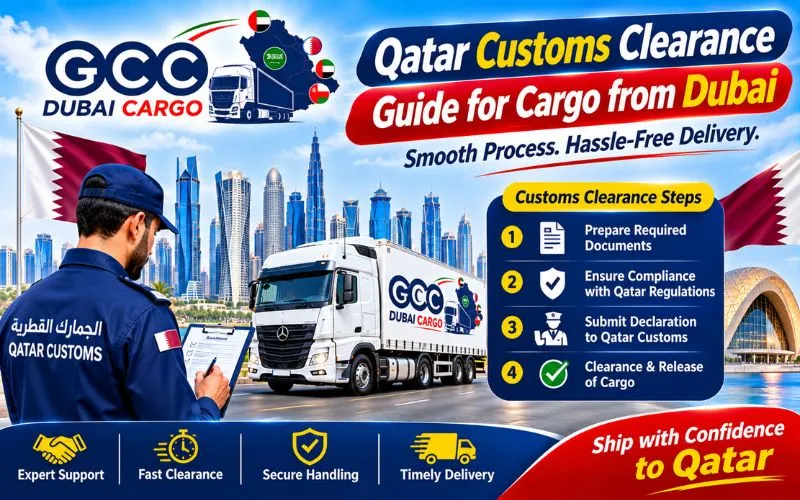
Shipping cargo from Dubai to Qatar is not only a transportation task. Customs preparation can influence whether a shipment moves smoothly from origin to destination, particularly when the cargo travels by road and the shipment documentation must accurately describe what is being transported.
Before your cargo leaves Dubai, you should know what the shipment contains, who is receiving it, how the goods are described, what documents apply, and whether the products require any special approval.
For road cargo, the route also matters. Cargo travelling from Dubai to Qatar can pass through Saudi Arabia before entering Qatar, meaning the shipment may need to be prepared for the applicable transit and destination customs procedures.
Qatar Customs provides separate procedures for commercial and personal imports, and land imports have their own documentation requirements. The exact requirements can vary according to the cargo, importer, product classification and applicable regulations.
This guide explains the customs side of shipping cargo from Dubai to Qatar and shows what customers should prepare before pickup.
Why Qatar Customs Clearance Matters for Dubai Cargo
Customs clearance is the process through which imported cargo is declared, reviewed and released according to the applicable customs requirements.
For a shipment from Dubai, customs preparation starts before the truck reaches Qatar. The information supplied at the beginning should accurately represent the physical cargo.
A mismatch between the shipment description and the actual goods can create questions during clearance. The same applies when quantities, values, product descriptions or supporting documents do not agree.
For this reason, customs preparation should not be treated as paperwork that is completed after the cargo has already started its journey.
A better approach is to review the shipment before pickup.
Prepare the cargo details, identify the receiver, check the documents that apply to the goods and disclose products that may require special treatment.
How Dubai-to-Qatar Road Cargo Reaches Qatar
Road cargo from Dubai to Qatar requires careful route planning because the UAE and Qatar do not share a direct land border.
For road shipments, the journey can involve Saudi Arabia as a transit country before the cargo reaches Qatar.
This makes the customs process different from a shipment travelling directly between two countries that share a land border.
The Saudi stage should therefore be considered when preparing transportation and customs documentation. The final destination remains Qatar, but the cargo may have to move under the applicable transit arrangements while crossing Saudi territory.
For customers arranging cargo from Dubai to Qatar, this distinction is important because customs preparation should reflect the complete route rather than only the final destination.
The Saudi Transit Stage
Saudi Arabia can form part of the road journey between Dubai and Qatar.
The cargo is not necessarily being imported into Saudi Arabia simply because the truck passes through Saudi territory. The applicable customs treatment depends on the shipment and transit arrangements.
This is why the documentation should be prepared correctly before departure.
The cargo description, quantity, value and other shipment information should be consistent throughout the documentation used for the journey.
Customers shipping through other Saudi-transit GCC routes can also review cargo from Dubai to Saudi Arabia when comparing route requirements.
The Qatar Import Stage
Qatar is the final import destination for the shipment.
At this stage, the cargo is handled according to Qatar’s applicable import and customs procedures.
Qatar Customs states that land imports require a cargo manifest, while packing lists can be required for multiple goods and should include relevant classification information where applicable. The customs declaration is submitted electronically by the importer, representative or authorized customs broker.
The cargo may also be subject to inspection or examination according to customs risk-assessment procedures.
What Qatar Customs Checks
Customs clearance is not simply about submitting a document.
The information in the documents must make sense when compared with the shipment.
Cargo Description and Quantity
Avoid vague descriptions when a clearer description is available.
For example, a shipment containing office chairs, electrical components or household furniture should be described appropriately rather than being reduced to an unclear general term.
The quantity should also correspond with the physical shipment.
If the packing list says there are a certain number of cartons but the actual shipment contains something different, the discrepancy should be corrected before dispatch.
Declared Value and Classification
The declared value should accurately represent the shipment information required for customs purposes.
Product classification can also matter. Some goods are subject to specific restrictions, approvals or controls.
When the classification is uncertain, it is better to identify the issue before shipment rather than assuming that the product will automatically clear.
Importer and Receiver Information
The receiving party should be clearly identified.
Commercial shipments may involve a business importer, while personal shipments have different circumstances.
The receiver’s name, address and contact details should be checked before the cargo leaves Dubai, particularly when final delivery is going to a residence, warehouse or commercial premises.
Documents Commonly Used for Qatar Cargo Clearance
The exact documents required depend on the shipment.
Qatar Customs’ importation guidance identifies several documents used in the customs process, including a detailed invoice, certificate of origin and land-import manifest, with packing lists applicable for multiple goods.
Commercial Invoice
A commercial invoice normally provides important information about the transaction and goods.
Descriptions, quantities and values should be accurate and consistent with the shipment.
Avoid changing product descriptions between documents simply to make them shorter.
Packing List
A packing list helps identify what is physically included in the shipment.
It can be particularly useful when cargo contains multiple cartons, pallets, different products or mixed items.
For multiple goods, Qatar Customs states that the packing list may need relevant HS-code information and international codes for chemicals or hazardous goods where applicable.
Certificate of Origin
A certificate of origin can be relevant depending on the shipment and applicable customs arrangements.
Do not assume that every cargo shipment will have identical origin-document requirements.
The origin of the goods and the applicable customs framework should be considered when preparing the shipment.
Land Cargo Manifest and Transport Documents
For land imports, Qatar Customs identifies the cargo manifest as a required document within the import procedure.
Transport documentation should also accurately identify the shipment and its movement.
Permits and Product Approvals
Some products are subject to restrictions or require approval from a competent authority.
Qatar Customs states that restricted goods require the relevant approvals or authorizations before importation.
The requirement depends on the product, so customers should identify controlled goods before transportation begins.
Commercial Cargo vs Personal Cargo
The customs process can differ according to whether the shipment is commercial or personal.
Commercial cargo may involve business importation requirements, product classification, commercial documentation and applicable approvals.
Personal cargo is treated differently.
Qatar Customs states that personal imports should be personal in nature and in non-commercial quantities, and the importer may need to provide identification such as a national ID, passport or applicable residence/visa documentation.
This distinction is important when sending furniture, appliances, clothes and personal belongings from Dubai.
A large quantity of identical products may not be viewed in the same way as ordinary household belongings, so customers should describe the shipment accurately.
Qatar Customs Clearance for Household Goods
Household cargo can include:
- Sofas
- Beds
- Tables
- Cabinets
- Mattresses
- Appliances
- Clothes
- Household boxes
- Personal belongings
Before packing, create an inventory.
Record the main items and quantities rather than relying on memory after everything has been loaded.
Large furniture should also be measured.
This information is useful not only for customs documentation but also for transportation planning.
If a sofa, cabinet or appliance is unusually large, provide its dimensions before requesting transportation.
Customers should also check access at the Dubai pickup location. An apartment may have a service elevator, restricted parking or a loading area that requires prior coordination.
The same principle applies to the Qatar delivery location.
If the destination is a residential building, warehouse or office, provide the relevant access information before delivery is arranged.
Customs Considerations for Heavy and Bulky Cargo
Heavy cargo needs additional preparation because transportation requirements and customs information can overlap.
Machinery, industrial equipment, large furniture and oversized items should be described accurately.
Before pickup, provide:
- Weight
- Length
- Width
- Height
- Number of pieces
- Packing method
- Loading requirements
- Destination
- Any unusual access requirements
Do not assume that a heavy item can be handled in the same way as standard cartons.
If the cargo is unusually large, disclose its dimensions before transportation is arranged.
For certain goods, additional permits or approvals may also apply.
The shipment should therefore be reviewed according to the actual product rather than simply its weight.
Restricted and Prohibited Goods
One of the most important customs checks should happen before packing.
Qatar Customs distinguishes restricted goods from prohibited goods. Restricted goods may require prior permission from the competent authority, while prohibited goods are not permitted under the applicable laws and customs rules.
Qatar Customs maintains dedicated lists and tariff information for restricted and prohibited goods.
Do not rely on a generic internet list when deciding whether a particular product can be imported.
If you are shipping food, medicines, chemicals, batteries, plants, machinery, electronics, controlled products or other potentially regulated goods, identify them before pickup and check the applicable requirements.
The fact that an item can be legally purchased or owned in Dubai does not automatically establish that it can be imported into Qatar without conditions.
How the Customs Declaration Works
The customs declaration is a formal part of the import process.
Qatar Customs states that the declaration can be electronically completed by the importer, the importer’s representative or an authorized customs broker. Supporting documents are submitted through the applicable customs process.
The goods can then be subject to customs inspection or examination according to risk assessment.
Once the applicable customs requirements have been completed, the cargo can proceed through the release process.
This is why accurate information is important from the start.
The objective is not simply to produce a large number of documents. The objective is to ensure that the documents and the physical shipment tell the same story.
Can Qatar Customs Clearance Be Prepared Before Arrival?
For some land imports, preparation can begin before the cargo reaches the customs zone.
Qatar Customs issued a 2025 decision concerning pre-clearance of goods. For land transport, the importer may submit the customs declaration in advance when the necessary clearance documents are available, subject to the applicable procedures.
This does not mean every shipment will automatically qualify for pre-clearance or that customs release is guaranteed.
It means customers should not assume that customs preparation has to wait until the truck physically arrives.
Where applicable, having the documentation ready in advance can make the overall process more organized.
Common Customs Problems When Shipping from Dubai
Problem: The invoice and packing list describe the goods differently
Solution: Review product descriptions before dispatch and make sure the documents correspond with the physical cargo.
Problem: The quantity changes after the documents are prepared
Solution: Update the shipment information before departure rather than adding unrecorded goods at the last moment.
Problem: A product requires approval
Solution: Identify potentially restricted goods before booking and confirm the applicable authority requirements.
Problem: Large cargo dimensions were not provided
Solution: Measure oversized pieces and provide dimensions during the quotation stage.
Problem: The receiver information is incomplete
Solution: Confirm the receiver’s name, contact details and delivery location before transportation begins.
Problem: Personal belongings are mixed with commercial stock
Solution: Clearly separate the shipment purpose and describe the goods accurately.
Dubai Pickup Information You Should Prepare
Customs preparation is only one part of getting cargo out of Dubai.
The pickup itself can affect how the shipment is loaded and documented.
Before collection, confirm:
- Pickup address
- Building or villa access
- Parking arrangements
- Loading bay availability
- Security requirements
- Service elevator access
- Stairs
- Loading distance
- Furniture dimensions
- Number of pieces
- Cargo weight
- Packing status
For customers arranging cargo services in Dubai, providing these details early can help establish what is being transported and how the pickup needs to be planned.
If building management requires a booking or approval, confirm it with the relevant building management rather than assuming the requirement is the same everywhere.
How Customs Affects Cargo Pricing
Customs clearance is only one part of the overall shipping cost.
A cargo quotation can depend on:
- Weight
- Volume
- Dimensions
- Destination
- FTL or LTL arrangement
- Truck type
- Loading requirements
- Packing requirements
- Delivery location
- Residential or commercial access
- Heavy or oversized cargo
- Customs-related requirements
- Product-specific approvals
- Special handling
Do not request a quote using only the number of cartons.
For a more useful quotation, provide the number of pieces, dimensions, estimated weight, cargo type, pickup location, Qatar destination and whether the shipment is personal or commercial.
A Pre-Dispatch Qatar Customs Checklist
Before your cargo leaves Dubai, review the following:
Cargo information
- What exactly is being shipped?
- How many pieces are there?
- What is the approximate weight?
- What are the dimensions of large items?
- Is the cargo personal or commercial?
Documentation
- Is the invoice accurate where applicable?
- Is the packing list complete?
- Is the certificate of origin available where applicable?
- Is the land cargo manifest prepared?
- Are required permits or approvals available?
- Does the receiver information match the shipment?
Cargo restrictions
- Does any item require special approval?
- Is any product restricted?
- Is any item prohibited?
- Are chemicals, batteries, food, medicines or other sensitive products included?
Pickup
- Is the Dubai pickup location accessible?
- Is parking available?
- Is a loading bay required?
- Does the building require advance coordination?
- Can large items pass through doors, corridors and elevators?
Destination
- Is the Qatar delivery address confirmed?
- Is the receiver available?
- Is the delivery location residential, commercial, warehouse or industrial?
- Are there access restrictions that should be disclosed?
Qatar Delivery After Customs Release
Customs clearance is not the end of the shipment.
Once the cargo is released, it still needs to reach its final destination.
For commercial shipments, the delivery point could be a shop, office, warehouse or industrial site.
For household cargo, the destination may be an apartment, villa or residential building.
The delivery plan should therefore be prepared before the shipment arrives.
If the receiver needs to arrange building access, unloading space or warehouse receiving hours, those details should be confirmed early.
This is especially important for furniture, machinery and other large cargo.
Practical Examples of Qatar Cargo Preparation
Household furniture
A customer moving furniture from Dubai to Qatar should prepare an inventory, measure large pieces, identify the receiver and separate personal belongings from anything that could be considered commercial stock.
Retail inventory
A business sending packaged products to Qatar should prepare accurate commercial documentation, product descriptions, quantities and any applicable product approvals.
Office equipment
An office moving equipment should identify the number of items, their dimensions and whether any products need additional review.
Machinery
A company moving industrial equipment should provide exact dimensions and weight and identify any requirements associated with oversized transportation or product-specific approvals.
These are examples of planning situations, not customer case studies.
Frequently Asked Questions
Documents depend on the shipment, but Qatar Customs identifies documents such as a detailed invoice, certificate of origin, land cargo manifest and applicable packing list within its import procedures. Restricted products may also require approvals or authorizations.
Road cargo between Dubai and Qatar can travel through Saudi Arabia because the UAE and Qatar do not share a direct land border. The Saudi portion should therefore be considered when preparing the shipment's applicable transit documentation.
Yes, personal imports are addressed separately in Qatar Customs procedures. Personal imports should be personal in nature and in non-commercial quantities, and applicable identification and shipment documents may be required.
Common preparation problems include unclear cargo descriptions, inconsistent quantities, incomplete documents, incorrect classification, missing approvals for restricted goods and incomplete receiver information. Customs may also inspect shipments according to its risk-assessment procedures.
For land transport, Qatar's 2025 pre-clearance decision allows an importer, when the necessary clearance documents are available, to submit the customs declaration before the goods arrive, subject to the applicable procedures.
Made Easy
GCC Cargo Destinations
Fast, secure, and reliable cargo delivery from Dubai to GCC countries.
Let's help you!
Need reliable cargo delivery from Dubai to GCC? Get in touch with our team today.
WhatsApp Now
+971 54 143 5685
Quick Links
© 2026 GCC Dubai Cargo. All Rights Reserved.
